
Mind map
Laocoon Essay Plan
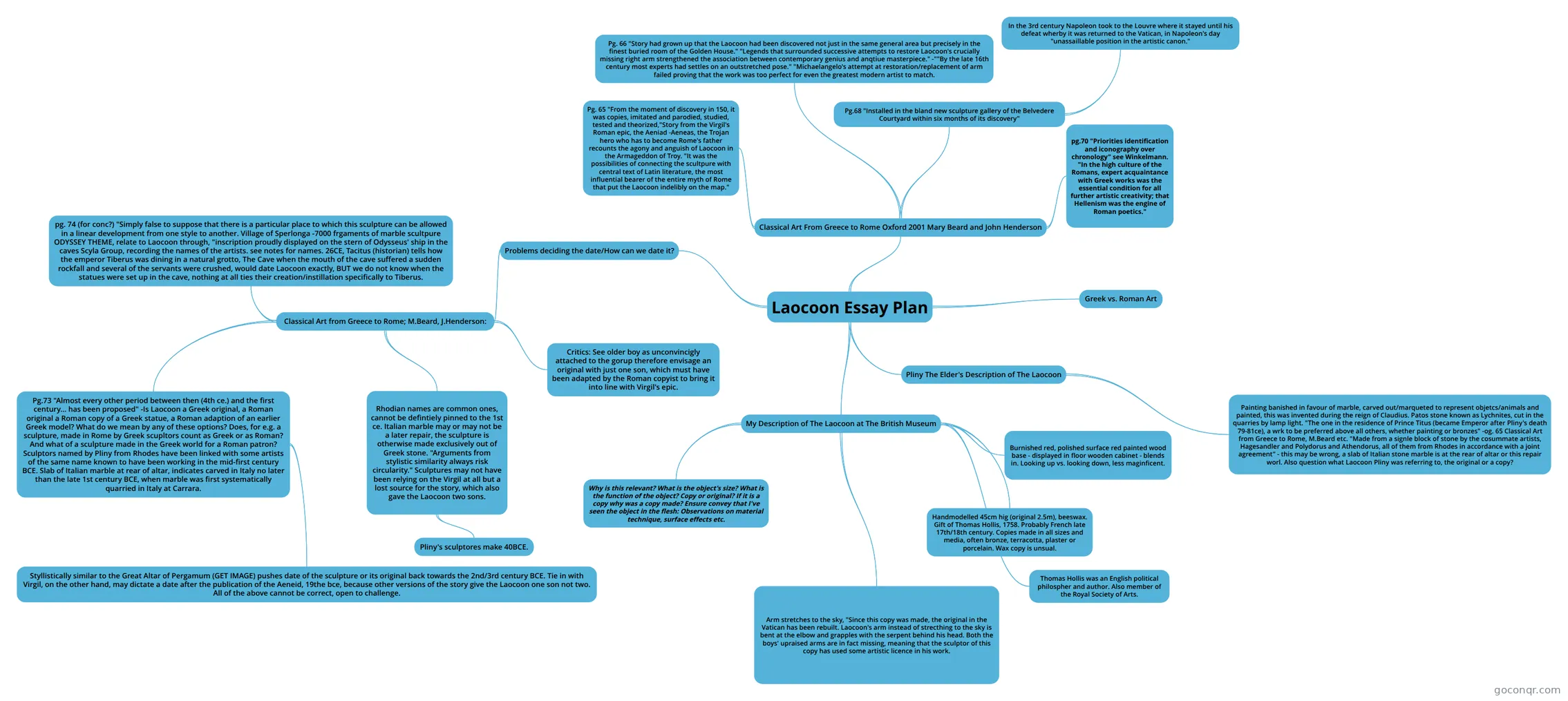
Mind map: Laocoon essay plan
Map content
Laocoon Essay Plan
My Description of The Laocoon at The British Museum
- Handmodelled 45cm hig (original 2.5m), beeswax. Gift of Thomas Hollis, 1758. Probably French late 17th/18th century. Copies made in all sizes and media, often bronze, terracotta, plaster or porcelain. Wax copy is unsual.
- Burnished red, polished surface red painted wood base - displayed in floor wooden cabinet - blends in. Looking up vs. looking down, less maginficent.
- Arm stretches to the sky, "Since this copy was made, the original in the Vatican has been rebuilt. Laocoon's arm instead of strecthing to the sky is bent at the elbow and grapples with the serpent behind his head. Both the boys' upraised arms are in fact missing, meaning that the sculptor of this copy has used some artistic licence in his work.
- Why is this relevant? What is the object's size? What is the function of the object? Copy or original? If it is a copy why was a copy made? Ensure convey that I've seen the object in the flesh: Observations on material technique, surface effects etc.
- Thomas Hollis was an English political philospher and author. Also member of the Royal Society of Arts.
Pliny The Elder's Description of The Laocoon
- Painting banished in favour of marble, carved out/marqueted to represent objetcs/animals and painted, this was invented during the reign of Claudius. Patos stone known as Lychnites, cut in the quarries by lamp light. "The one in the residence of Prince Titus (became Emperor after Pliny's death 79-81ce), a wrk to be preferred above all others, whether painting or bronzes" -og. 65 Classical Art from Greece to Rome, M.Beard etc. "Made from a signle block of stone by the cosummate artists, Hagesandler and Polydorus and Athendorus, all of them from Rhodes in accordance with a joint agreement" - this may be wrong, a slab of Italian stone marble is at the rear of altar or this repair worl. Also question what Laocoon Pliny was referring to, the original or a copy?
Classical Art From Greece to Rome Oxford 2001 Mary Beard and John Henderson
- Pg. 65 "From the moment of discovery in 150, it was copies, imitated and parodied, studied, tested and theorized,"Story from the Virgil's Roman epic, the Aeniad -Aeneas, the Trojan hero who has to become Rome's father recounts the agony and anguish of Laocoon in the Armageddon of Troy. "It was the possibilities of connecting the scultpure with central text of Latin literature, the most influential bearer of the entire myth of Rome that put the Laocoon indelibly on the map."
- Pg. 66 "Story had grown up that the Laocoon had been discovered not just in the same general area but precisely in the finest buried room of the Golden House." "Legends that surrounded successive attempts to restore Laocoon's crucially missing right arm strengthened the association between contemporary genius and anqtiue masterpiece." -""By the late 16th century most experts had settles on an outstretched pose." "Michaelangelo's attempt at restoration/replacement of arm failed proving that the work was too perfect for even the greatest modern artist to match.
- Pg.68 "Installed in the bland new sculpture gallery of the Belvedere Courtyard within six months of its discovery"
- In the 3rd century Napoleon took to the Louvre where it stayed until his defeat wherby it was returned to the Vatican, in Napoleon's day "unassaillable position in the artistic canon."
- pg.70 "Priorities identification and iconography over chronology" see Winkelmann. "In the high culture of the Romans, expert acquaintance with Greek works was the essential condition for all further artistic creativity; that Hellenism was the engine of Roman poetics."
Problems deciding the date/How can we date it?
- Classical Art from Greece to Rome; M.Beard, J.Henderson:
- Pg.73 "Almost every other period between then (4th ce.) and the first century... has been proposed" -Is Laocoon a Greek original, a Roman original a Roman copy of a Greek statue, a Roman adaption of an earlier Greek model? What do we mean by any of these options? Does, for e.g. a sculpture, made in Rome by Greek scupltors count as Greek or as Roman? And what of a sculpture made in the Greek world for a Roman patron? Sculptors named by Pliny from Rhodes have been linked with some artists of the same name known to have been working in the mid-first century BCE. Slab of Italian marble at rear of altar, indicates carved in Italy no later than the late 1st century BCE, when marble was first systematically quarried in Italy at Carrara.
- Styllistically similar to the Great Altar of Pergamum (GET IMAGE) pushes date of the sculpture or its original back towards the 2nd/3rd century BCE. Tie in with Virgil, on the other hand, may dictate a date after the publication of the Aeneid, 19the bce, because other versions of the story give the Laocoon one son not two. All of the above cannot be correct, open to challenge.
- Rhodian names are common ones, cannot be defintiely pinned to the 1st ce. Italian marble may or may not be a later repair, the sculpture is otherwise made exclusively out of Greek stone. "Arguments from stylistic similarity always risk circularity." Sculptures may not have been relying on the Virgil at all but a lost source for the story, which also gave the Laocoon two sons.
- Pliny's sculptores make 40BCE.
- Critics: See older boy as unconvincigly attached to the gorup therefore envisage an original with just one son, which must have been adapted by the Roman copyist to bring it into line with Virgil's epic.
- pg. 74 (for conc?) "Simply false to suppose that there is a particular place to which this sculpture can be allowed in a linear development from one style to another. Village of Sperlonga -7000 frgaments of marble scultpure ODYSSEY THEME, relate to Laocoon through, "inscription proudly displayed on the stern of Odysseus' ship in the caves Scyla Group, recording the names of the artists. see notes for names. 26CE, Tacitus (historian) tells how the emperor Tiberus was dining in a natural grotto, The Cave when the mouth of the cave suffered a sudden rockfall and several of the servants were crushed, would date Laocoon exactly, BUT we do not know when the statues were set up in the cave, nothing at all ties their creation/instillation specifically to Tiberus.
- Pg.73 "Almost every other period between then (4th ce.) and the first century... has been proposed" -Is Laocoon a Greek original, a Roman original a Roman copy of a Greek statue, a Roman adaption of an earlier Greek model? What do we mean by any of these options? Does, for e.g. a sculpture, made in Rome by Greek scupltors count as Greek or as Roman? And what of a sculpture made in the Greek world for a Roman patron? Sculptors named by Pliny from Rhodes have been linked with some artists of the same name known to have been working in the mid-first century BCE. Slab of Italian marble at rear of altar, indicates carved in Italy no later than the late 1st century BCE, when marble was first systematically quarried in Italy at Carrara.
- Classical Art from Greece to Rome; M.Beard, J.Henderson:
Greek vs. Roman Art
Information
- Description
- Mind Map on Laocoon Essay Plan, created by Sophie Taylor on 18/10/2014.
- Created by
- Sophie Taylor
- Views
- 12
- Rating