
Mind map
Particles and Radiation
Map content
Particles and Radiation
Matter and Radiation
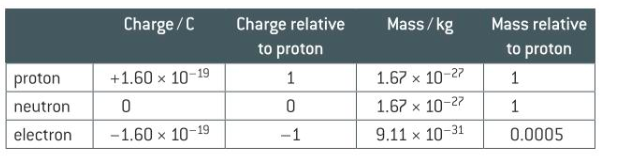
- Inside the Atom
- Nucleus
- Nucleon
- Proton(Positive charge)
- Atomic Number: Total number of protons
- Neutron(Neutral Charge)
- Almost Equal Mass
- Nucleon number: Total Number of protons and neutrons
- Proton(Positive charge)
- Nucleon
- Electrons (Negative Charge)
- Much smaller mass than nucleons.
- Isotopes
- Same number of protons
- Different number of neutrons
- Specific Charge
- Charge/Mass
- Nucleus
- Stable and Unstable Nuclei
- The Strong Nuclear Force
- Overcomes the electrostatic force of repulsion between protons in the nucleus
- Keeps protons and neutrons together in the nucleus
- Range of 3-4 femtometres(fm)
- 1 fm = 10^-15m
- Roughly the same as the diameter of a small nucleus
- 1 fm = 10^-15m
- Same effect
- Between two protons
- Between two neutrons
- Between a proton and a neutron
- Below 0.5 fm, a repulsive force acts to prevent protons and neutrons from being pushed into each other
- Overcomes the electrostatic force of repulsion between protons in the nucleus
- Radioactive Decay
- Alpha radiation
- Alpha Particles (two protons, two neutrons)
- Beta radiation
- Beta Particles
- Antineutrinos emitted to conserve energy.
- Gamma radiation
- Electromagnetic radiation
- No mass, no charge
- Emitted by a nucleus with too much energy, following an alpha or beta emmission
- Alpha radiation
- The Strong Nuclear Force
- Photons
- Electromagnetic Waves
- Electric wave
- Travel together and vibrate at right angles to each other and in phase with each other
- Magnetic wave
- Electric wave
- A photon is a packet of electromagnetic waves.
- Used to explain the photoelectric effect
- Photon energy: E = hf
- h: Planck constant
- Electromagnetic Waves
- Particles and Antiparticles
- Pair production: A photon creates a particle and a corresponding antiparticle, vanishing in the process.
- Pair annihilation: A particle and a corresponding antiparticle meet and their mass is converted into radiation energy.
- Positron is the antiparticle of the electron.
- Antimatter has the same structure as regular matter except that all the signs of the particles are reversed.
- Dirac's theory of antiparticles: For every particle there is a corresponding antiparticle that:
- Annihilates the particle and itself if they meet.
- Has exactly the same rest mass as the particle.
- Has exactly opposite charge to the particle if the particle has charge
- Particle Interactions
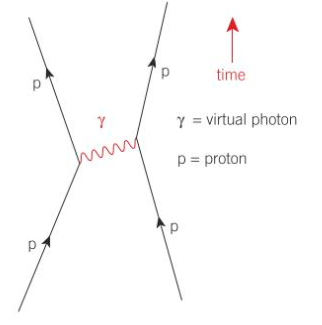
- The Electromagnetic Force
- Exchange of virtual photons
- Conservation of Momentum
- Mass Multiplied by velocity
- The weak nuclear force
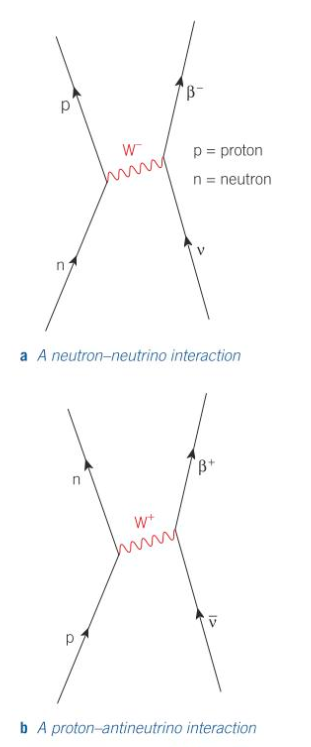
- Exchange of W bosons
- Non-zero rest mass
- No more than 0.001 fm of range
- W^+
- w^-
- Beta decay
- W^- boson decays into B^- particle and antineutrino
- W^+ boson decays into B^+ particle and neutrino
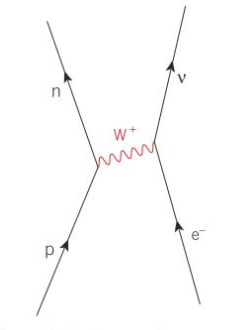
- Electron capture
- Exchange of W bosons
- Force carriers
- The Electromagnetic Force
- Inside the Atom
Quarks and Leptons
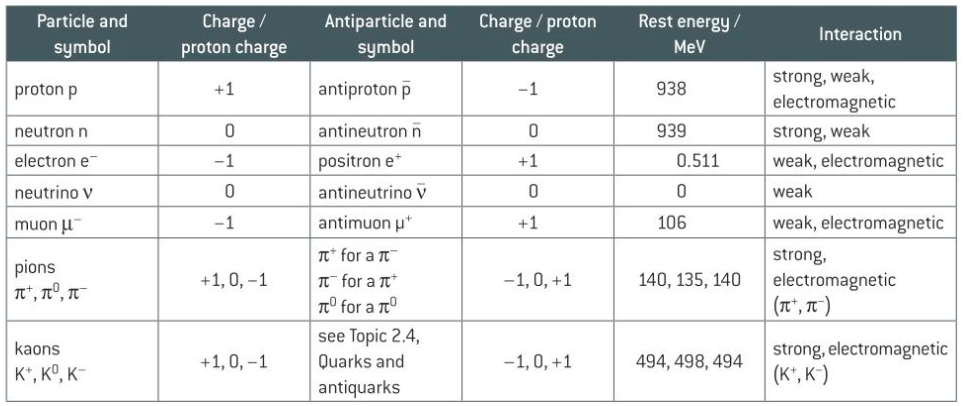
- The particle zoo
- Cosmic Rays: High energy paticles that travel through space from the stars.
- Through the Earth's atmosphere, cosmic rays create short-lived particles and antiparticles as well as photons
- muons
- pions
- kaons
- Through the Earth's atmosphere, cosmic rays create short-lived particles and antiparticles as well as photons
- Cosmic Rays: High energy paticles that travel through space from the stars.
- Particle sorting
- Hadrons
- Baryons
- 3 quarks
- Mesons
- 2 quarks
- 1 quark
- 1 antiquark
- 2 quarks
- Not fundamental
- Baryons
- Leptons
- Fundamental particles
- Hadrons
- Leptons at work
- Lepton collisions
- Leptons and antileptons can interact to produce hadrons
- A single electron-positron annihilation event can produce a quark and a corresponding antiquark
- Neutrino Types
- Muon neutrino
- Corresponding antineutrinos
- Electron neutrino
- Corresponding antineutrinos
- Muon neutrino
- Lepton Rules
- In an interaction between a lepton and a hadron, a neutrino or antineutrino can change into or from a corresponding charged lepton
- In muon decay, the muon changes into a muon neutrino
- A muon cannot decay into a muon antineutrino
- The lepton number is conserved in any change
- Lepton number
- +1 for any lepton
- -1 for any antilepton
- 0 for any non-lepton
- Lepton collisions
- Quarks and antiquarks
- Up quarks
- Charge: +2/3
- Baryon number: 1/3
- Down quarks
- Charge: -1/3
- Strange quarks
- Strangeness: -1
- Up quarks
- Conservation Rules
- Conservation of energy and conservation of charge
- Conservation of lepton numbers
- Conservation of baryon nubmers
- Conservation of strangeness
- The particle zoo
Quantum Phenomena
- The photoelectric effect
- Discovered from looking at the effect of electromagnetic radiation on metals
- Electrons emitted from the metal surface when the directed electromagnetic radiation was above a certain frequency
- Problems
- Photoelectric emission doesn't take place if the incident electromagnetic radiation is below threshold frequency
- Wavelength of incident light must be less than a maximum value equal to the speed of light/threshold frequency
- Electrons emitted per second proportional to the intensity of the incident radiation above the threshold frequency. Otherwise no photoelectric emission can take place regardless of the intensity of the incident radiation.
- Photoelectric emission occurs without delay, regardless of intensity
- Photoelectric emission doesn't take place if the incident electromagnetic radiation is below threshold frequency
- Photon theory put forward in 1905 by Albert Einstein to explain the photoelectric effect
- Light composed of wavepackets/photons
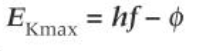
- Energy of a photon = hf
- An electron at the metal surface absorbs a single photon from the incident light
- Electron can leave metal surface if it's gained energy exceeds the work function of the metal
- Stopping potential
- Minimum potential needed to stop photoelectric emission
- Discovered from looking at the effect of electromagnetic radiation on metals
- Collisions of electrons with atoms
- Energy levels in atoms
- Energy levels and spectra
- Wave-particle duality
- The photoelectric effect
Images and files in the map



Information
- Description
- A level Physics Mind Map on Particles and Radiation, created by Matthew Bunyan on 12/10/2018.
- Created by
- Matthew Bunyan · Oct 2018
- Updated
- Oct 14, 2018
- Views
- 0
- Rating