
Mind map
GENERATIVE LINGUISTICS
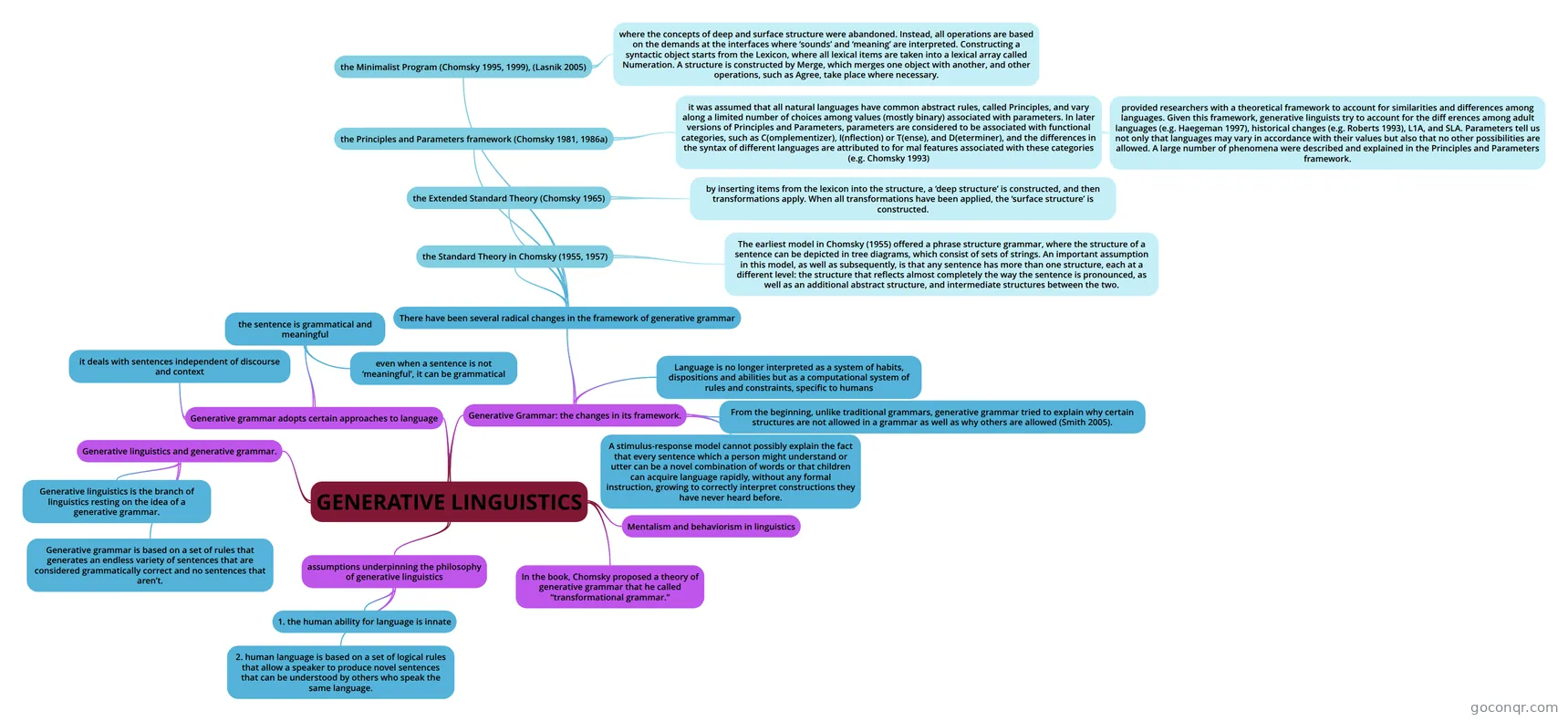
Mind map: generative linguistics
Map content
GENERATIVE LINGUISTICS
Generative linguistics and generative grammar.
- Generative linguistics is the branch of linguistics resting on the idea of a generative grammar.
- Generative grammar is based on a set of rules that generates an endless variety of sentences that are considered grammatically correct and no sentences that aren’t.
In the book, Chomsky proposed a theory of generative grammar that he called “transformational grammar.”
Mentalism and behaviorism in linguistics
assumptions underpinning the philosophy of generative linguistics
- 1. the human ability for language is innate
- 2. human language is based on a set of logical rules that allow a speaker to produce novel sentences that can be understood by others who speak the same language.
Generative Grammar: the changes in its framework.
- A stimulus-response model cannot possibly explain the fact that every sentence which a person might understand or utter can be a novel combination of words or that children can acquire language rapidly, without any formal instruction, growing to correctly interpret constructions they have never heard before.
- Language is no longer interpreted as a system of habits, dispositions and abilities but as a computational system of rules and constraints, specific to humans
- There have been several radical changes in the framework of generative grammar
- the Standard Theory in Chomsky (1955, 1957)
- The earliest model in Chomsky (1955) offered a phrase structure grammar, where the structure of a sentence can be depicted in tree diagrams, which consist of sets of strings. An important assumption in this model, as well as subsequently, is that any sentence has more than one structure, each at a different level: the structure that reflects almost completely the way the sentence is pronounced, as well as an additional abstract structure, and intermediate structures between the two.
- the Extended Standard Theory (Chomsky 1965)
- by inserting items from the lexicon into the structure, a ‘deep structure’ is constructed, and then transformations apply. When all transformations have been applied, the ‘surface structure’ is constructed.
- the Principles and Parameters framework (Chomsky 1981, 1986a)
- it was assumed that all natural languages have common abstract rules, called Principles, and vary along a limited number of choices among values (mostly binary) associated with parameters. In later versions of Principles and Parameters, parameters are considered to be associated with functional categories, such as C(omplementizer), I(nflection) or T(ense), and D(eterminer), and the differences in the syntax of different languages are attributed to for mal features associated with these categories (e.g. Chomsky 1993)
- provided researchers with a theoretical framework to account for similarities and differences among languages. Given this framework, generative linguists try to account for the diff erences among adult languages (e.g. Haegeman 1997), historical changes (e.g. Roberts 1993), L1A, and SLA. Parameters tell us not only that languages may vary in accordance with their values but also that no other possibilities are allowed. A large number of phenomena were described and explained in the Principles and Parameters framework.
- it was assumed that all natural languages have common abstract rules, called Principles, and vary along a limited number of choices among values (mostly binary) associated with parameters. In later versions of Principles and Parameters, parameters are considered to be associated with functional categories, such as C(omplementizer), I(nflection) or T(ense), and D(eterminer), and the differences in the syntax of different languages are attributed to for mal features associated with these categories (e.g. Chomsky 1993)
- the Minimalist Program (Chomsky 1995, 1999), (Lasnik 2005)
- where the concepts of deep and surface structure were abandoned. Instead, all operations are based on the demands at the interfaces where ‘sounds’ and ‘meaning’ are interpreted. Constructing a syntactic object starts from the Lexicon, where all lexical items are taken into a lexical array called Numeration. A structure is constructed by Merge, which merges one object with another, and other operations, such as Agree, take place where necessary.
- the Standard Theory in Chomsky (1955, 1957)
- From the beginning, unlike traditional grammars, generative grammar tried to explain why certain structures are not allowed in a grammar as well as why others are allowed (Smith 2005).
Generative grammar adopts certain approaches to language
- it deals with sentences independent of discourse and context
- the sentence is grammatical and meaningful
- even when a sentence is not ‘meaningful’, it can be grammatical
Information
- Description
- Mind Map on GENERATIVE LINGUISTICS, created by DIANA S. on 15/10/2018.
- Created by
- DIANA S.
- Views
- 12
- Rating