
Mind map
PSYCHOLINGUISTICS
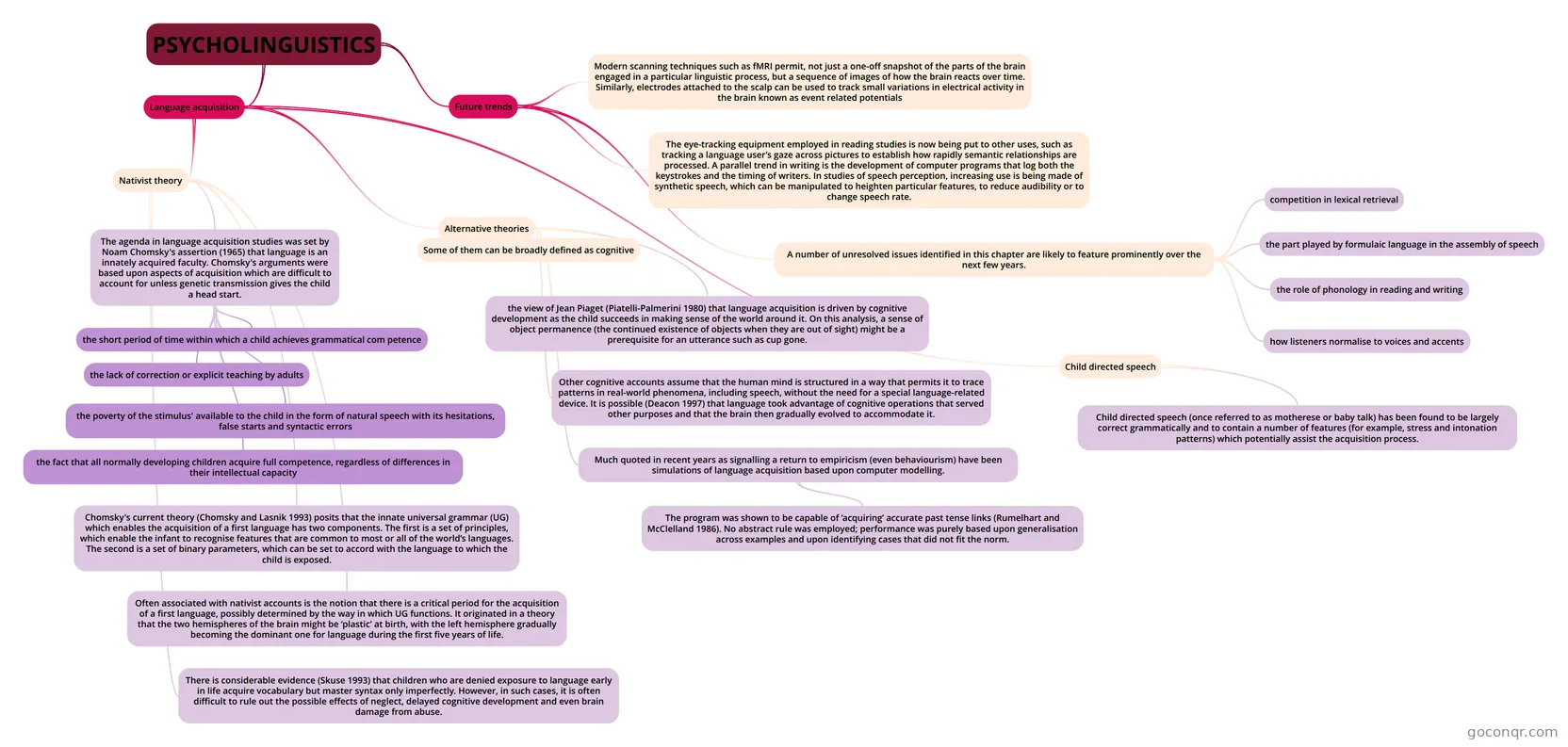
Mind map: Psycholinguistics
Map content
PSYCHOLINGUISTICS
Language acquisition
- Alternative theories
- Some of them can be broadly defined as cognitive
- the view of Jean Piaget (Piatelli-Palmerini 1980) that language acquisition is driven by cognitive development as the child succeeds in making sense of the world around it. On this analysis, a sense of object permanence (the continued existence of objects when they are out of sight) might be a prerequisite for an utterance such as cup gone.
- Other cognitive accounts assume that the human mind is structured in a way that permits it to trace patterns in real-world phenomena, including speech, without the need for a special language-related device. It is possible (Deacon 1997) that language took advantage of cognitive operations that served other purposes and that the brain then gradually evolved to accommodate it.
- Much quoted in recent years as signalling a return to empiricism (even behaviourism) have been simulations of language acquisition based upon computer modelling.
- The program was shown to be capable of ‘acquiring’ accurate past tense links (Rumelhart and McClelland 1986). No abstract rule was employed; performance was purely based upon generalisation across examples and upon identifying cases that did not fit the norm.
- Nativist theory
- The agenda in language acquisition studies was set by Noam Chomsky's assertion (1965) that language is an innately acquired faculty. Chomsky's arguments were based upon aspects of acquisition which are difficult to account for unless genetic transmission gives the child a head start.
- the short period of time within which a child achieves grammatical com petence
- the lack of correction or explicit teaching by adults
- the poverty of the stimulus' available to the child in the form of natural speech with its hesitations, false starts and syntactic errors
- the fact that all normally developing children acquire full competence, regardless of differences in their intellectual capacity
- Chomsky's current theory (Chomsky and Lasnik 1993) posits that the innate universal grammar (UG) which enables the acquisition of a first language has two components. The first is a set of principles, which enable the infant to recognise features that are common to most or all of the world’s languages. The second is a set of binary parameters, which can be set to accord with the language to which the child is exposed.
- Often associated with nativist accounts is the notion that there is a critical period for the acquisition of a first language, possibly determined by the way in which UG functions. It originated in a theory that the two hemispheres of the brain might be ‘plastic’ at birth, with the left hemisphere gradually becoming the dominant one for language during the first five years of life.
- There is considerable evidence (Skuse 1993) that children who are denied exposure to language early in life acquire vocabulary but master syntax only imperfectly. However, in such cases, it is often difficult to rule out the possible effects of neglect, delayed cognitive development and even brain damage from abuse.
- The agenda in language acquisition studies was set by Noam Chomsky's assertion (1965) that language is an innately acquired faculty. Chomsky's arguments were based upon aspects of acquisition which are difficult to account for unless genetic transmission gives the child a head start.
- Child directed speech
- Child directed speech (once referred to as motherese or baby talk) has been found to be largely correct grammatically and to contain a number of features (for example, stress and intonation patterns) which potentially assist the acquisition process.
- Alternative theories
Future trends
- Modern scanning techniques such as fMRI permit, not just a one-off snapshot of the parts of the brain engaged in a particular linguistic process, but a sequence of images of how the brain reacts over time. Similarly, electrodes attached to the scalp can be used to track small variations in electrical activity in the brain known as event related potentials
- The eye-tracking equipment employed in reading studies is now being put to other uses, such as tracking a language user’s gaze across pictures to establish how rapidly semantic relationships are processed. A parallel trend in writing is the development of computer programs that log both the keystrokes and the timing of writers. In studies of speech perception, increasing use is being made of synthetic speech, which can be manipulated to heighten particular features, to reduce audibility or to change speech rate.
- A number of unresolved issues identified in this chapter are likely to feature prominently over the next few years.
- competition in lexical retrieval
- the part played by formulaic language in the assembly of speech
- the role of phonology in reading and writing
- how listeners normalise to voices and accents
Information
- Description
- Mind Map on PSYCHOLINGUISTICS, created by DIANA S. on 23/10/2018.
- Created by
- DIANA S.
- Views
- 21
- Rating