
Mind map
COMMUNICATIVE LINGUISTICS. DISCOURSE ANALYSIS. PRAGMATICS
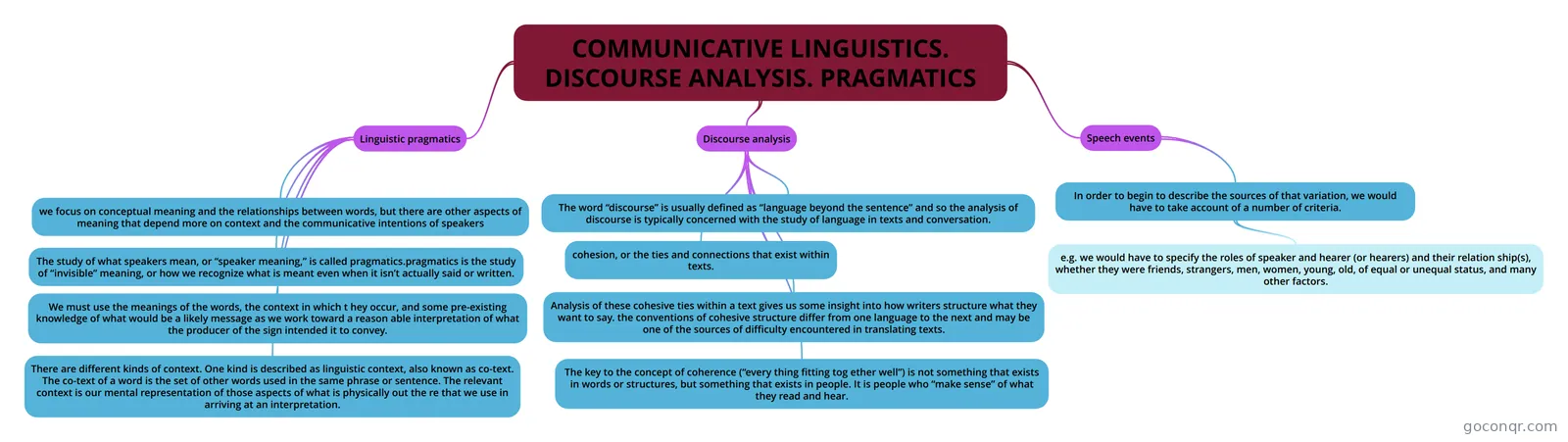
Mind map: Communicative linguistics, discourse analysis and pragmatics
Map content
COMMUNICATIVE LINGUISTICS. DISCOURSE ANALYSIS. PRAGMATICS
Linguistic pragmatics
- we focus on conceptual meaning and the relationships between words, but there are other aspects of meaning that depend more on context and the communicative intentions of speakers
- The study of what speakers mean, or “speaker meaning,” is called pragmatics.pragmatics is the study of “invisible” meaning, or how we recognize what is meant even when it isn’t actually said or written.
- We must use the meanings of the words, the context in which t hey occur, and some pre-existing knowledge of what would be a likely message as we work toward a reason able interpretation of what the producer of the sign intended it to convey.
- There are different kinds of context. One kind is described as linguistic context, also known as co-text. The co-text of a word is the set of other words used in the same phrase or sentence. The relevant context is our mental representation of those aspects of what is physically out the re that we use in arriving at an interpretation.
Discourse analysis
- The word “discourse” is usually defined as “language beyond the sentence” and so the analysis of discourse is typically concerned with the study of language in texts and conversation.
- cohesion, or the ties and connections that exist within texts.
- Analysis of these cohesive ties within a text gives us some insight into how writers structure what they want to say. the conventions of cohesive structure differ from one language to the next and may be one of the sources of difficulty encountered in translating texts.
- The key to the concept of coherence (“every thing fitting tog ether well”) is not something that exists in words or structures, but something that exists in people. It is people who “make sense” of what they read and hear.
Speech events
- In order to begin to describe the sources of that variation, we would have to take account of a number of criteria.
- e.g. we would have to specify the roles of speaker and hearer (or hearers) and their relation ship(s), whether they were friends, strangers, men, women, young, old, of equal or unequal status, and many other factors.
- In order to begin to describe the sources of that variation, we would have to take account of a number of criteria.
Information
- Description
- Mind Map on COMMUNICATIVE LINGUISTICS. DISCOURSE ANALYSIS. PRAGMATICS, created by DIANA S. on 23/10/2018.
- Created by
- DIANA S.
- Views
- 8
- Rating