
Pragmatics
340 resources created by 235 users
This Pragmatics page on GoConqr gathers community-made mind maps, flashcards, quizzes and notes on how meaning works beyond the words themselves, from Grice's maxims and speech acts to politeness, deixis and implicature. It's built for university students revising a topic and teachers after ready-made material. There are over 300 resources here, including nearly 300 mind maps, more than 20 flashcard decks and more than 8 quizzes. Pick a map to start, then test yourself with a quiz.
Top Pragmatics resources
-
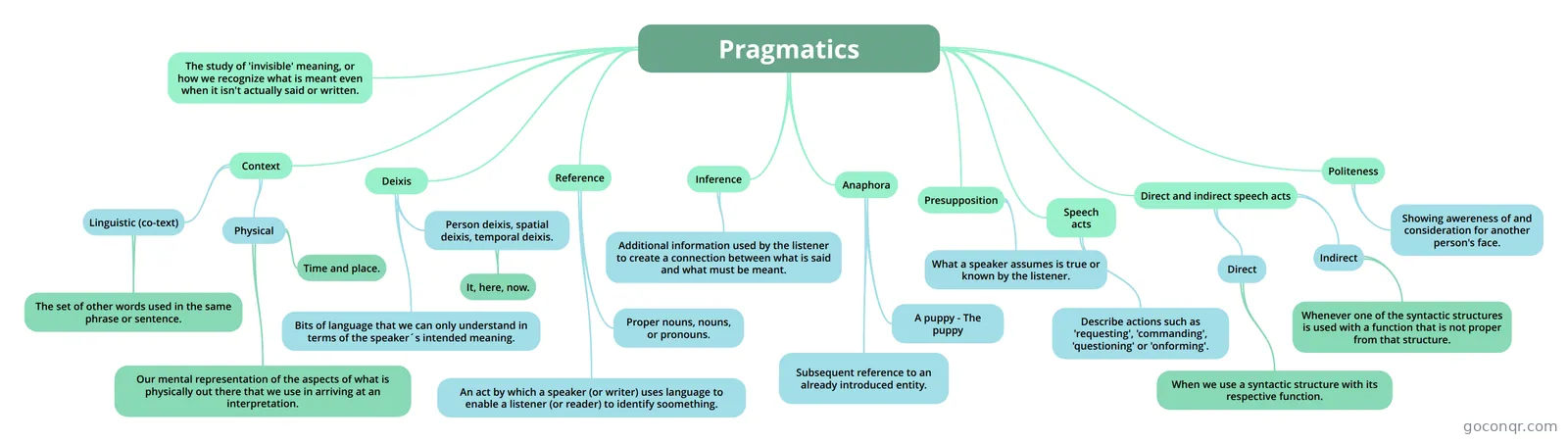 Mind map Pragmatics References: Yule, G. (2006). Pragmatics. In The study of language (3rd ed.). Cambridge [England: Cambridge ...
-
Mind map Grice's Maxims
-
155 questionskiwis A presupposition is a proposition entailed by a sentence and its negation:
-
138 questionspragmatics
-
76 cardsPragmatics What is pragmatics?
-
85 cardsPragmatics
-
Mind map Pragmatics Pragmatics
-
Mind map Pragmatics Pragmatics
Quizzes
-
155 questionskiwis A presupposition is a proposition entailed by a sentence and its negation:
-
138 questionspragmatics
-
22 questionsDiscourse Analysis: Self-evaluation Unit 3 NO SIRVE Semantics and Pragmatics ...
-
8 questionsUntitled "they are not like you or me..." Is what form of denial
-
4 questionsUntitled Describe the type of deixes for the word "there" in the sentence below: Aizat when to Australia last summer...
-
5 questionsFACE what is face?
-
5 questionsExercises What can you interpret from this symbol?
-
4 questionsGrace's Maximums What is Grice Maximum of quantity?
Mind maps
See all 298 mind maps
Flashcards
See all 21 flashcards-
76 cardsPragmatics What is pragmatics?
-
85 cardsPragmatics
-
53 cardsLasc5 - Pragmatics and Discourse
-
35 cardsLasc6 - Pragmatics & Discourse 2
-
10 cardsPragmatics English
-
41 cardsImportant Definitions - Pragmatics and discourse
-
30 cardsInterculturalCommunication_Lernkartei
-
33 cardsTalk and Action What are implicatures?
Flowcharts
Notes
-
Austin speech theory - creado desde un Mapa Mental Austin reconsiders the senses in saying something is doing something. The locutionary act The illocutionary act
-
Using and Understanding language IntroductionPragmatics: explaining how we produce and understand such everyday but apparently rather peculiar uses of language.Atkinson, Kilby and Roca: "The distinction between what a speaker's words mean and what th...
-
Grice's Maxims - created from Mind Map Principles of quantity Principles of quality Principles of relevance
Slides
Topics in Pragmatics
More Linguistics and philology topics
About Pragmatics
GoConqr OriginalWhat this unit covers
Pragmatics is described in one of the maps as the study of 'invisible' meaning: how we recognise what is meant even when it isn't said or written. The listed resources work through context, deixis, reference, inference, anaphora, presupposition and speech acts. Most of the material is mind maps, with flashcard decks, notes, flowcharts and a few quizzes alongside.
Where to start
Begin with the Mind Map called Pragmatics, which lays out the main terms in one view. Then open the Grice's Maxims map, which starts with the maxim of quantity: giving as much information as is needed, and no more. The Grice's cooperative Principles (CP) map goes further into implicature and the critiques of intentionalism.
Speech acts and politeness
- Speech acts: the Speech acts map separates the locutionary, illocutionary and perlocutionary act, and mentions IFIDs and performative verbs.
- Illocutionary forces: several maps cover statements, questions, commands, threats, warnings and promises, along with register and formulaic elements.
- Politeness: the Politeness flashcard deck covers Lakoff's three strategies and Leech's six maxims, and there is a separate deck on Brown & Levinson politeness theory.
Using maps and quizzes together
Read a map first, then close it and try to rebuild the main branches from memory. Flashcards such as Pragmatics 101 and Important Definitions - Pragmatics and discourse suit short sessions on key terms. Then try the quizzes, including the one on Grice's maxims and the one called FACE, to see which ideas need another pass. The notes called Using and Understanding language give a written introduction to the field.
Where it sits
This unit belongs to the strand Meaning, Use and Text within Linguistics and philology. It links naturally with the discourse analysis maps listed here. Almost everything is aimed at university level, so it suits seminar preparation and teachers looking for material to adapt. Choose one resource, work through it, and add your own maps or flashcards where something is missing.
Frequently asked questions
Which resource should I open first?
Start with the Mind Map called Pragmatics. It introduces the study of 'invisible' meaning and branches into context, deixis, reference, inference, anaphora, presupposition and speech acts. After that, move to the Grice's Maxims map for a first look at how conversational cooperation is described.
What do the mind maps cover?
They cover Grice's maxims and cooperative principles, speech acts, illocutionary forces, register and formulaic elements, politeness, deixis, reference, and context and inference. There are also maps on discourse analysis and on language functions, including speech as action.
Are there quizzes on this page?
Yes, more than 8 quizzes are listed. They include one on Grice's maxims, one called FACE, one simply titled pragmatics, and a set of exercises. Use them after reading a map or notes to see which topics you can recall without help.
Is everything free to use?
Yes. Every resource listed here is free to open, study and take, with no account needed. A free account also saves your quiz scores and lets you make your own quizzes, mind maps, flashcards and notes.
Who made these resources and what level are they?
They were made by GoConqr users, not by GoConqr itself. Nearly all of them are at university level, so they suit university students and teachers looking for ready-made material. A small share is aimed at school level.
Which flashcards cover politeness theory?
The Politeness deck covers Lakoff's three strategies and Leech's six maxims, each with a name and definition. A separate deck covers Brown & Levinson politeness theory. The FACE quiz is a useful follow-up for checking what you remember.