
Mind map
Development of emotions
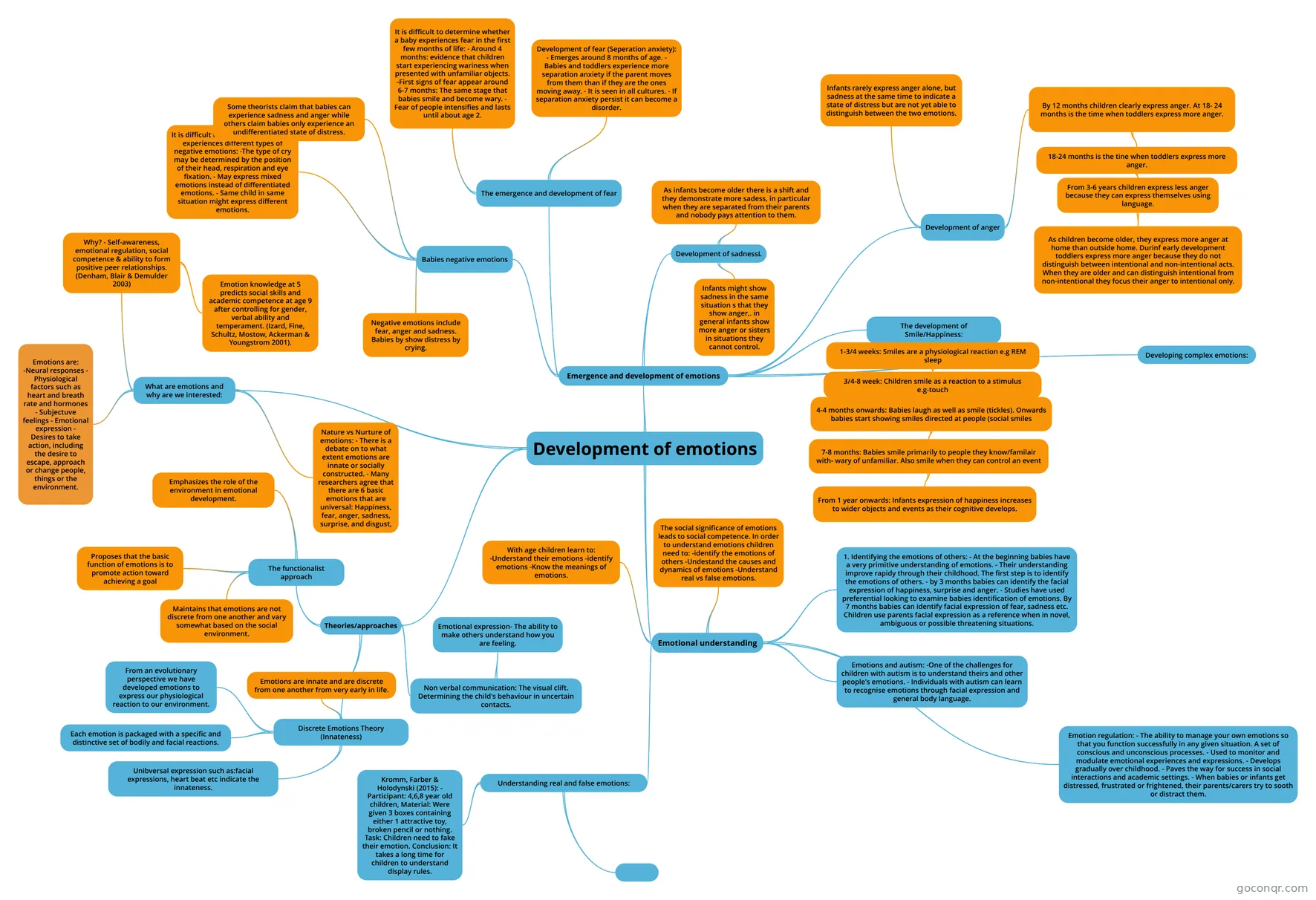
Mind map: Development of emotions
Map content
Development of emotions
What are emotions and why are we interested:
- Emotions are: -Neural responses - Physiological factors such as heart and breath rate and hormones - Subjectuve feelings - Emotional expression - Desires to take action, including the desire to escape, approach or change people, things or the environment.
- Why? - Self-awareness, emotional regulation, social competence & ability to form positive peer relationships. (Denham, Blair & Demulder 2003)
- Emotion knowledge at 5 predicts social skills and academic competence at age 9 after controlling for gender, verbal ability and temperament. (Izard, Fine, Schultz, Mostow, Ackerman & Youngstrom 2001).
- Nature vs Nurture of emotions: - There is a debate on to what extent emotions are innate or socially constructed. - Many researchers agree that there are 6 basic emotions that are universal: Happiness, fear, anger, sadness, surprise, and disgust,
Theories/approaches
- The functionalist approach
- Emphasizes the role of the environment in emotional development.
- Proposes that the basic function of emotions is to promote action toward achieving a goal
- Maintains that emotions are not discrete from one another and vary somewhat based on the social environment.
- Non verbal communication: The visual clift. Determining the child's behaviour in uncertain contacts.
- Emotional expression- The ability to make others understand how you are feeling.
- Discrete Emotions Theory (Innateness)
- Emotions are innate and are discrete from one another from very early in life.
- From an evolutionary perspective we have developed emotions to express our physiological reaction to our environment.
- Each emotion is packaged with a specific and distinctive set of bodily and facial reactions.
- Unibversal expression such as:facial expressions, heart beat etc indicate the innateness.
- The functionalist approach
Emergence and development of emotions
- The development of Smile/Happiness:
- 1-3/4 weeks: Smiles are a physiological reaction e.g REM sleep
- 3/4-8 week: Children smile as a reaction to a stimulus e.g-touch
- 4-4 months onwards: Babies laugh as well as smile (tickles). Onwards babies start showing smiles directed at people (social smiles
- 7-8 months: Babies smile primarily to people they know/familair with- wary of unfamiliar. Also smile when they can control an event
- From 1 year onwards: Infants expression of happiness increases to wider objects and events as their cognitive develops.
- 7-8 months: Babies smile primarily to people they know/familair with- wary of unfamiliar. Also smile when they can control an event
- 4-4 months onwards: Babies laugh as well as smile (tickles). Onwards babies start showing smiles directed at people (social smiles
- 3/4-8 week: Children smile as a reaction to a stimulus e.g-touch
- 1-3/4 weeks: Smiles are a physiological reaction e.g REM sleep
- Babies negative emotions
- It is difficult to know whether a baby experiences different types of negative emotions: -The type of cry may be determined by the position of their head, respiration and eye fixation. - May express mixed emotions instead of differentiated emotions. - Same child in same situation might express different emotions.
- Negative emotions include fear, anger and sadness. Babies by show distress by crying.
- Some theorists claim that babies can experience sadness and anger while others claim babies only experience an undifferentiated state of distress.
- The emergence and development of fear
- It is difficult to determine whether a baby experiences fear in the first few months of life: - Around 4 months: evidence that children start experiencing wariness when presented with unfamiliar objects. -First signs of fear appear around 6-7 months: The same stage that babies smile and become wary. - Fear of people intensifies and lasts until about age 2.
- Development of fear (Seperation anxiety): - Emerges around 8 months of age. - Babies and toddlers experience more separation anxiety if the parent moves from them than if they are the ones moving away. - It is seen in all cultures. - If separation anxiety persist it can become a disorder.
- Development of anger
- Infants rarely express anger alone, but sadness at the same time to indicate a state of distress but are not yet able to distinguish between the two emotions.
- By 12 months children clearly express anger. At 18- 24 months is the time when toddlers express more anger.
- 18-24 months is the tine when toddlers express more anger.
- From 3-6 years children express less anger because they can express themselves using language.
- As children become older, they express more anger at home than outside home. Durinf early development toddlers express more anger because they do not distinguish between intentional and non-intentional acts. When they are older and can distinguish intentional from non-intentional they focus their anger to intentional only.
- From 3-6 years children express less anger because they can express themselves using language.
- 18-24 months is the tine when toddlers express more anger.
- Development of sadnessL
- Infants might show sadness in the same situation s that they show anger,. in general infants show more anger or sisters in situations they cannot control.
- As infants become older there is a shift and they demonstrate more sadess, in particular when they are separated from their parents and nobody pays attention to them.
- Developing complex emotions:
- The development of Smile/Happiness:
Emotional understanding
- With age children learn to: -Understand their emotions -identify emotions -Know the meanings of emotions.
- The social significance of emotions leads to social competence. In order to understand emotions children need to: -identify the emotions of others -Undestand the causes and dynamics of emotions -Understand real vs false emotions.
- 1. Identifying the emotions of others: - At the beginning babies have a very primitive understanding of emotions. - Their understanding improve rapidy through their childhood. The first step is to identify the emotions of others. - by 3 months babies can identify the facial expression of happiness, surprise and anger. - Studies have used preferential looking to examine babies identification of emotions. By 7 months babies can identify facial expression of fear, sadness etc. Children use parents facial expression as a reference when in novel, ambiguous or possible threatening situations.
- Understanding real and false emotions:
- Kromm, Farber & Holodynski (2015): - Participant: 4,6,8 year old children, Material: Were given 3 boxes containing either 1 attractive toy, broken pencil or nothing. Task: Children need to fake their emotion. Conclusion: It takes a long time for children to understand display rules.
- Emotions and autism: -One of the challenges for children with autism is to understand theirs and other people's emotions. - Individuals with autism can learn to recognise emotions through facial expression and general body language.
- Emotion regulation: - The ability to manage your own emotions so that you function successfully in any given situation. A set of conscious and unconscious processes. - Used to monitor and modulate emotional experiences and expressions. - Develops gradually over childhood. - Paves the way for success in social interactions and academic settings. - When babies or infants get distressed, frustrated or frightened, their parents/carers try to sooth or distract them.
Information
- Description
- Mind Map on Development of emotions, created by Spanner Price on 25/10/2018.
- Created by
- Spanner Price
- Views
- 0
- Rating