
Mind map
PROCESSES LEADING TO SPECIATION
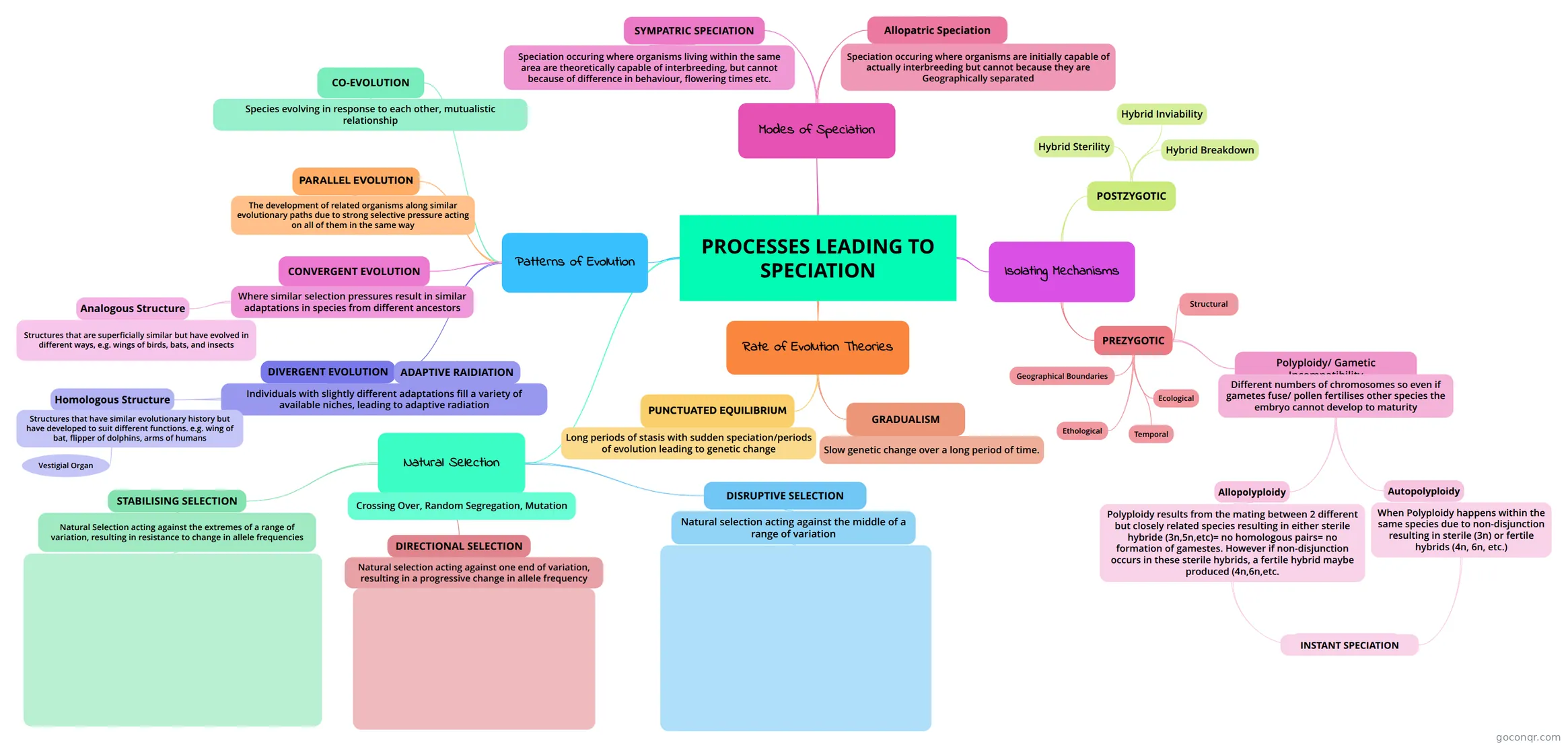
Mind map: Processes leading to speciation
Map content
PROCESSES LEADING TO SPECIATION
Rate of Evolution Theories
- PUNCTUATED EQUILIBRIUM
- Long periods of stasis with sudden speciation/periods of evolution leading to genetic change
- GRADUALISM
- Slow genetic change over a long period of time.
- PUNCTUATED EQUILIBRIUM
Isolating Mechanisms
- PREZYGOTIC
- Geographical Boundaries
- Ecological
- Ethological
- Temporal
- Structural
- Polyploidy/ Gametic Incompatibility
- Different numbers of chromosomes so even if gametes fuse/ pollen fertilises other species the embryo cannot develop to maturity
- Allopolyploidy
- Polyploidy results from the mating between 2 different but closely related species resulting in either sterile hybride (3n,5n,etc)= no homologous pairs= no formation of gamestes. However if non-disjunction occurs in these sterile hybrids, a fertile hybrid maybe produced (4n,6n,etc.
- INSTANT SPECIATION
- Polyploidy results from the mating between 2 different but closely related species resulting in either sterile hybride (3n,5n,etc)= no homologous pairs= no formation of gamestes. However if non-disjunction occurs in these sterile hybrids, a fertile hybrid maybe produced (4n,6n,etc.
- Autopolyploidy
- When Polyploidy happens within the same species due to non-disjunction resulting in sterile (3n) or fertile hybrids (4n, 6n, etc.)
- INSTANT SPECIATION
- When Polyploidy happens within the same species due to non-disjunction resulting in sterile (3n) or fertile hybrids (4n, 6n, etc.)
- Allopolyploidy
- Different numbers of chromosomes so even if gametes fuse/ pollen fertilises other species the embryo cannot develop to maturity
- POSTZYGOTIC
- Hybrid Sterility
- Hybrid Inviability
- Hybrid Breakdown
- PREZYGOTIC
Patterns of Evolution
- CONVERGENT EVOLUTION
- Where similar selection pressures result in similar adaptations in species from different ancestors
- Analogous Structure
- Structures that are superficially similar but have evolved in different ways, e.g. wings of birds, bats, and insects
- Analogous Structure
- Where similar selection pressures result in similar adaptations in species from different ancestors
- DIVERGENT EVOLUTION
- Individuals with slightly different adaptations fill a variety of available niches, leading to adaptive radiation
- Homologous Structure
- Vestigial Organ
- Structures that have similar evolutionary history but have developed to suit different functions. e.g. wing of bat, flipper of dolphins, arms of humans
- Homologous Structure
- ADAPTIVE RAIDIATION
- Individuals with slightly different adaptations fill a variety of available niches, leading to adaptive radiation
- CO-EVOLUTION
- Species evolving in response to each other, mutualistic relationship
- PARALLEL EVOLUTION
- The development of related organisms along similar evolutionary paths due to strong selective pressure acting on all of them in the same way
- CONVERGENT EVOLUTION
Modes of Speciation
- SYMPATRIC SPECIATION
- Speciation occuring where organisms living within the same area are theoretically capable of interbreeding, but cannot because of difference in behaviour, flowering times etc.
- Allopatric Speciation
- Speciation occuring where organisms are initially capable of actually interbreeding but cannot because they are Geographically separated
- SYMPATRIC SPECIATION
Natural Selection
- STABILISING SELECTION
- Natural Selection acting against the extremes of a range of variation, resulting in resistance to change in allele frequencies
- Natural Selection acting against the extremes of a range of variation, resulting in resistance to change in allele frequencies
- DIRECTIONAL SELECTION
- Natural selection acting against one end of variation, resulting in a progressive change in allele frequency
- Natural selection acting against one end of variation, resulting in a progressive change in allele frequency
- DISRUPTIVE SELECTION
- Natural selection acting against the middle of a range of variation
- Natural selection acting against the middle of a range of variation
- Crossing Over, Random Segregation, Mutation
- STABILISING SELECTION
Information
- Description
- Mind Map on PROCESSES LEADING TO SPECIATION, created by Bubbles101 on 05/11/2014.
- Created by
- Bubbles101
- Views
- 7
- Rating