
Mind map
Liver and Biliary tree
Map content
Liver and Biliary tree
Location: deep to ribs 7–11, most of the right hypochondrium
- largest gland, weighs 1500 gr
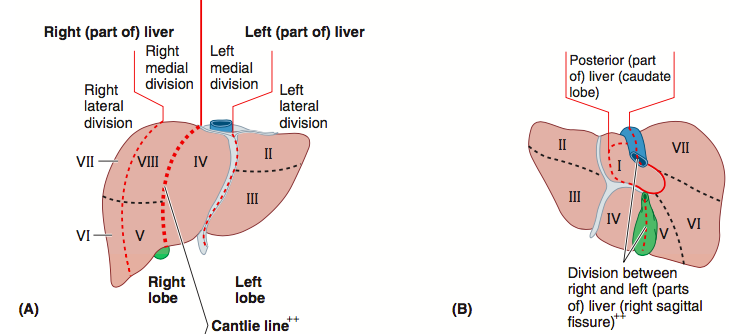
- Anatomically is divided in 4 segments
- Right lobe
- Left lobe
- Caudate lobe
- Quadrate lobe
- Caudate lobe
- Left lobe
- Functionally is divided in 8 segments
- has its own vascular inflow and biliary drainage
- Right lobe
- Covered by the Glisson capsule
Ligaments
- Falciform ligaments
- joins liver to anterior abdominal wall
- Coronary ligament
- Right and left triangular ligaments
- Round ligament
- Bare area: direct contact with diaphragm
- hepatoduodenal ligament
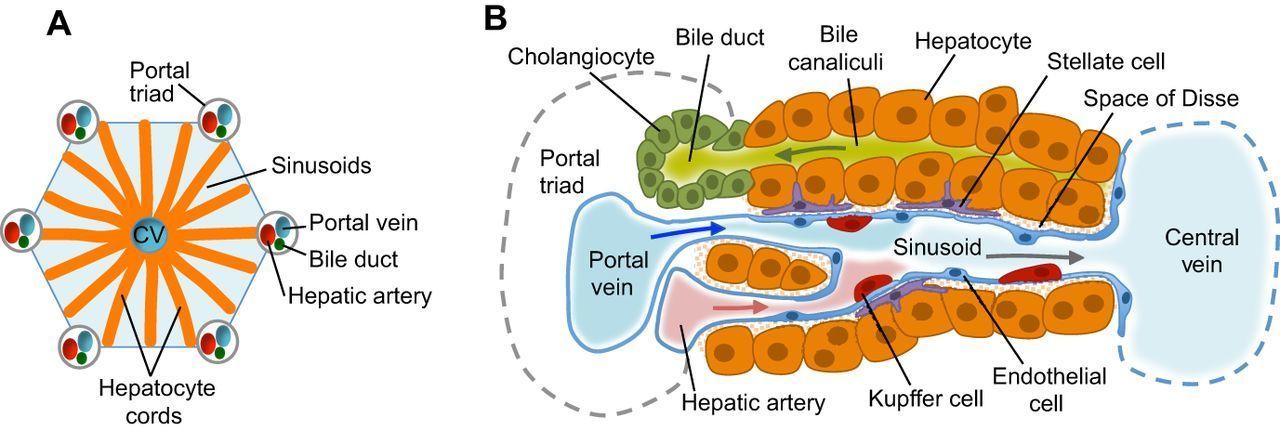
- portal triad: bile duct, hepatic artery, and hepatic portal vein
- hepato- gastric ligament
- Falciform ligaments
Irrigation
- 75% by hepatic portal vein
- Formed by: Superior mesenteric artery and splenic
- nutritive blood supply
- 25% hepatic artery (right or left)
- Proper hepatic artery
- Common hepatic artery
- Proper hepatic artery
- Both supplies mix within the hepatic sinusoids
- Drain: on the central vein
- Hepatic vein
- Inferior vena cava
- Hepatic vein
- Drain: on the central vein
- 75% by hepatic portal vein
Innervation
- Sympatic: celiac plexus
- Parasympatic: X nerve
Fossa for the gallbladder
- Gallbladder (7-10cm)
- Fundus
- 9th costal cartilage
- Body
- Neck
- joins the cystic duct
- cystic duct (3–4 cm long)
- Ends on the hepatopancreatic sphincter
- CCK
- Ends on the hepatopancreatic sphincter
- Irrigation
- cystic artery
- cystohepatic triangle (of Calot)
- from: right hepatic artery
- cystic artery
- FUNCTION: store and concentrate bile (30 ml to 50 ml)
- Fundus
- Gallbladder (7-10cm)
Biliary tree
- Left and right hepatic ducts
- Joined by the cystic duct =
- Common hepatic duct
- Ampulla of Vater
- Common hepatic duct
- Joined by the cystic duct =
- Bile
- formed by the hepatocyte
- Modified by: bile duct epithelium
- secretin stimulates this secretion.
- consists of 95% water, bile salts, bilirubin phospholipid, cholesterol, amino acids
- 2 primary bile acids: Cholic acid and Chenodeoxycholic acid
- conjugated with: glycine and taurine
- = bile salts (amphipathic)
- FUNCTION: emulsify fats into smaller particles
- = bile salts (amphipathic)
- Micelles: transport lipids, cholesterol and increase their absorption
- Bile returns to the liver to be recycled via the enterohepatic circulation
- reabsorbed in: ileum and return via the hepatic portal vein.
- Bile returns to the liver to be recycled via the enterohepatic circulation
- conjugated with: glycine and taurine
- Modified by: bile duct epithelium
- Bile concentration in the gallbladder
- sodium ions are exchanged for protons
- overall sodium ions increas and chloride and bicarbonate diminishes
- Bile can be concentrated almost 15 times or more
- Secretion: stimulated by Secretin, vagus nerve and CCK
- Bile can be concentrated almost 15 times or more
- overall sodium ions increas and chloride and bicarbonate diminishes
- sodium ions are exchanged for protons
- formed by the hepatocyte
- Left and right hepatic ducts
Pauly Carrera Camacho A01364154
- Guyton, A.C.& Hall, J.E. (1996). "Tratado de Fisiología médica". 9ª Edición. Interamericana-McGraw-Hill. Madrid Moore K.L. Anatomía Humana con Orientación Clínica Editorial Médica Panamericana. Barcelona (1993)
Other hepatic functions
- Detoxify xenobiotics
- Storage for vitamin A in the Ito cells
- Storage of vitamin K
- Bile production
- synthesis of bile and VLDL
- convert glucose to glycogen
Images and files in the map
Information
- Description
- Mind Map on Liver and Biliary tree, created by Pauly Carrera on 05/11/2018.
- Created by
- Pauly Carrera
- Views
- 1
- Rating