
Mind map
2 Interpretations of joint attention
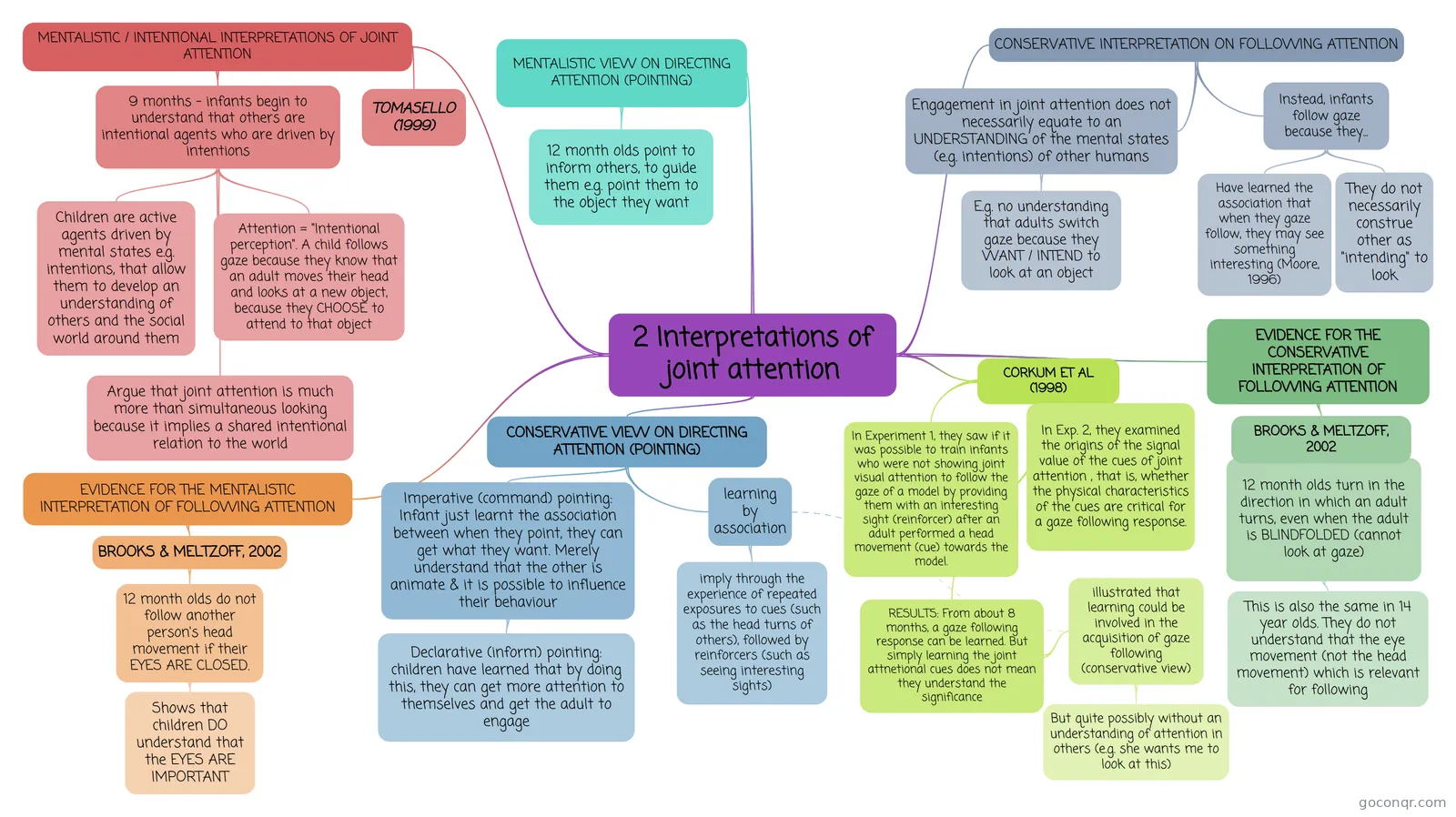
Mind map: Interpretations of joint attention
Map content
2 Interpretations of joint attention
MENTALISTIC / INTENTIONAL INTERPRETATIONS OF JOINT ATTENTION
- 9 months - infants begin to understand that others are intentional agents who are driven by intentions
- Children are active agents driven by mental states e.g. intentions, that allow them to develop an understanding of others and the social world around them
- Attention = "Intentional perception". A child follows gaze because they know that an adult moves their head and looks at a new object, because they CHOOSE to attend to that object
- Argue that joint attention is much more than simultaneous looking because it implies a shared intentional relation to the world
- TOMASELLO (1999)
- 9 months - infants begin to understand that others are intentional agents who are driven by intentions
CONSERVATIVE INTERPRETATION ON FOLLOWING ATTENTION
- Engagement in joint attention does not necessarily equate to an UNDERSTANDING of the mental states (e.g. intentions) of other humans
- E.g. no understanding that adults switch gaze because they WANT / INTEND to look at an object
- Instead, infants follow gaze because they...
- Have learned the association that when they gaze follow, they may see something interesting (Moore, 1996)
- They do not necessarily construe other as "intending" to look
- Engagement in joint attention does not necessarily equate to an UNDERSTANDING of the mental states (e.g. intentions) of other humans
EVIDENCE FOR THE CONSERVATIVE INTERPRETATION OF FOLLOWING ATTENTION
- BROOKS & MELTZOFF, 2002
- 12 month olds turn in the direction in which an adult turns, even when the adult is BLINDFOLDED (cannot look at gaze)
- This is also the same in 14 year olds. They do not understand that the eye movement (not the head movement) which is relevant for following
- 12 month olds turn in the direction in which an adult turns, even when the adult is BLINDFOLDED (cannot look at gaze)
- BROOKS & MELTZOFF, 2002
EVIDENCE FOR THE MENTALISTIC INTERPRETATION OF FOLLOWING ATTENTION
- BROOKS & MELTZOFF, 2002
- 12 month olds do not follow another person's head movement if their EYES ARE CLOSED.
- Shows that children DO understand that the EYES ARE IMPORTANT
- 12 month olds do not follow another person's head movement if their EYES ARE CLOSED.
- BROOKS & MELTZOFF, 2002
CONSERVATIVE VIEW ON DIRECTING ATTENTION (POINTING)
- Imperative (command) pointing: Infant just learnt the association between when they point, they can get what they want. Merely understand that the other is animate & it is possible to influence their behaviour
- Declarative (inform) pointing: children have learned that by doing this, they can get more attention to themselves and get the adult to engage
- learning by association
- imply through the experience of repeated exposures to cues (such as the head turns of others), followed by reinforcers (such as seeing interesting sights)
- Imperative (command) pointing: Infant just learnt the association between when they point, they can get what they want. Merely understand that the other is animate & it is possible to influence their behaviour
MENTALISTIC VIEW ON DIRECTING ATTENTION (POINTING)
- 12 month olds point to inform others, to guide them e.g. point them to the object they want
CORKUM ET AL (1998)
- In Experiment 1, they saw if it was possible to train infants who were not showing joint visual attention to follow the gaze of a model by providing them with an interesting sight (reinforcer) after an adult performed a head movement (cue) towards the model.
- In Exp. 2, they examined the origins of the signal value of the cues of joint attention , that is, whether the physical characteristics of the cues are critical for a gaze following response.
- RESULTS: From about 8 months, a gaze following response can be learned. But simply learning the joint attnetional cues does not mean they understand the significance
- illustrated that learning could be involved in the acquisition of gaze following (conservative view)
- But quite possibly without an understanding of attention in others (e.g. she wants me to look at this)
- illustrated that learning could be involved in the acquisition of gaze following (conservative view)
Information
- Description
- Mind Map on 2 Interpretations of joint attention, created by seasider 01 on 12/11/2018.
- Created by
- seasider 01
- Views
- 1
- Rating