
Mind map
Monopolistic Competition and Oligopoly
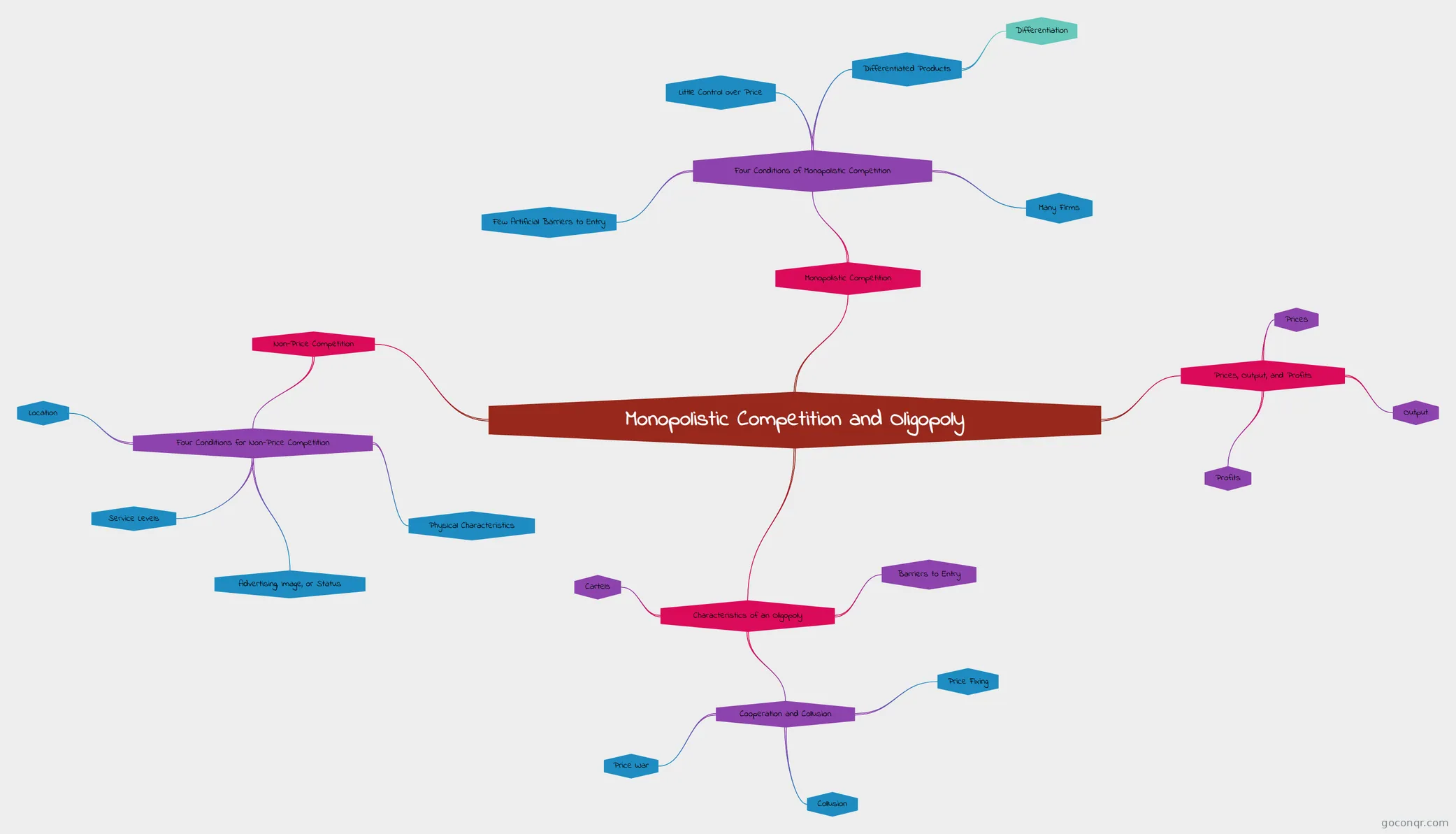
Mind map: Monopolistic Competition and Oligopoly
Map content
Monopolistic Competition and Oligopoly
Monopolistic Competition
- Many companies compete in an open market to sell products that are similar but not identical.
- Four Conditions of Monopolistic Competition
- Many Firms
- Firms can begin to sell goods and earn money after a mall initial investment and new firms spring up quickly to join the market.
- Few Artificial Barriers to Entry
- Firms do not face high barriers to enter the market because patents no longer protect people from competition and producers cannot work together to keep out new competitors.
- Little Control over Price
- Firms have slightly different products so they can lower or raise the prices of their products, but not too much to drive away their costumers.
- Differentiated Products
- Firms distinguish their goods from other products in the market.
- Differentiation
- The act of recognizing what makes something different.
- Many Firms
Non-Price Competition
- Competition through ways other than lowered prices.
- Four Conditions for Non-Price Competition
- Physical Characteristics
- Simplest way for a firm to distinguish its products is to offer a new size, color, shape, texture, or taste.
- Location
- Goods can be differentiated by where they are sold.
- Service Levels
- Sellers can charge higher prices because they offer their customers a high level of service.
- Advertising, Image, or Status
- The advertising of products points out differences between different firm offerings and other products, these product differences are more a matter of perception than reality.
- Physical Characteristics
Prices, Output, and Profits
- Prices
- The firm can raise the price, but they cannot raise the price too high for fear of losing costumers to competition.
- Output
- Output is negatively related to price. Output is the something produced by a person, machine, or industry.
- Profits
- Firms usually just break even, but there are points where the firms earn more than their costs. At this time, two market trends work to take those profits away, which include is fierce competition would cause rivals to find new ways to sell their products more and new firms will enter the market with new products.
- Prices
Characteristics of an Oligopoly
- An oligopoly is a market which is dominated by a few large, profitable firms.
- Barriers to Entry
- Barriers are difficult to enter for new companies, they can be technological or created by the government. High start-up costs and greater economies of scale also contribute to difficult barriers of entry.
- Cooperation and Collusion
- When there is cooperation between oligopolistic firms, the market is damaged. But usually do not last long because people like to cheat to earn more profits.
- Price War
- A disagreement causes this to happen and it is when competitors cut their prices very low to win business. It is harmful to producers, but great for consumers.
- Collusion
- Agreement among members of an oligopoly to illegally set prices and production levels.
- Price Fixing
- An outcome caused by collusion and it is an agreement among firms to sell at the same or very similar prices.
- Cartels
- A cartel is stronger than a collusive agreement because it is an agreement by a formal organization of producers to coordinate prices and production. Can only survive if everyone agrees on the output levels.