
Mind map
Introduction to Invertebrates Pt 1
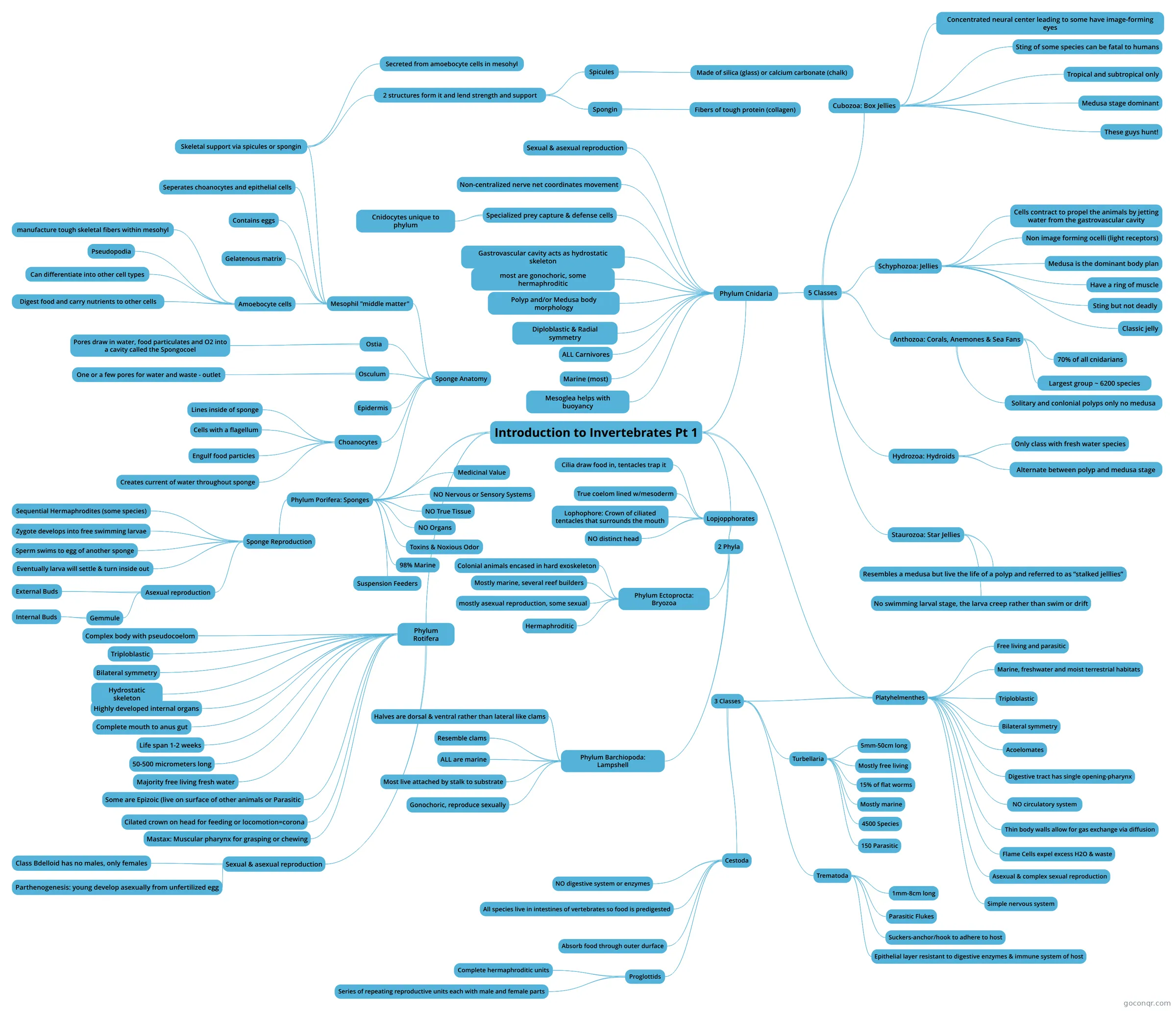
Mind map: Invertebrate Phyla Characteristics
Map content
Introduction to Invertebrates Pt 1
Phylum Porifera: Sponges
- 98% Marine
- Medicinal Value
- NO Nervous or Sensory Systems
- NO True Tissue
- NO Organs
- Toxins & Noxious Odor
- Sponge Reproduction
- Sequential Hermaphrodites (some species)
- Sperm swims to egg of another sponge
- Zygote develops into free swimming larvae
- Eventually larva will settle & turn inside out
- Asexual reproduction
- External Buds
- Gemmule
- Internal Buds
- Suspension Feeders
- Sponge Anatomy
- Ostia
- Pores draw in water, food particulates and O2 into a cavity called the Spongocoel
- Osculum
- One or a few pores for water and waste - outlet
- Choanocytes
- Engulf food particles
- Lines inside of sponge
- Cells with a flagellum
- Creates current of water throughout sponge
- Epidermis
- Mesophil "middle matter"
- Gelatenous matrix
- Seperates choanocytes and epithelial cells
- Contains eggs
- Amoebocyte cells
- Pseudopodia
- Can differentiate into other cell types
- Digest food and carry nutrients to other cells
- manufacture tough skeletal fibers within mesohyl
- Skeletal support via spicules or spongin
- Secreted from amoebocyte cells in mesohyl
- 2 structures form it and lend strength and support
- Spicules
- Made of silica (glass) or calcium carbonate (chalk)
- Spongin
- Fibers of tough protein (collagen)
- Spicules
- Ostia
Phylum Cnidaria
- Marine (most)
- ALL Carnivores
- Polyp and/or Medusa body morphology
- Diploblastic & Radial symmetry
- Specialized prey capture & defense cells
- Cnidocytes unique to phylum
- Non-centralized nerve net coordinates movement
- Gastrovascular cavity acts as hydrostatic skeleton
- Mesoglea helps with buoyancy
- most are gonochoric, some hermaphroditic
- Sexual & asexual reproduction
- 5 Classes
- Cubozoa: Box Jellies
- Medusa stage dominant
- Concentrated neural center leading to some have image-forming eyes
- These guys hunt!
- Sting of some species can be fatal to humans
- Tropical and subtropical only
- Staurozoa: Star Jellies
- Resembles a medusa but live the life of a polyp and referred to as “stalked jelllies”
- No swimming larval stage, the larva creep rather than swim or drift
- Anthozoa: Corals, Anemones & Sea Fans
- Largest group ~ 6200 species
- 70% of all cnidarians
- Solitary and conlonial polyps only no medusa
- Hydrozoa: Hydroids
- Alternate between polyp and medusa stage
- Only class with fresh water species
- Schyphozoa: Jellies
- Classic jelly
- Medusa is the dominant body plan
- Have a ring of muscle
- Cells contract to propel the animals by jetting water from the gastrovascular cavity
- Non image forming ocelli (light receptors)
- Sting but not deadly
- Cubozoa: Box Jellies
Platyhelmenthes
- Free living and parasitic
- Marine, freshwater and moist terrestrial habitats
- Triploblastic
- Bilateral symmetry
- Acoelomates
- Digestive tract has single opening-pharynx
- NO circulatory system
- Thin body walls allow for gas exchange via diffusion
- Flame Cells expel excess H2O & waste
- Simple nervous system
- Asexual & complex sexual reproduction
- 3 Classes
- Turbellaria
- Mostly free living
- 15% of flat worms
- 4500 Species
- 150 Parasitic
- Mostly marine
- 5mm-50cm long
- Trematoda
- Parasitic Flukes
- 1mm-8cm long
- Epithelial layer resistant to digestive enzymes & immune system of host
- Suckers-anchor/hook to adhere to host
- Cestoda
- NO digestive system or enzymes
- All species live in intestines of vertebrates so food is predigested
- Absorb food through outer durface
- Proglottids
- Complete hermaphroditic units
- Series of repeating reproductive units each with male and female parts
- Turbellaria
Phylum Rotifera
- Complex body with pseudocoelom
- Triploblastic
- Bilateral symmetry
- Hydrostatic skeleton
- Highly developed internal organs
- Complete mouth to anus gut
- Life span 1-2 weeks
- 50-500 micrometers long
- Majority free living fresh water
- Some are Epizoic (live on surface of other animals or Parasitic
- Cilated crown on head for feeding or locomotion=corona
- Mastax: Muscular pharynx for grasping or chewing
- Sexual & asexual reproduction
- Class Bdelloid has no males, only females
- Parthenogenesis: young develop asexually from unfertilized egg
Lopjopphorates
- Lophophore: Crown of ciliated tentacles that surrounds the mouth
- NO distinct head
- True coelom lined w/mesoderm
- Cilia draw food in, tentacles trap it
- 2 Phyla
- Phylum Ectoprocta: Bryozoa
- Colonial animals encased in hard exoskeleton
- Mostly marine, several reef builders
- mostly asexual reproduction, some sexual
- Hermaphroditic
- Phylum Barchiopoda: Lampshell
- Resemble clams
- Halves are dorsal & ventral rather than lateral like clams
- ALL are marine
- Most live attached by stalk to substrate
- Gonochoric, reproduce sexually
- Phylum Ectoprocta: Bryozoa
Information
- Description
- Mind Map on Introduction to Invertebrates Pt 1, created by nyashahendricks on 09/11/2014.
- Created by
- nyashahendricks
- Views
- 12
- Rating
More on Sponges, cnidarians and ctenophores