
Mind map
Qualitative Research (background)
Map content
Qualitative Research (background)
- Sage. Benefits: - The results are more understandable and experientally credible (even for participants) - For formative studies (to improve practices) (sistematizacion) - Encourage collaborative, and empowerment research for participants & researchers
Looks like ...(?)
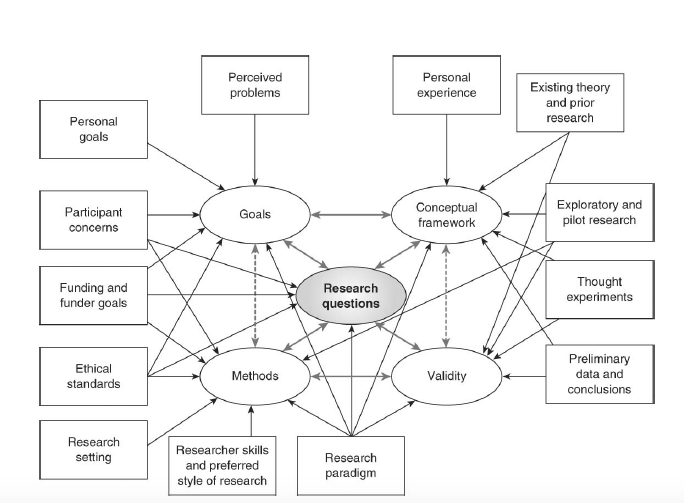
- Scheme (Sage)
- Goals
- compatibility with a qualitative research
- meaning?
- how participants make sense. Interpretive.
- particular context?
- qual. preserves the individuality of each participant of the sample/quant. big samples and aggregating data across individuals or situations
- an unanthicipated phenomena?
- exploratory feature of a qualitative research
- process?
- qual. gets the process to outcomes, a feature that its missed when applying surveys on quantitative method
- causal explanations?
- conceptual framework
- research paradigm
- There is no "qualitative paradigm". It can be extracted from (ex.): - grounded theory - critical realism - phenomenology - narrative research It can be more than just one. Its not a matter of free choice (important). Important to be conscient, aware, and explicit about own assumptions.
- Experiential Knowledge
- not to be seen as bias.
- Existing theory and research
- - important to have it in a qualitative study
- pilot and exploratory studies
- thought experiments
- Tool: concept mapping
- research question: what do you understand?
- important to have one, even if its qualitative (on the epistemological flexibility, of "openess"). - The research questions in a qualitative study should not be formulated in detail until the goals and conceptual framework of the design are clarified, and should remain sensitive and adaptable to the implications of other parts of the design.
- functions of research questions
- In qualitative study is recommended not to make questions in order to frame the differences (one of the main differences with quantitative).
- questions of the process: 1)questions about the meaning of events and activities to the people involved in them and (2) questions about the influence of the physical and social context on these events and activities.
- research paradigm
- Methods
- prestucturing qualitative
- how much do you attempt to prestructured the methods to be used.
- Structured approaches: comparability of data across sources and researchers, particularly useful in answering variance questions, questions that deal with differences between things and the explanation for these differences. Unstructured approaches, focus on the particular phenomena studied; trade generalizability and comparability for internal validity and contextual understanding. Useful for understanding the processes that led to specific outcomes
- research relationship
- Reflexivity: unavoidable mutual influence of the research participants and the researcher on each other.
- sampling
- purposeful sample: to achieve representativeness, to capture adequately heterogeneity, cases that are critical for the theories, and/or reasons for differences between settings or individuals (multicase).
- data collection
- integration of data: triangulation.
- data analysis
- Data analysis should be conducted simultaneously with data collection. Types of qualit analysis: categorizing strategies (such as coding and thematic analysis), connecting strategies (such as narrative analysis and individual case studies), and memos and displays
- categorizing
- cons: analytic blinders,don't see alternative ways of seeing data. ex: grounded theory and "emic" categories
- organizational
- preview
- substancial
- meaning descriptive
- theoretical
- abstract framework
- connecting strategies
- case studies
- ethnographic microanalysis
- narrative analysis
- memos and displays
- methods --> questions
- matrix!
- prestucturing qualitative
- Validity
- not easy to tackle them all, dff from quanti (control group, and differences between hypotheses.
- Tests for threats
- threats are bias and reactivity (trying to "control" the effect of the researcher in the study)
- long-term involvement
- Rich data
- respondent validation
- discrepance evidence/negative cases
- triangulation
- quasi-statistics
- Comparison
- generalization
- why on qualit: on the development of a theory that can be extended to other cases ("transferability").
- Goals
- reflexive
- not linear
- broader/not restrictive
- "interactive"
- goals
- conceptual framework
- research questions
- Methods
- Validity
- Scheme (Sage)
Field work (luker, salsa dancing)
- PO (ethnography)
- interviews
- pattern recognition
- metaphors, expresions
- punch up ideas
- emotional agitation
- bring over and over
- pattern recognition
- Focus group
- content analysis
Images and files in the map
Information
- Description
- Mind Map on Qualitative Research (background), created by Asun Luksic on 09/11/2014.
- Created by
- Asun Luksic
- Views
- 11
- Rating