
Mind map
Religious Language - Twentieth century perspectives
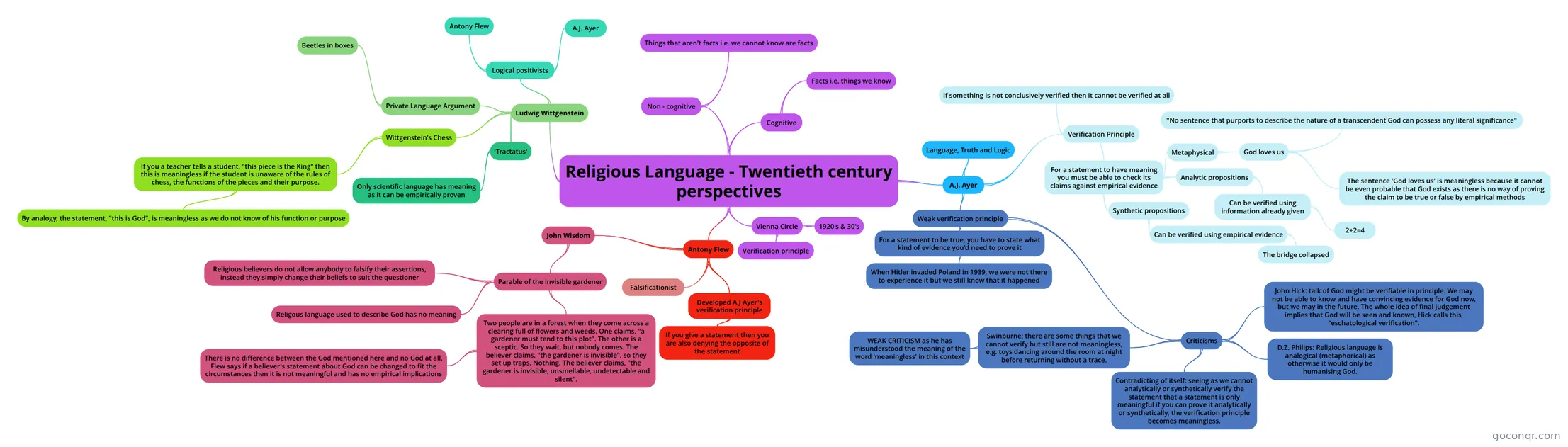
Mind map: Religious language twentieth century perspectives
Map content
Religious Language - Twentieth century perspectives
A.J. Ayer
- Verification Principle
- For a statement to have meaning you must be able to check its claims against empirical evidence
- Analytic propositions
- Can be verified using information already given
- 2+2=4
- Can be verified using information already given
- Metaphysical
- God loves us
- The sentence 'God loves us' is meaningless because it cannot be even probable that God exists as there is no way of proving the claim to be true or false by empirical methods
- "No sentence that purports to describe the nature of a transcendent God can possess any literal significance"
- God loves us
- Synthetic propositions
- Can be verified using empirical evidence
- The bridge collapsed
- Can be verified using empirical evidence
- Analytic propositions
- If something is not conclusively verified then it cannot be verified at all
- For a statement to have meaning you must be able to check its claims against empirical evidence
- Language, Truth and Logic
- Weak verification principle
- For a statement to be true, you have to state what kind of evidence you'd need to prove it
- When Hitler invaded Poland in 1939, we were not there to experience it but we still know that it happened
- Criticisms
- John Hick: talk of God might be verifiable in principle. We may not be able to know and have convincing evidence for God now, but we may in the future. The whole idea of final judgement implies that God will be seen and known, Hick calls this, "eschatological verification".
- D.Z. Philips: Religious language is analogical (metaphorical) as otherwise it would only be humanising God.
- Contradicting of itself: seeing as we cannot analytically or synthetically verify the statement that a statement is only meaningful if you can prove it analytically or synthetically, the verification principle becomes meaningless.
- Swinburne: there are some things that we cannot verify but still are not meaningless, e.g. toys dancing around the room at night before returning without a trace.
- WEAK CRITICISM as he has misunderstood the meaning of the word 'meaningless' in this context
- For a statement to be true, you have to state what kind of evidence you'd need to prove it
- Verification Principle
Ludwig Wittgenstein
- Logical positivists
- A.J. Ayer
- Antony Flew
- Private Language Argument
- Beetles in boxes
- 'Tractatus'
- Only scientific language has meaning as it can be empirically proven
- Wittgenstein's Chess
- If you a teacher tells a student, "this piece is the King" then this is meaningless if the student is unaware of the rules of chess, the functions of the pieces and their purpose.
- By analogy, the statement, "this is God", is meaningless as we do not know of his function or purpose
- If you a teacher tells a student, "this piece is the King" then this is meaningless if the student is unaware of the rules of chess, the functions of the pieces and their purpose.
- Logical positivists
Antony Flew
- Falsificationist
- Developed A.J Ayer's verification principle
- If you give a statement then you are also denying the opposite of the statement
- John Wisdom
- Parable of the invisible gardener
- Religous language used to describe God has no meaning
- Two people are in a forest when they come across a clearing full of flowers and weeds. One claims, "a gardener must tend to this plot". The other is a sceptic. So they wait, but nobody comes. The believer claims, "the gardener is invisible", so they set up traps. Nothing. The believer claims, "the gardener is invisible, unsmellable, undetectable and silent".
- There is no difference between the God mentioned here and no God at all. Flew says if a believer's statement about God can be changed to fit the circumstances then it is not meaningful and has no empirical implications
- Religious believers do not allow anybody to falsify their assertions, instead they simply change their beliefs to suit the questioner
- Parable of the invisible gardener
Cognitive
- Facts i.e. things we know
Non - cognitive
- Things that aren't facts i.e. we cannot know are facts
Vienna Circle
- Verification principle
- 1920's & 30's
Information
- Description
- Mindmap of Religious Language A2 Philosophy
- Created by
- Amira Hamereras
- Views
- 17
- Tags
- History
-
- Created by Oliver Downes · Sep 11, 2017
- Copied by Amira Hamereras · Nov 29, 2018
- Rating