
Mind map
Biomechanics in PE
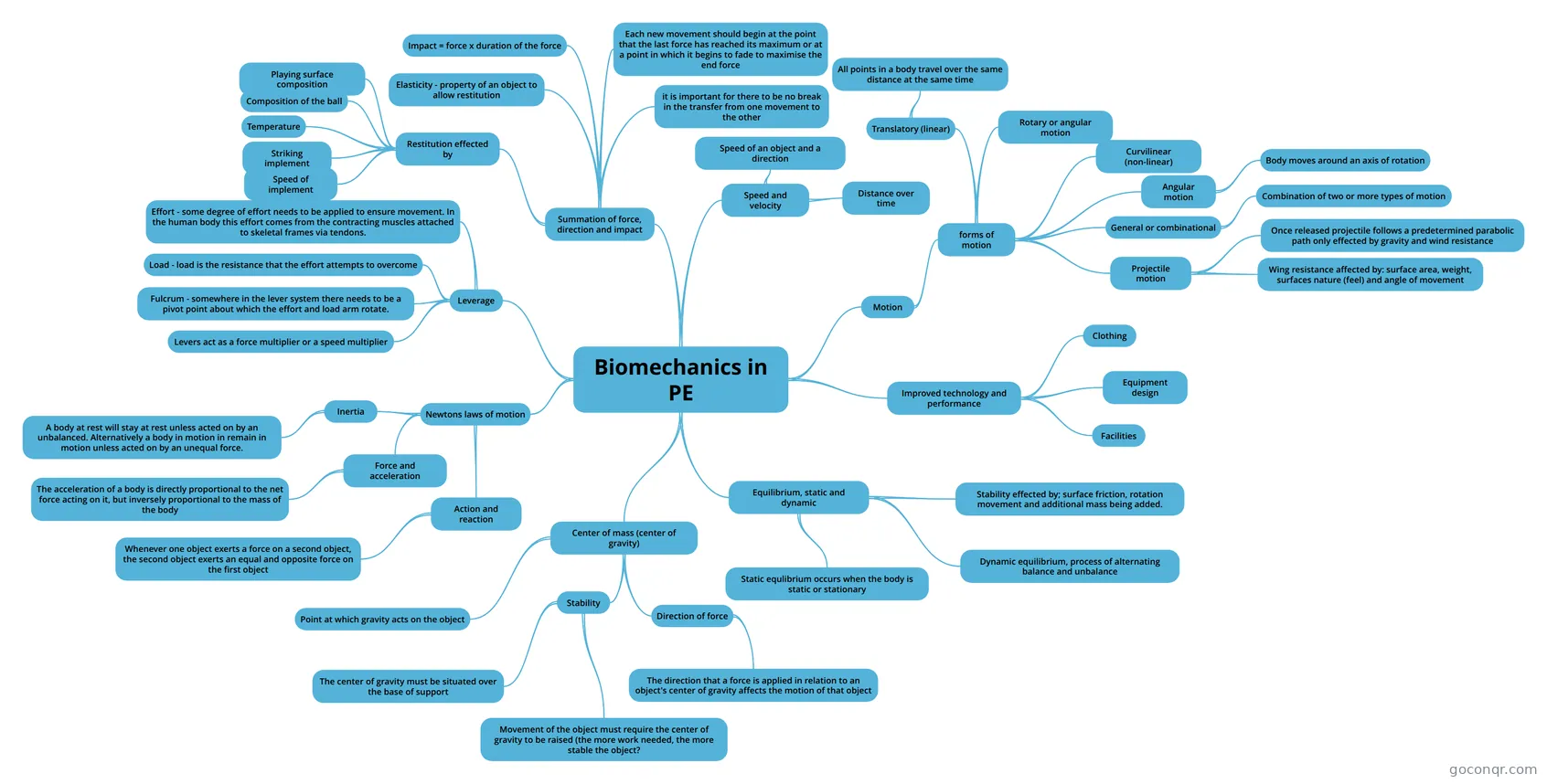
Mind map: Biomechanics in PE
Map content
Biomechanics in PE
Motion
- forms of motion
- Translatory (linear)
- All points in a body travel over the same distance at the same time
- Rotary or angular motion
- Curvilinear (non-linear)
- Angular motion
- Body moves around an axis of rotation
- General or combinational
- Combination of two or more types of motion
- Projectile motion
- Once released projectile follows a predetermined parabolic path only effected by gravity and wind resistance
- Wing resistance affected by: surface area, weight, surfaces nature (feel) and angle of movement
- Translatory (linear)
- forms of motion
Speed and velocity
- Distance over time
- Speed of an object and a direction
Summation of force, direction and impact
- it is important for there to be no break in the transfer from one movement to the other
- Each new movement should begin at the point that the last force has reached its maximum or at a point in which it begins to fade to maximise the end force
- Impact = force x duration of the force
- Elasticity - property of an object to allow restitution
- Restitution effected by
- Playing surface composition
- Composition of the ball
- Temperature
- Striking implement
- Speed of implement
Leverage
- Effort - some degree of effort needs to be applied to ensure movement. In the human body this effort comes from the contracting muscles attached to skeletal frames via tendons.
- Load - load is the resistance that the effort attempts to overcome
- Fulcrum - somewhere in the lever system there needs to be a pivot point about which the effort and load arm rotate.
- Levers act as a force multiplier or a speed multiplier
Newtons laws of motion
- Inertia
- A body at rest will stay at rest unless acted on by an unbalanced. Alternatively a body in motion in remain in motion unless acted on by an unequal force.
- Force and acceleration
- The acceleration of a body is directly proportional to the net force acting on it, but inversely proportional to the mass of the body
- Action and reaction
- Whenever one object exerts a force on a second object, the second object exerts an equal and opposite force on the first object
- Inertia
Center of mass (center of gravity)
- Point at which gravity acts on the object
- Stability
- The center of gravity must be situated over the base of support
- Movement of the object must require the center of gravity to be raised (the more work needed, the more stable the object?
- Direction of force
- The direction that a force is applied in relation to an object's center of gravity affects the motion of that object
Equilibrium, static and dynamic
- Static equlibrium occurs when the body is static or stationary
- Dynamic equilibrium, process of alternating balance and unbalance
- Stability effected by; surface friction, rotation movement and additional mass being added.
Improved technology and performance
- Clothing
- Equipment design
- Facilities
Information
- Description
- Mind Map on Biomechanics in PE, created by nickhewish on 11/11/2014.
- Created by
- nickhewish
- Views
- 19
- Rating