
Biomechanics and Movement Analysis
23 resources created by 21 users
This Biomechanics and Movement Analysis page on GoConqr gathers community-made mind maps, flashcards, quizzes and notes, from Newton's laws, levers and stability to projectile motion, angular kinetics and fluid dynamics. It's built for school students, university students and professional candidates revising or filling gaps, and for teachers after ready-made material. There are over 250 resources here, including more than 140 mind maps, over 80 flashcard decks and over 10 quizzes. Pick a topic, try a quiz to find your gaps, then make your own revision sets.
Top Biomechanics and Movement Analysis resources
-
64 cardsBiomechanics of Human Movement Mid Term Review Application of mechanics to the study of structure and function of living systems
-
34 cardsBiomechanical principles: Sports science What does COG stand for?
-
Mind map Basic Concepts of Biomechanics
-
Mind map Biomechanics
-
3 cardsplanes and axis what axis is paired with the sagittal plane?
-
18 cardsForces and newtons laws What is a force? (1)
-
34 cardsChapter 2:- Movement Analysis (Paper 1)
-
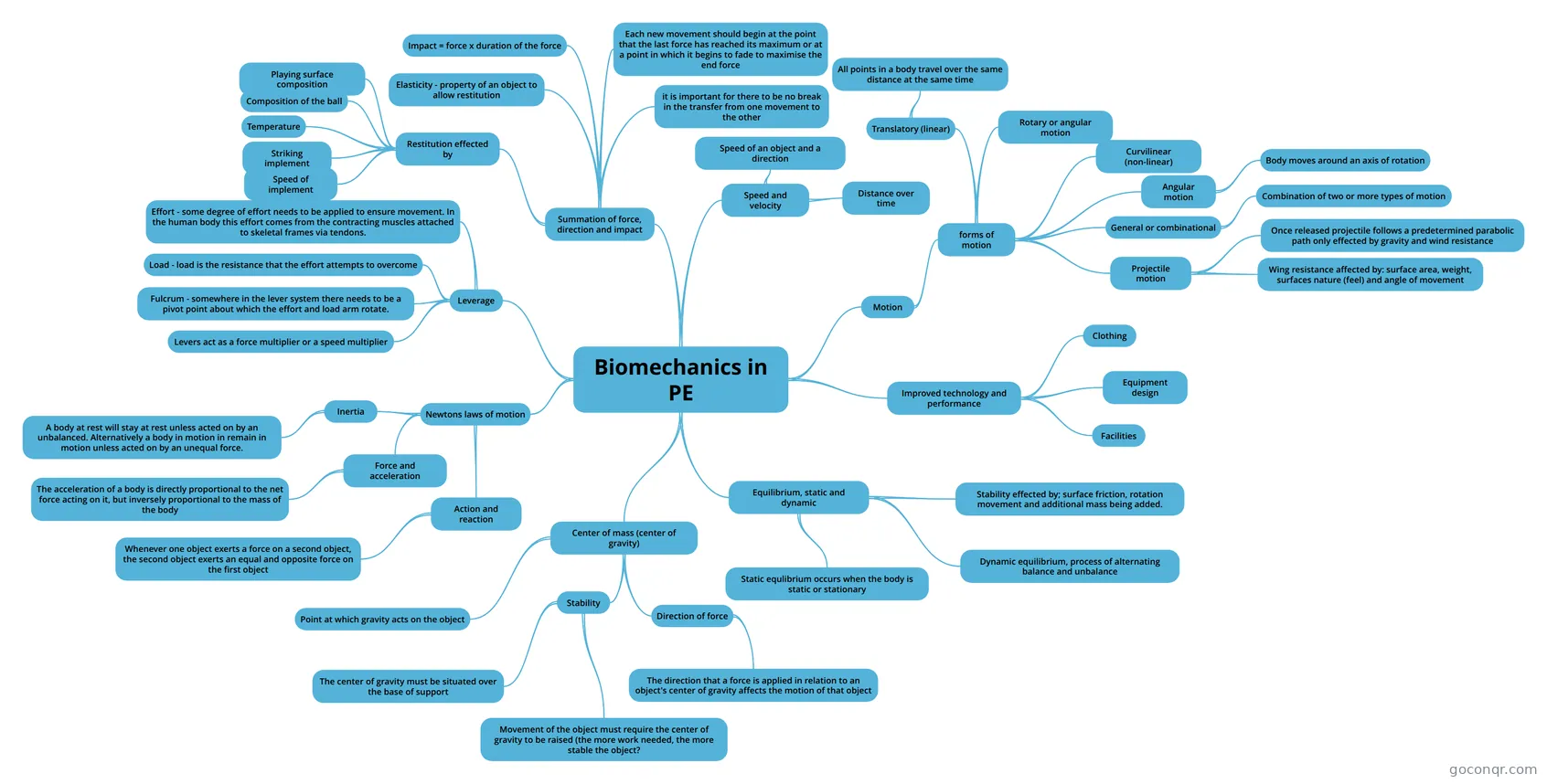 Mind map Biomechanics in PE
Quizzes
Mind maps
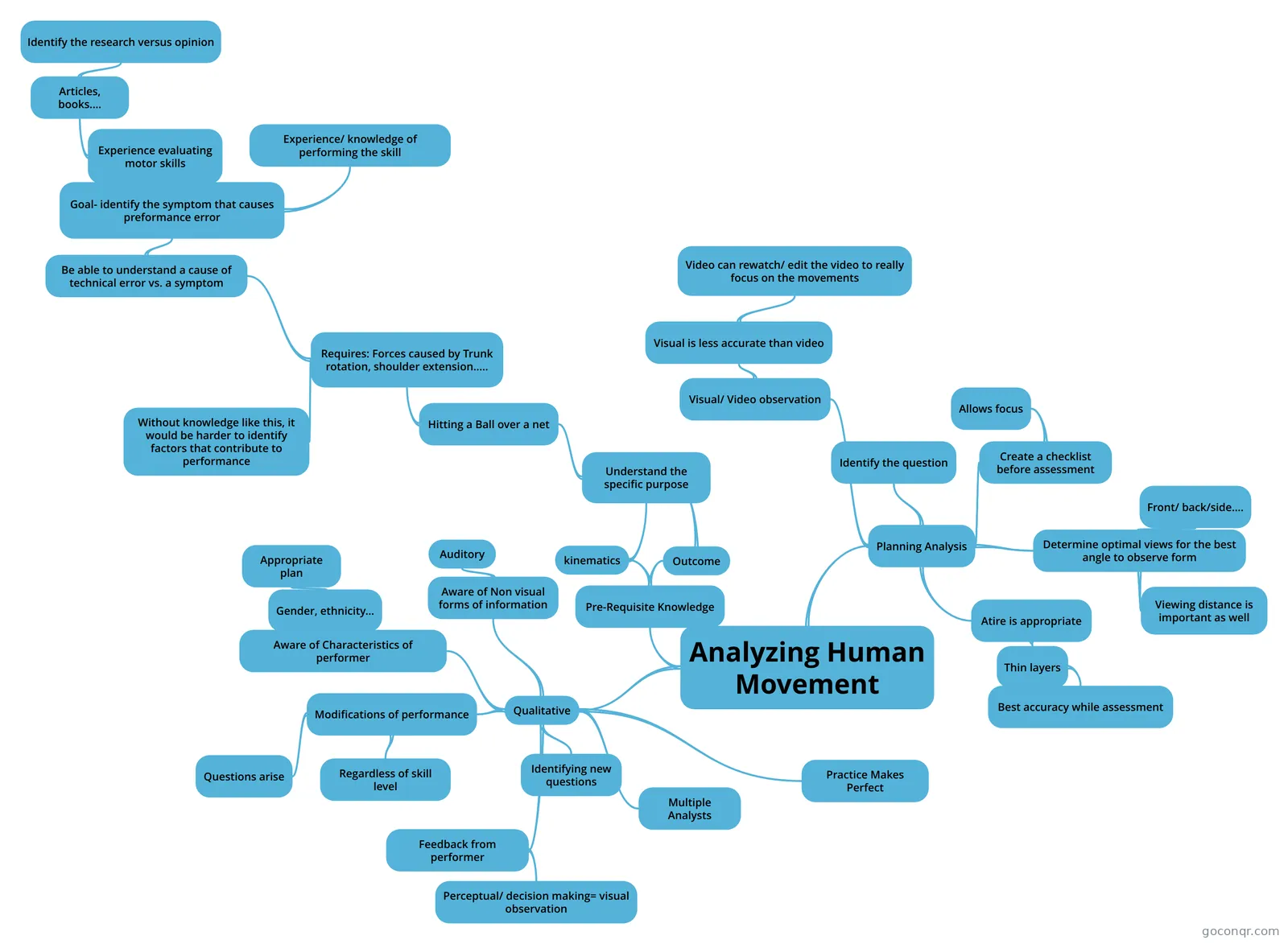
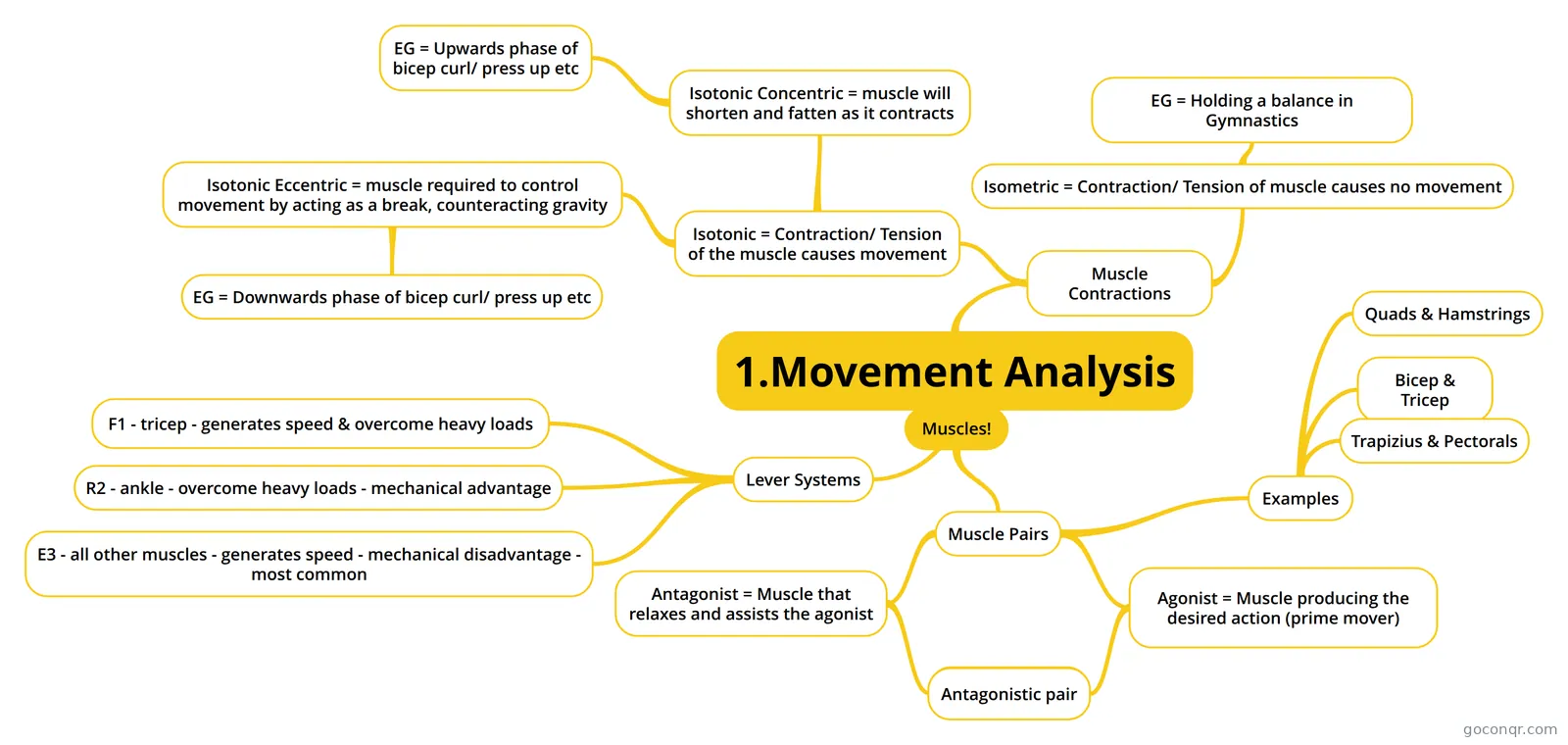
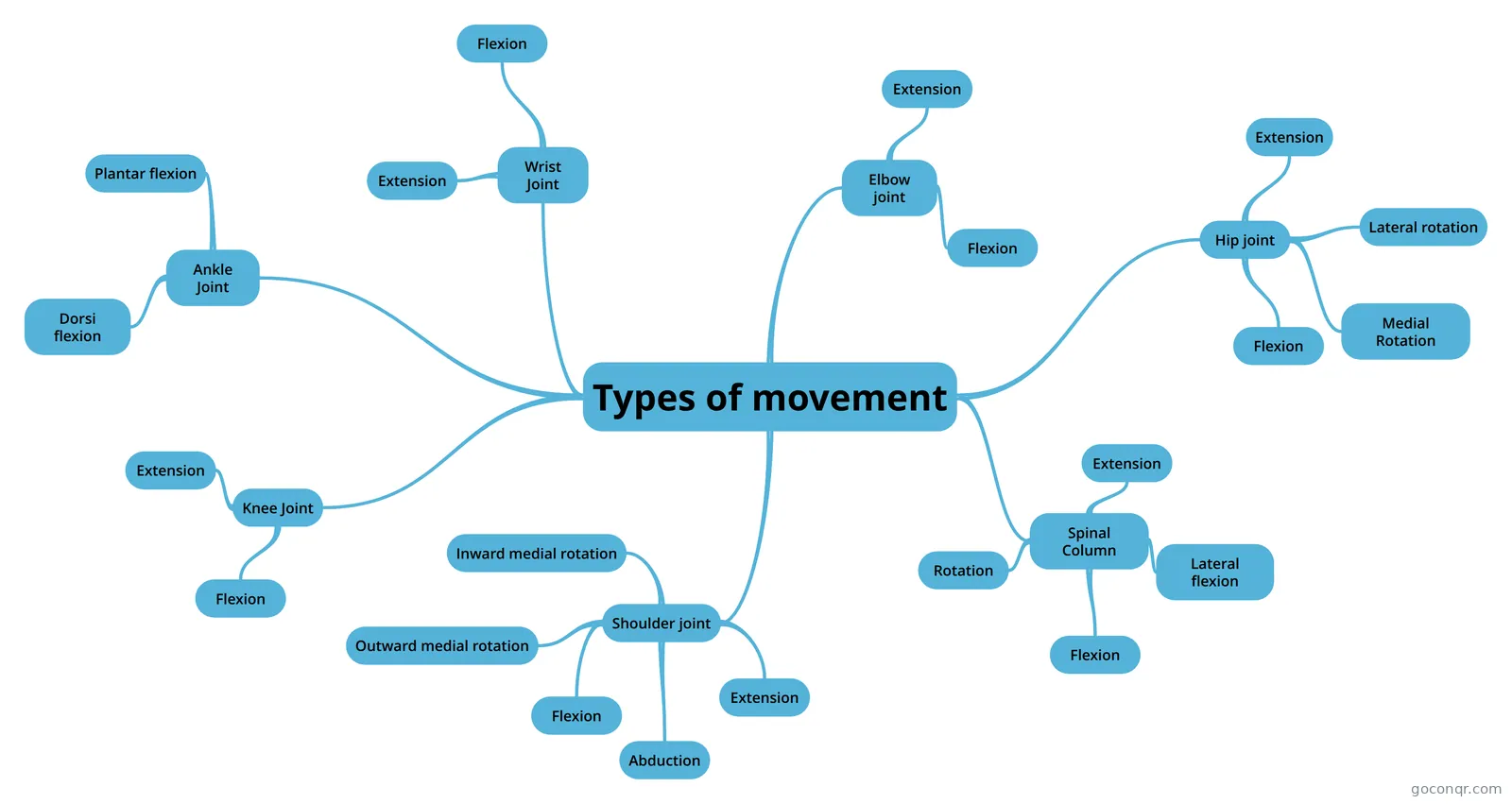
Flashcards
See all 13 flashcards-
64 cardsBiomechanics of Human Movement Mid Term Review Application of mechanics to the study of structure and function of living systems
-
34 cardsBiomechanical principles: Sports science What does COG stand for?
-
3 cardsplanes and axis what axis is paired with the sagittal plane?
-
18 cardsForces and newtons laws What is a force? (1)
-
34 cardsChapter 2:- Movement Analysis (Paper 1)
-
19 cardsTypes of Movement
-
14 cardsBiomechanics What is biomechanics
-
12 cardsChapter 14 Angular Kinetics The "resistance to acceleration" and is directly proportional to a body's/object's mass
Notes
More Physical education and sport topics
About Biomechanics and Movement Analysis
GoConqr OriginalWhat the resources cover
The page brings together material on how forces shape movement. The mind map Basic Concepts of Biomechanics walks through Newton's three laws, with the first law stated as an object staying at rest unless an external force acts on it. PE Studies Biomechanics adds spin, drag, momentum, angular motion, levers, torque, balance and coordination. Topic 4 - Movement Analysis links neuromuscular function, joint and movement types, and the fundamentals of biomechanics.
Where to start
Begin with a mind map to see the whole topic on one screen. Biomechanics covers motion, force, centre of mass, stability, and linear, angular and general motion, with examples such as the javelin. Then move to the flashcard deck Forces and newtons laws, which defines force, speed, velocity and acceleration in turn.
- Read a broad map for the big picture.
- Work through flashcards on key terms.
- Take a quiz to check what stuck.
- Return to the maps for the gaps.
Going deeper
Once the basics feel familiar, try the decks on Levers in the Body and LEVER SYSTEMS, or Magnus Effect Spin & Swing. One Biomechanics deck covers coefficient of restitution, drag types, boundary layer, buoyancy and the Bernoulli principle. The deck Biomechanical principles: Sports science asks about centre of gravity, base of support and stability, with football examples.
Using quizzes and maps together
Quizzes such as Biomechanics Quiz, Throwing Biomechanics and Jumping and Landing test the ideas in a sporting setting. When you miss a question, find the matching map and read that branch again. Some resources mention GCSE PE, IB and A-level Physical Education, so school students can look for their course in the titles and contents.
Where it sits
This unit belongs to the strand Applied Anatomy, Physiology and Biomechanics in Physical education and sport. Choose one map or quiz today and see where it takes you.
Frequently asked questions
Which resource should I open first?
Start with the mind map Basic Concepts of Biomechanics. It sets out Newton's three laws and the core ideas in one view. After that, the flashcard deck Forces and newtons laws helps you practise definitions such as force, speed, velocity and acceleration.
What do the mind maps on this page cover?
They range from Newton's laws, centre of mass and stability to linear and angular motion, levers, torque, projectiles and moment of inertia. Some follow a course topic, such as Topic 4 - Movement Analysis, which includes neuromuscular function and joint and movement types.
Are the resources free to use?
Yes. Every resource listed here is free to open, study and take, with no account needed. They were made by GoConqr users, not by GoConqr itself. A free account also saves your quiz scores and lets you make your own quizzes, mind maps, flashcards and notes.
Which levels and exams do they suit?
The mix is mostly secondary, with a good share of university material. Some resources mention GCSE PE, GCSE Physical Education, IB and A-level Physical Education. Others read like university lecture sets, such as the decks on stability and on work, power and energy.
Are there quizzes on specific sporting skills?
Yes. Throwing Biomechanics and Jumping and Landing test the ideas through sporting movements. Newton's Laws - Biomechanical principles checks the laws themselves, and Biomechanics Progress check quiz is useful for a broader check of where you stand.
What if I can't find the topic I need?
Try a nearby resource first. For example, the flashcard decks on fluid dynamics or balance and stability may cover related ground. If a gap remains, you can make your own mind map or flashcards with a free account and keep them for revision.