
Mind map
Aggression; Why do We Hurt Others? Can we Prevent It?
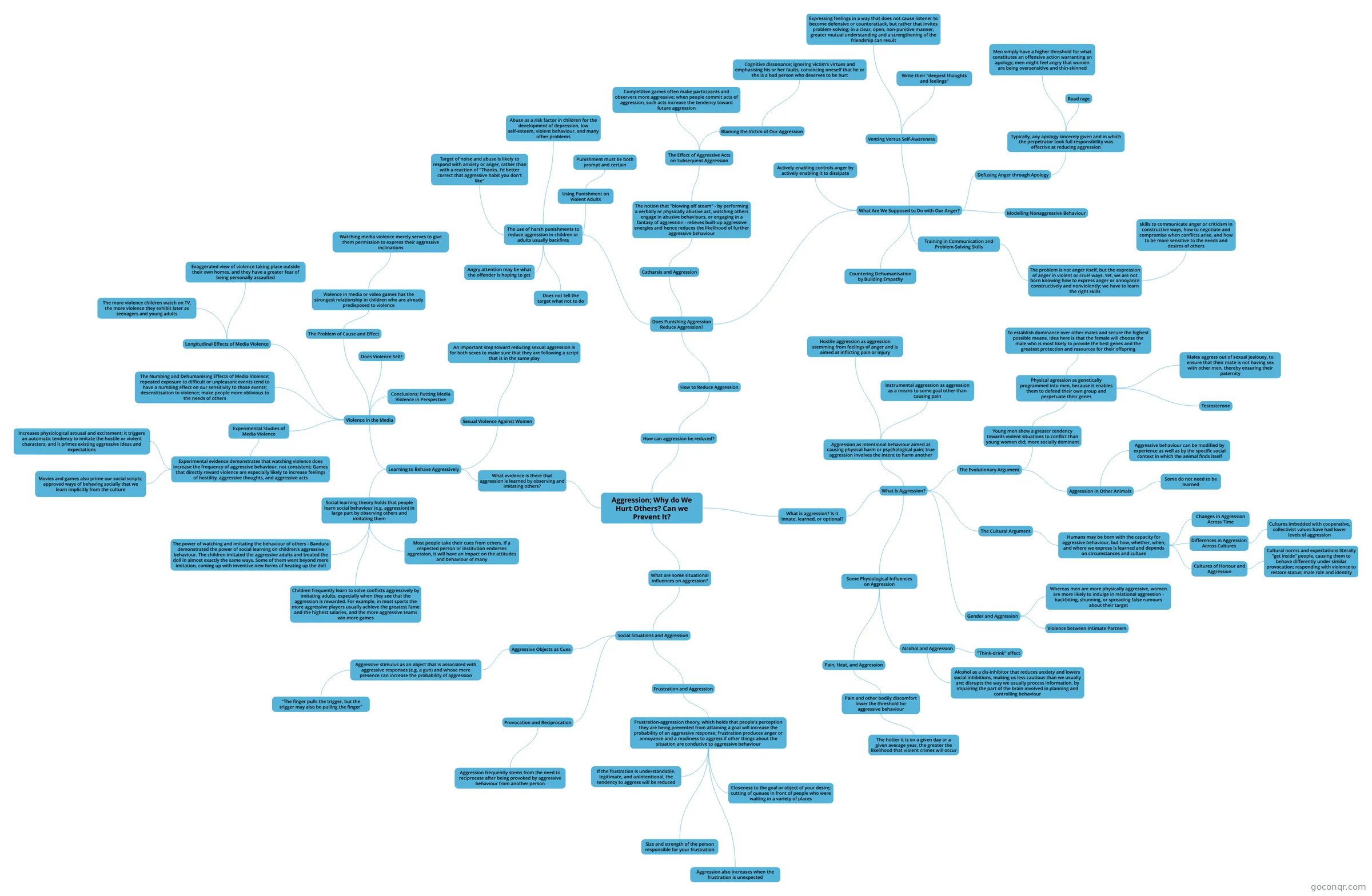
Mind map: Aggression: why do we hurt others and can we prevent it
Map content
Aggression; Why do We Hurt Others? Can we Prevent It?
What is aggression? Is it innate, learned, or optional?
- What is Aggression?
- Aggression as intentional behaviour aimed at causing physical harm or psychological pain; true aggression involves the intent to harm another
- Hostile aggression as aggression stemming from feelings of anger and is aimed at inflicting pain or injury
- Instrumental aggression as aggression as a means to some goal other than causing pain
- The Evolutionary Argument
- Young men show a greater tendency towards violent situations to conflict than young women did; more socially dominant
- Physical agression as genetically programmed into men, because it enables them to defend their own group and perpetuate their genes
- To establish dominance over other males and secure the highest possible means. Idea here is that the female will choose the male who is most likely to provide the best genes and the greatest protection and resources for their offspring
- Males aggress out of sexual jealousy, to ensure that their mate is not having sex with other men, thereby ensuring their paternity
- Testosterone
- Physical agression as genetically programmed into men, because it enables them to defend their own group and perpetuate their genes
- Aggression in Other Animals
- Aggressive behaviour can be modified by experience as well as by the specific social context in which the animal finds itself
- Some do not need to be learned
- Young men show a greater tendency towards violent situations to conflict than young women did; more socially dominant
- The Cultural Argument
- Humans may be born with the capacity for aggressive behaviour, but how, whether, when, and where we express is learned and depends on circumstances and culture
- Changes in Aggression Across Time
- Differences in Aggression Across Cultures
- Cultures imbedded with cooperative, collectivist values have had lower levels of aggression
- Cultures of Honour and Aggression
- Cultural norms and expectations literally "get inside" people, causing them to behave differently under similar provocation; responding with violence to restore status; male role and identity
- Humans may be born with the capacity for aggressive behaviour, but how, whether, when, and where we express is learned and depends on circumstances and culture
- Gender and Aggression
- Whereas men are more physically aggressive, women are more likely to indulge in relational aggression - backbiting, shunning, or spreading false rumours about their target
- Violence between Intimate Partners
- Some Physiological Influences on Aggression
- Alcohol and Aggression
- Alcohol as a dis-inhibitor that reduces anxiety and lowers social inhibitions, making us less cautious than we usually are; disrupts the way we usually process information, by impairing the part of the brain involved in planning and controlling behaviour
- "Think-drink" effect
- Pain, Heat, and Aggression
- Pain and other bodily discomfort lower the threshold for aggressive behaviour
- The hotter it is on a given day or a given average year, the greater the likelihood that violent crimes will occur
- Pain and other bodily discomfort lower the threshold for aggressive behaviour
- Alcohol and Aggression
- Aggression as intentional behaviour aimed at causing physical harm or psychological pain; true aggression involves the intent to harm another
- What is Aggression?
What are some situational influences on aggression?
- Social Situations and Aggression
- Frustration and Aggression
- Frustration-aggression theory, which holds that people's perception they are being prevented from attaining a goal will increase the probability of an aggressive response; frustration produces anger or annoyance and a readiness to aggress if other things about the situation are conducive to aggressive behaviour
- Closeness to the goal or object of your desire; cutting of queues in front of people who were waiting in a variety of places
- Aggression also increases when the frustration is unexpected
- Size and strength of the person responsible for your frustration
- If the frustration is understandable, legitimate, and unintentional, the tendency to aggress will be reduced
- Frustration-aggression theory, which holds that people's perception they are being prevented from attaining a goal will increase the probability of an aggressive response; frustration produces anger or annoyance and a readiness to aggress if other things about the situation are conducive to aggressive behaviour
- Provocation and Reciprocation
- Aggression frequently stems from the need to reciprocate after being provoked by aggressive behaviour from another person
- Aggressive Objects as Cues
- Aggressive stimulus as an object that is associated with aggressive responses (e.g. a gun) and whose mere presence can increase the probability of aggression
- "The finger pulls the trigger, but the trigger may also be pulling the finger"
- Aggressive stimulus as an object that is associated with aggressive responses (e.g. a gun) and whose mere presence can increase the probability of aggression
- Frustration and Aggression
- Social Situations and Aggression
What evidence is there that aggression is learned by observing and imitating others?
- Learning to Behave Aggressively
- Social learning theory holds that people learn social behaviour (e.g. aggression) in large part by observing others and imitating them
- Most people take their cues from others. If a respected person or institution endorses aggression, it will have an impact on the attitudes and behaviour of many
- Children frequently learn to solve conflicts aggressively by imitating adults, especially when they see that the aggression is rewarded. For example, in most sports the more aggressive players usually achieve the greatest fame and the highest salaries, and the more aggressive teams win more games
- The power of watching and imitating the behaviour of others - Bandura demonstrated the power of social learning on children's aggressive behaviour. The children imitated the aggressive adults and treated the doll in almost exactly the same ways. Some of them went beyond mere imitation, coming up with inventive new forms of beating up the doll
- Violence in the Media
- Experimental Studies of Media Violence
- Experimental evidence demonstrates that watching violence does increase the frequency of aggressive behaviour. not consistent; Games that directly reward violence are especially likely to increase feelings of hostility, aggressive thoughts, and aggressive acts
- Increases physiological arousal and excitement; it triggers an automatic tendency to imitate the hostile or violent characters; and it primes existing aggressive ideas and expectations
- Movies and games also prime our social scripts, approved ways of behaving socially that we learn implicitly from the culture
- Experimental evidence demonstrates that watching violence does increase the frequency of aggressive behaviour. not consistent; Games that directly reward violence are especially likely to increase feelings of hostility, aggressive thoughts, and aggressive acts
- The Numbing and Dehumanising Effects of Media Violence; repeated exposure to difficult or unpleasant events tend to have a numbing effect on our sensitivity to those events; desensitisation to violence; make people more oblivious to the needs of others
- Longitudinal Effects of Media Violence
- The more violence children watch on TV, the more violence they exhibit later as teenagers and young adults
- Exaggerated view of violence taking place outside their own homes, and they have a greater fear of being personally assaulted
- The Problem of Cause and Effect
- Violence in media or video games has the strongest relationship in children who are already predisposed to violence
- Watching media violence merely serves to give them permission to express their aggressive inclinations
- Violence in media or video games has the strongest relationship in children who are already predisposed to violence
- Does Violence Sell?
- Conclusions; Putting Media Violence in Perspective
- Experimental Studies of Media Violence
- Sexual Violence Against Women
- An important step toward reducing sexual aggression is for both sexes to make sure that they are following a script that is in the same play
- Social learning theory holds that people learn social behaviour (e.g. aggression) in large part by observing others and imitating them
- Learning to Behave Aggressively
How can aggression be reduced?
- How to Reduce Aggression
- Does Punishing Aggression Reduce Aggression?
- The use of harsh punishments to reduce aggression in children or adults usually backfires
- Target of noise and abuse is likely to respond with anxiety or anger, rather than with a reaction of "Thanks. I'd better correct that aggressive habit you don't like"
- Angry attention may be what the offender is hoping to get
- Abuse as a risk factor in children for the development of depression, low self-esteem, violent behaviour, and many other problems
- Does not tell the target what not to do
- Using Punishment on Violent Adults
- Punishment must be both prompt and certain
- Catharsis and Aggression
- The notion that "blowing off steam" - by performing a verbally or physically abusive act, watching others engage in abusive behaviours, or engaging in a fantasy of aggression - relieves built-up aggressive energies and hence reduces the likelihood of further aggressive behaviour
- The Effect of Aggressive Acts on Subsequent Aggression
- Competitive games often make participants and observers more aggressive; when people commit acts of aggression, such acts increase the tendency toward future aggression
- Blaming the Victim of Our Aggression
- Cognitive dissonance; ignoring victim's virtues and emphasising his or her faults, convincing oneself that he or she is a bad person who deserves to be hurt
- The Effect of Aggressive Acts on Subsequent Aggression
- The notion that "blowing off steam" - by performing a verbally or physically abusive act, watching others engage in abusive behaviours, or engaging in a fantasy of aggression - relieves built-up aggressive energies and hence reduces the likelihood of further aggressive behaviour
- What Are We Supposed to Do with Our Anger?
- Actively enabling controls anger by actively enabling it to dissipate
- Venting Versus Self-Awareness
- Expressing feelings in a way that does not cause listener to become defensive or counterattack, but rather that invites problem-solving; in a clear, open, non-punitive manner, greater mutual understanding and a strengthening of the friendship can result
- Write their "deepest thoughts and feelings"
- Defusing Anger through Apology
- Typically, any apology sincerely given and in which the perpetrator took full responsibility was effective at reducing aggression
- Men simply have a higher threshold for what constitutes an offensive action warranting an apology; men might feel angry that women are being oversensitive and thin-skinned
- Road rage
- Typically, any apology sincerely given and in which the perpetrator took full responsibility was effective at reducing aggression
- Modelling Nonaggressive Behaviour
- Training in Communication and Problem-Solving Skills
- The problem is not anger itself, but the expression of anger in violent or cruel ways. Yet, we are not born knowing how to express anger or annoyance constructively and nonviolently; we have to learn the right skills
- skills to communicate anger or criticism in constructive ways, how to negotiate and compromise when conflicts arise, and how to be more sensitive to the needs and desires of others
- The problem is not anger itself, but the expression of anger in violent or cruel ways. Yet, we are not born knowing how to express anger or annoyance constructively and nonviolently; we have to learn the right skills
- Countering Dehumanisation by Building Empathy
- The use of harsh punishments to reduce aggression in children or adults usually backfires
- Does Punishing Aggression Reduce Aggression?
- How to Reduce Aggression
Information
- Description
- Mind Map on Aggression; Why do We Hurt Others? Can we Prevent It?, created by Kidman Kiu on 01/12/2018.
- Created by
- Kidman Kiu
- Views
- 0
- Rating
More on Social psychological explanations of aggression