
Mind map
Migration, Identity, Sovereignty
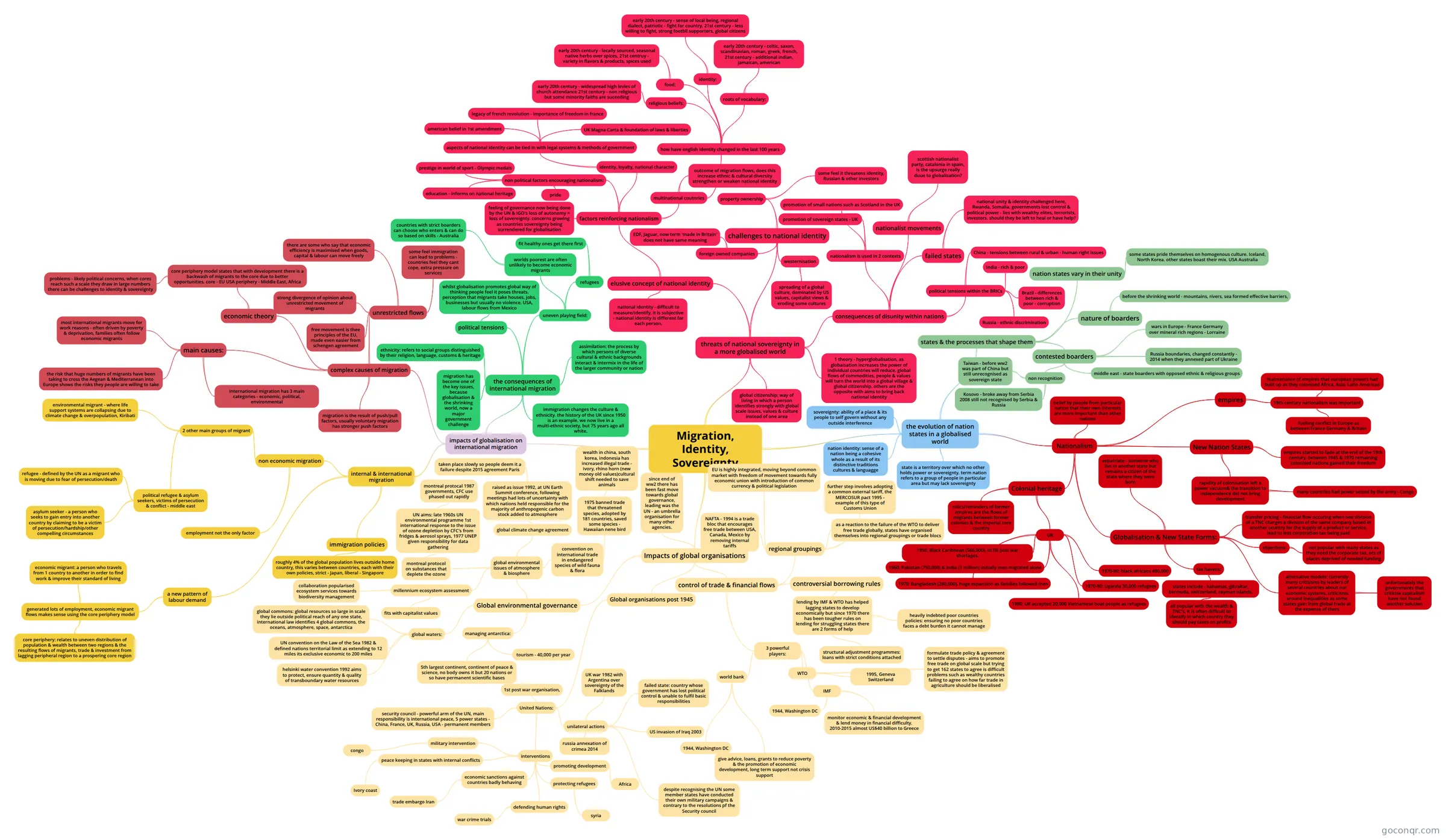
Mind map: migration, identity and sovereignty
Map content
Migration, Identity, Sovereignty
impacts of globalisation on international migration
- internal & international migration
- a new pattern of labour demand
- generated lots of employment, economic migrant flows makes sense using the core periphery model
- economic migrant: a person who travels from 1 country to another in order to find work & improve their standard of living
- core periphery: relates to uneven distribution of population & wealth between two regions & the resulting flows of migrants, trade & investment from lagging peripheral region to a prospering core region
- generated lots of employment, economic migrant flows makes sense using the core periphery model
- immigration policies
- roughly 4% of the global population lives outside home country, this varies between countries, each with their own policies, strict - Japan, liberal - Singapore
- non economic migration
- employment not the only factor
- 2 other main groups of migrant
- political refugee & asylum seekers, victims of persecution & conflict - middle east
- refugee - defined by the UN as a migrant who is moving due to fear of persecution/death
- asylum seeker - a person who seeks to gain entry into another country by claiming to be a victim of persecution/hardship/other compelling circumstances
- environmental migrant - where life support systems are collapsing due to climate change & overpopulation, Kiribati
- political refugee & asylum seekers, victims of persecution & conflict - middle east
- a new pattern of labour demand
- complex causes of migration
- migration is the result of push/pull factors, usually voluntary migration has stronger push factors
- main causes:
- international migration has 3 main categories - economic, political, environmental
- the risk that huge numbers of migrants have been taking to cross the Aegean & Mediterranean into Europe shows the risks they people are willing to take
- most international migrants move for work reasons - often driven by poverty & deprivation, families often follow economic migrants
- economic theory
- core periphery model states that with development there is a backwash of migrants to the core due to better opportunities. core - EU USA periphery - Middle East, Africa
- problems - likely political concerns, when cores reach such a scale they draw in large numbers there can be challenges to identity & sovereignty
- core periphery model states that with development there is a backwash of migrants to the core due to better opportunities. core - EU USA periphery - Middle East, Africa
- unrestricted flows
- strong divergence of opinion about unrestricted movement of migrants
- there are some who say that economic efficiency is maximised when goods, capital & labour can move freely
- free movement is thee principles of the EU, made even easier from schengen agreement
- some feel immigration can lead to problems - countries feel they cant cope, extra pressure on services
- the consequences of international migration
- migration has become one of the key issues, because globalisation & the shrinking world, now a major government challenge
- immigration changes the culture & ethnicity. the history of the UK since 1950 is an example. we now live in a multi-ethnic society, but 75 years ago all white.
- ethnicity: refers to social groups distinguished by their religion, language, customs & heritage
- assimilation: the process by which persons of diverse cultural & ethnic backgrounds interact & intermix in the life of the larger community or nation
- political tensions
- whilst globalisation promotes global way of thinking people feel it poses threats. perception that migrants take houses, jobs, businesses but usually no violence. USA, labour flows from Mexico
- uneven playing field:
- worlds poorest are often unlikely to become economic migrants
- countries with strict boarders can choose who enters & can do so based on skills - Australia
- refugees
- fit healthy ones get there first
- worlds poorest are often unlikely to become economic migrants
- internal & international migration
the evolution of nation states in a globalised world
- nation identity: sense of a nation being a cohesive whole as a result of its distinctive traditions cultures & languagge
- sovereignty: ability of a place & its people to self govern without any outside interference
- state is a territory over which no other holds power or sovereignty. term nation refers to a group of people in particular area but may lack sovereignty
- states & the processes that shape them
- nation states vary in their unity
- some states pride themselves on homogenous culture. Iceland, North Korea. other states boast their mix. USA Australia
- nature of boarders
- before the shrinking world - mountains, rivers, sea formed effective barriers,
- contested boarders
- wars in Europe - France Germany over mineral rich regions - Lorraine
- Russia boundaries, changed constantly - 2014 when they annexed part of Ukraine
- middle east - state boarders with opposed ethnic & religious groups
- non recognition
- Kosovo - broke away from Serbia 2008 still not recognised by Serbia & Russia
- Taiwan - before ww2 was part of China but still unrecognised as sovereign state
- nation states vary in their unity
- Nationalism
- belief by people from particular nation that their own interests are more important than other nations
- empires
- 19th century nationalism was important
- maintenance of empires that european powers had built up as they colonised Africa, Asia, Latin American
- fuelling conflict in Europe as between France Germany & Britain
- 19th century nationalism was important
- New Nation States
- empires started to fade at the end of the 19th century, between 1945 & 1970 remaining colonised nations gained their freedom
- rapidity of colonisation left a power vacuum& the transition to independence did not bring development
- many countries had power seized by the army - Congo
- Colonial heritage
- relics/reminders of former empires are the flows of migrants between former colonies & the imperial core country
- UK
- 1950: Black Caribbean (566,000), to fill post war shortages.
- 1960: Pakistan (750,000) & India (1 million) initially men migrated alone
- 1970: Bangladesh (280,000), huge expansion as families followed men
- 1980: UK accepted 20,000 Vietnamese boat people as refugees
- 1970-80: Uganda 30,000 refugees
- 1970-80: black africans 480,000
- Globalisation & New State Forms:
- expatriate - someone who livs in another state but remains a citizen of the state where they were born
- transfer pricing - financial flow occuring when one division of a TNC charges a division of the same company based in another ocuntry for the supply of a product or service, lead to less corporation tax being paid
- tax havens:
- states include - bahamas, gibraltar, bermuda, switzerland, cayman islands.
- all popular with the wealth & TNC's, it is often difficult to identify in which country they should pay taxes on profits
- states include - bahamas, gibraltar, bermuda, switzerland, cayman islands.
- objections:
- not popular with many states as they need the corporate tax, ots of places deprived of needed funding
- alternative models: currently many critisisms by leaders of several countries about our economic systems, criticisms around inequalities as some states gain from global trade at the expense of thers
- unfortunately the governments that criticise capitalism have not found another solution
Impacts of global organisations
- since end of ww2 there has been fast move towards global governance, leading was the UN - an umbrella organisation for many other agencies.
- Global organisations post 1945
- United Nations:
- 1st post war organisation,
- security council - powerful arm of the UN, main responsibility is international peace, 5 power states - China, France, UK, Russia, USA - permanent members
- interventions
- military intervention
- congo
- peace keeping in states with internal conflicts
- Ivory coast
- economic sanctions against countries badly behaving
- trade embargo Iran
- defending human rights
- war crime trials
- protecting refugees
- syria
- promoting development
- Africa
- military intervention
- unilateral actions
- despite recognising the UN some member states have conducted their own military campaigns & contrary to the resolutions pf the Security council
- UK war 1982 with Argentina over sovereignty of the Falklands
- russia annexation of crimea 2014
- US invasion of Iraq 2003
- failed state: country whose government has lost political control & unable to fulfil basic responsibilities
- United Nations:
- control of trade & financial flows
- 3 powerful players:
- world bank
- 1944, Washington DC
- give advice, loans, grants to reduce poverty & the promotion of economic development, long term support not crisis support
- IMF
- 1944, Washington DC
- monitor economic & financial development & lend money in financial difficulty. 2010-2015 almost US$40 billion to Greece
- WTO
- 1995, Geneva Switzerland
- formulate trade policy & agreement to settle disputes - aims to promote free trade on global scale but trying to get 162 states to agree is difficult problems such as wealthy countries failing to agree on how far trade in agriculture should be liberalised
- world bank
- controversial borrowing rules
- lending by IMF & WTO has helped lagging states to develop economically but since 1970 there has been tougher rules on lending for struggling states there are 2 forms of help
- structural adjustment programmes: loans with strict conditions attached
- heavily indebted poor countries policies: ensuring no poor countries faces a debt burden it cannot manage
- lending by IMF & WTO has helped lagging states to develop economically but since 1970 there has been tougher rules on lending for struggling states there are 2 forms of help
- regional groupings
- as a reaction to the failure of the WTO to deliver free trade globally, states have organised themselves into regional groupings or trade blocs
- NAFTA - 1994 is a trade bloc that encourages free trade between USA, Canada, Mexico by removing internal tariffs
- further step involves adopting a common external tariff, the MERCOSUR pact 1995 - example of this type of Customs Union
- EU is highly integrated, moving beyond common market with freedom of movement towards fully economic union with introduction of common currency & political legislation
- 3 powerful players:
- Global environmental governance
- global environmental issues of atmosphere & biosphere
- montreal protocol on substances that deplete the ozone
- UN aims: late 1960s UN environmental programme 1st international response to the issue of ozone depletion by CFC's from fridges & aerosol sprays, 1977 UNEP given responsibility for data gathering
- montreal protocal 1987 governments, CFC use phased out rapidly
- UN aims: late 1960s UN environmental programme 1st international response to the issue of ozone depletion by CFC's from fridges & aerosol sprays, 1977 UNEP given responsibility for data gathering
- global climate change agreement
- raised as issue 1992, at UN Earth Summit conference, following meetings had lots of uncertainty with which nations held responsible for the majority of anthropogenic carbon stock added to atmosphere
- taken place slowly so people deem it a failure despite 2015 agreement Paris
- raised as issue 1992, at UN Earth Summit conference, following meetings had lots of uncertainty with which nations held responsible for the majority of anthropogenic carbon stock added to atmosphere
- convention on international trade in endangered species of wild fauna & flora
- 1975 banned trade that threatened species, adopted by 181 countries, saved some species - Hawaiian nene bird
- wealth in china, south korea, indonesia has increased illegal trade - ivory, rhino horn (new money old values)cultural shift needed to save animals
- 1975 banned trade that threatened species, adopted by 181 countries, saved some species - Hawaiian nene bird
- millennium ecosystem assessment
- collaboration popularised ecosystem services towards biodiversity management
- fits with capitalist values
- montreal protocol on substances that deplete the ozone
- global waters:
- global commons: global resources so large in scale they lie outside political reach of any one state, international law identifies 4 global commons, the oceans, atmosphere, space, antarctica
- UN convention on the Law of the Sea 1982 & defined nations territorial limit as extending to 12 miles its exclusive economic to 200 miles
- helsinki water convention 1992 aims to protect, ensure quantity & quality of transboundary water resources
- managing antarctica:
- 5th largest continent, continent of peace & science, no body owns it but 20 nations or so have permanent scientific bases
- tourism - 40,000 per year
- global environmental issues of atmosphere & biosphere
threats of national sovereignty in a more globalised world
- global citizenship: way of living in which a person identifies strongly with global scale issues, values & culture instead of one area
- 1 theory - hyperglobalisation, as globaisation increases the power of individual countries will reduce. global flows of commodities, people & values will turn the world into a global village & global citizenship. others are the opposite with aims to bring back national identity
- elusive concept of national identity
- national identity - difficult to measure/identify. it is subjective - national identity is different for each person.
- factors reinforcing nationalism
- feeling of governance now being done by the UN & IGO's loss of autonomy = loss of sovereignty. concerns growing as countries sovereignty being surrendered for globalisation
- non political factors encouraging nationalism:
- education - informs on national heritage
- prestige in world of sport - Olympic medals
- pride
- identity, loyalty, national character
- aspects of national identity can be tied in with legal systems & methods of government
- american belief in 1st amendment
- legacy of french revolution - importance of freedom in france
- UK Magna Carta & foundation of laws & liberties
- aspects of national identity can be tied in with legal systems & methods of government
- multinational coutnries
- outcome of migration flows, does this increase ethnic & cultural diversity strengthen or weaken national identity
- how have english identity changed in the last 100 years -
- religious beliefs:
- early 20th century - widespread high levles of church attendance 21st century - non religious but some minority faiths are suceeding
- food:
- early 20th century - locally sourced, seasonal native herbs over spices, 21st centruy - variety in flavors & products, spices used
- identity:
- early 20th century - sense of local being, regional dialect, patriotic - fight for country, 21st century - less willing to fight, strong footbll supporters, global citizens
- roots of vocabulary:
- early 20th century - celtic, saxon, scandinavian, roman, greek, french, 21st century - additional indian, jamaican, american
- religious beliefs:
- challenges to national identity
- foreign owned companies
- EDF, Jaguar, now term 'made in Britain' does not have same meaning
- westernisation
- spreading of a global culture, dominated by US values, capitalist views & eroding some cultures
- property ownership
- some feel it threatens identity, Russian & other investors
- foreign owned companies
- consequences of disunity within nations
- nationalism is used in 2 contexts
- promotion of sovereign states - UK
- promotion of small nations such as Scotland in the UK
- nationalist movements
- scottish nationalist party, catalonia in spain, is the upsurge really duue to globalisation?
- political tensions within the BRICs
- Brazil - differences between rich & poor - corruption
- Russia - ethnic discrimination
- India - rich & poor
- China - tensions between rural & urban - human right issues
- failed states
- national unity & identity challenged here, Rwanda, Somalia. governments lost control & political power - lies with wealthy elites, terrorists, investors. should they be left to heal or have help?
- nationalism is used in 2 contexts
Information
- Description
- Mind Map on Migration, Identity, Sovereignty, created by Louis Gibson on 31/12/2018.
- Created by
- Louis Gibson
- Views
- 9
- Rating