
Mind map
Evol. Lecture 4: More on Selection
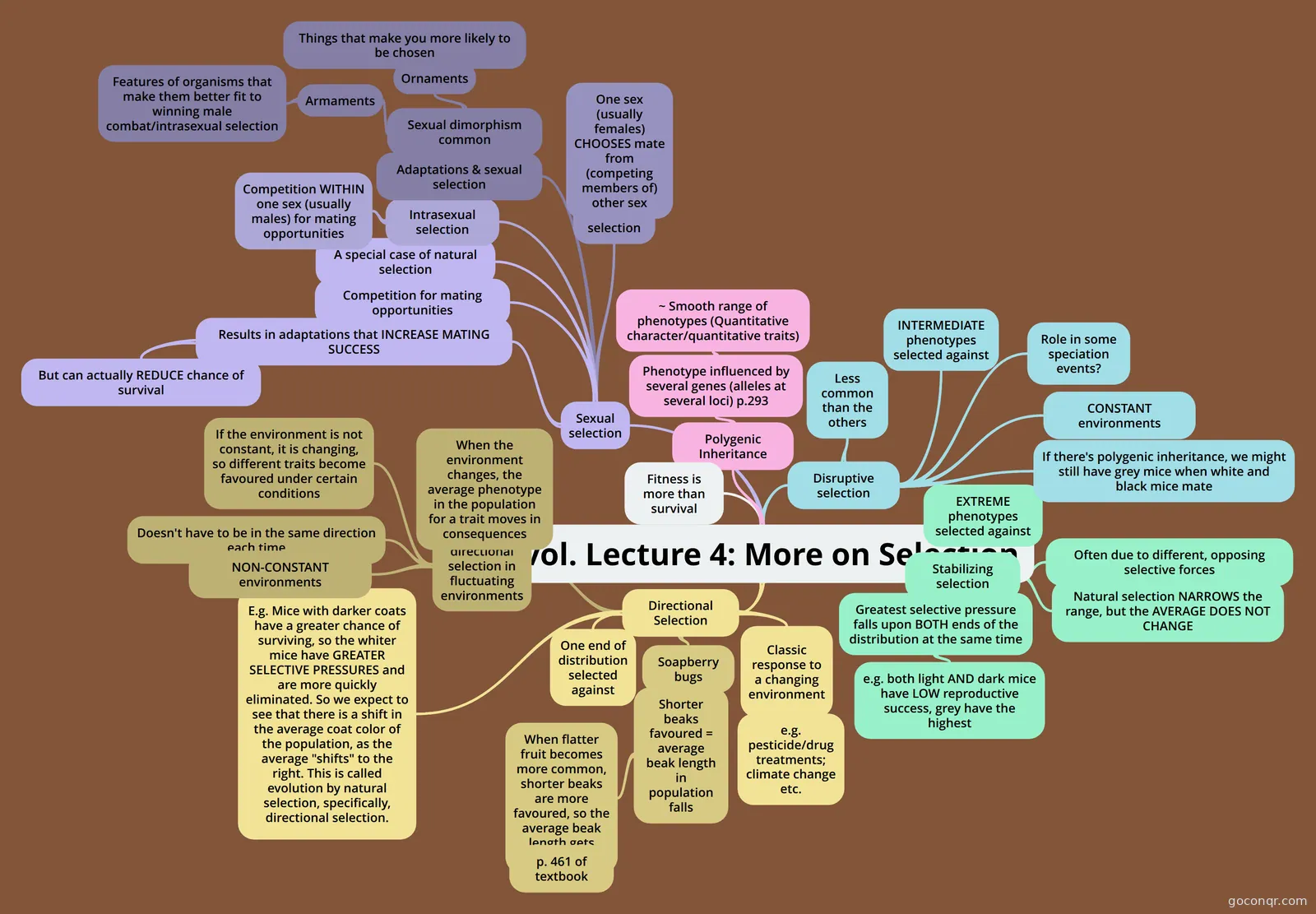
Mind map: More on selection
Map content
Evol. Lecture 4: More on Selection
Polygenic Inheritance
- Phenotype influenced by several genes (alleles at several loci) p.293
- ~ Smooth range of phenotypes (Quantitative character/quantitative traits)
- Phenotype influenced by several genes (alleles at several loci) p.293
Directional Selection
- One end of distribution selected against
- Classic response to a changing environment
- e.g. pesticide/drug treatments; climate change etc.
- E.g. Mice with darker coats have a greater chance of surviving, so the whiter mice have GREATER SELECTIVE PRESSURES and are more quickly eliminated. So we expect to see that there is a shift in the average coat color of the population, as the average "shifts" to the right. This is called evolution by natural selection, specifically, directional selection.
- Soapberry bugs
- Shorter beaks favoured = average beak length in population falls
- When flatter fruit becomes more common, shorter beaks are more favoured, so the average beak length gets shorter
- p. 461 of textbook
- When flatter fruit becomes more common, shorter beaks are more favoured, so the average beak length gets shorter
- Shorter beaks favoured = average beak length in population falls
- Oscillating directional selection in fluctuating environments
- When the environment changes, the average phenotype in the population for a trait moves in consequences
- If the environment is not constant, it is changing, so different traits become favoured under certain conditions
- Doesn't have to be in the same direction each time
- NON-CONSTANT environments
Stabilizing selection
- EXTREME phenotypes selected against
- Often due to different, opposing selective forces
- Greatest selective pressure falls upon BOTH ends of the distribution at the same time
- e.g. both light AND dark mice have LOW reproductive success, grey have the highest
- Natural selection NARROWS the range, but the AVERAGE DOES NOT CHANGE
Disruptive selection
- Less common than the others
- If there's polygenic inheritance, we might still have grey mice when white and black mice mate
- INTERMEDIATE phenotypes selected against
- Role in some speciation events?
- CONSTANT environments
Fitness is more than survival
Sexual selection
- A special case of natural selection
- Competition for mating opportunities
- Results in adaptations that INCREASE MATING SUCCESS
- But can actually REDUCE chance of survival
- Intrasexual selection
- Competition WITHIN one sex (usually males) for mating opportunities
- Intersexual selection
- One sex (usually females) CHOOSES mate from (competing members of) other sex
- Adaptations & sexual selection
- Sexual dimorphism common
- Armaments
- Features of organisms that make them better fit to winning male combat/intrasexual selection
- Ornaments
- Things that make you more likely to be chosen
- Armaments
- Sexual dimorphism common
Information
- Description
- Mind Map on Evol. Lecture 4: More on Selection, created by julia guk on 19/11/2014.
- Created by
- julia guk
- Views
- 21
- Rating