
Mind map
FOUNDATION OF DECISION MAKING
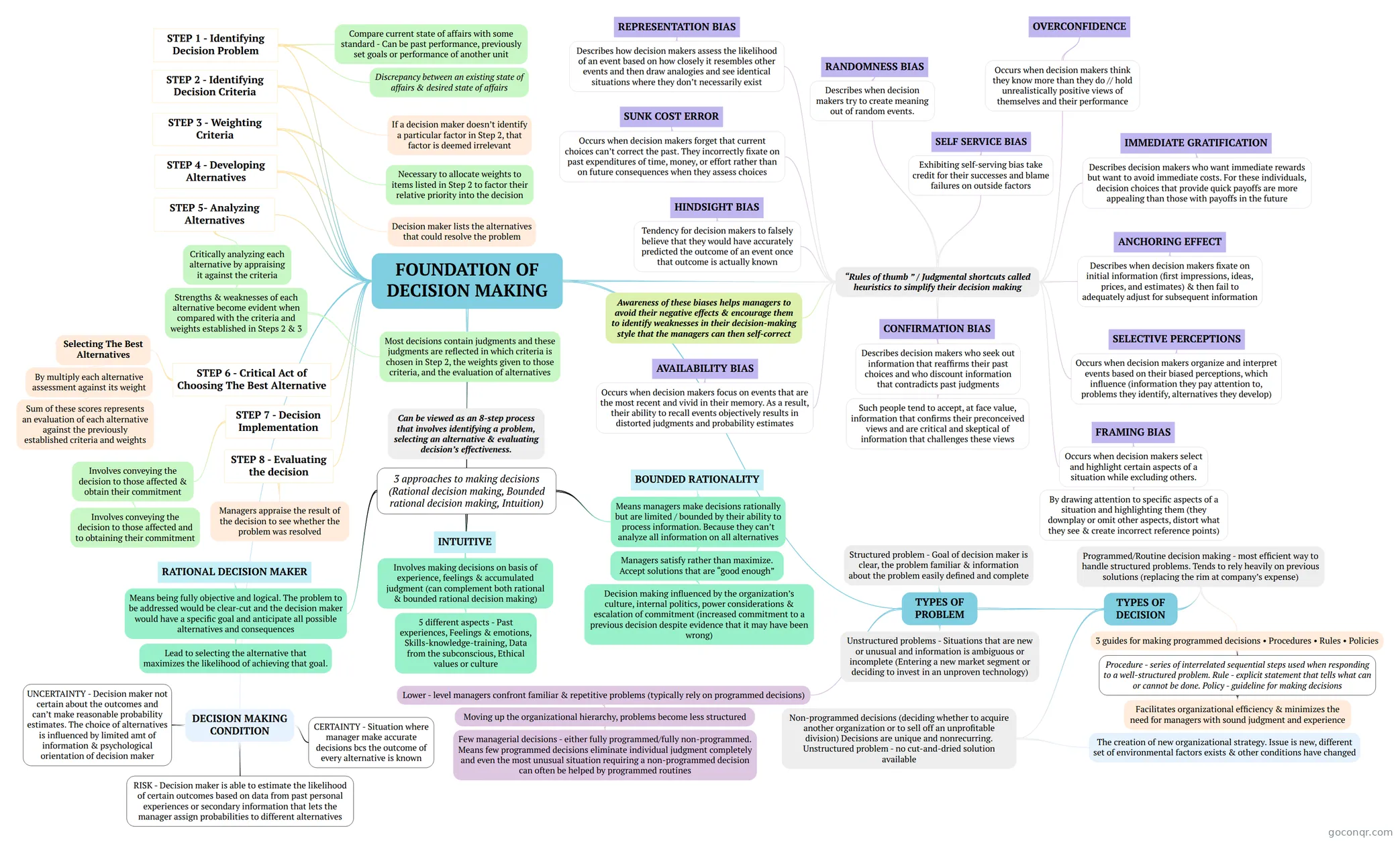
Mind map: Foundation of decision making
Map content
FOUNDATION OF DECISION MAKING
Can be viewed as an 8-step process that involves identifying a problem, selecting an alternative & evaluating decision’s effectiveness.
STEP 1 - Identifying Decision Problem
- Discrepancy between an existing state of affairs & desired state of affairs
- Compare current state of affairs with some standard - Can be past performance, previously set goals or performance of another unit
STEP 2 - Identifying Decision Criteria
- If a decision maker doesn’t identify a particular factor in Step 2, that factor is deemed irrelevant
STEP 3 - Weighting Criteria
- Necessary to allocate weights to items listed in Step 2 to factor their relative priority into the decision
STEP 4 - Developing Alternatives
- Decision maker lists the alternatives that could resolve the problem
STEP 5- Analyzing Alternatives
- Critically analyzing each alternative by appraising it against the criteria
- Strengths & weaknesses of each alternative become evident when compared with the criteria and weights established in Steps 2 & 3
- Most decisions contain judgments and these judgments are reflected in which criteria is chosen in Step 2, the weights given to those criteria, and the evaluation of alternatives
- Strengths & weaknesses of each alternative become evident when compared with the criteria and weights established in Steps 2 & 3
- Critically analyzing each alternative by appraising it against the criteria
STEP 6 - Critical Act of Choosing The Best Alternative
- Selecting The Best Alternatives
- By multiply each alternative assessment against its weight
- Sum of these scores represents an evaluation of each alternative against the previously established criteria and weights
- By multiply each alternative assessment against its weight
- Selecting The Best Alternatives
STEP 7 - Decision Implementation
- Involves conveying the decision to those affected & obtain their commitment
- Involves conveying the decision to those affected and to obtaining their commitment
- Involves conveying the decision to those affected & obtain their commitment
STEP 8 - Evaluating the decision
- Managers appraise the result of the decision to see whether the problem was resolved
“Rules of thumb ” / Judgmental shortcuts called heuristics to simplify their decision making
- Occurs when decision makers think they know more than they do // hold unrealistically positive views of themselves and their performance
- OVERCONFIDENCE
- Describes decision makers who want immediate rewards but want to avoid immediate costs. For these individuals, decision choices that provide quick payoffs are more appealing than those with payoffs in the future
- IMMEDIATE GRATIFICATION
- Describes when decision makers fixate on initial information (first impressions, ideas, prices, and estimates) & then fail to adequately adjust for subsequent information
- ANCHORING EFFECT
- Occurs when decision makers organize and interpret events based on their biased perceptions, which influence (information they pay attention to, problems they identify, alternatives they develop)
- SELECTIVE PERCEPTIONS
- Describes decision makers who seek out information that reaffirms their past choices and who discount information that contradicts past judgments
- Such people tend to accept, at face value, information that confirms their preconceived views and are critical and skeptical of information that challenges these views
- CONFIRMATION BIAS
- Occurs when decision makers select and highlight certain aspects of a situation while excluding others.
- FRAMING BIAS
- By drawing attention to specific aspects of a situation and highlighting them (they downplay or omit other aspects, distort what they see & create incorrect reference points)
- Occurs when decision makers focus on events that are the most recent and vivid in their memory. As a result, their ability to recall events objectively results in distorted judgments and probability estimates
- AVAILABILITY BIAS
- Describes how decision makers assess the likelihood of an event based on how closely it resembles other events and then draw analogies and see identical situations where they don’t necessarily exist
- REPRESENTATION BIAS
- Describes when decision makers try to create meaning out of random events.
- RANDOMNESS BIAS
- Occurs when decision makers forget that current choices can’t correct the past. They incorrectly fixate on past expenditures of time, money, or effort rather than on future consequences when they assess choices
- SUNK COST ERROR
- Exhibiting self-serving bias take credit for their successes and blame failures on outside factors
- SELF SERVICE BIAS
- Tendency for decision makers to falsely believe that they would have accurately predicted the outcome of an event once that outcome is actually known
- HINDSIGHT BIAS
- Awareness of these biases helps managers to avoid their negative effects & encourage them to identify weaknesses in their decision-making style that the managers can then self-correct
- Occurs when decision makers think they know more than they do // hold unrealistically positive views of themselves and their performance
3 approaches to making decisions (Rational decision making, Bounded rational decision making, Intuition)
- Means being fully objective and logical. The problem to be addressed would be clear-cut and the decision maker would have a specific goal and anticipate all possible alternatives and consequences
- Lead to selecting the alternative that maximizes the likelihood of achieving that goal.
- RATIONAL DECISION MAKER
- Means managers make decisions rationally but are limited / bounded by their ability to process information. Because they can’t analyze all information on all alternatives
- Managers satisfy rather than maximize. Accept solutions that are “good enough”
- Decision making influenced by the organization’s culture, internal politics, power considerations & escalation of commitment (increased commitment to a previous decision despite evidence that it may have been wrong)
- BOUNDED RATIONALITY
- Managers satisfy rather than maximize. Accept solutions that are “good enough”
- Involves making decisions on basis of experience, feelings & accumulated judgment (can complement both rational & bounded rational decision making)
- INTUITIVE
- 5 different aspects - Past experiences, Feelings & emotions, Skills-knowledge-training, Data from the subconscious, Ethical values or culture
- Means being fully objective and logical. The problem to be addressed would be clear-cut and the decision maker would have a specific goal and anticipate all possible alternatives and consequences
TYPES OF PROBLEM
- Structured problem - Goal of decision maker is clear, the problem familiar & information about the problem easily defined and complete
- Unstructured problems - Situations that are new or unusual and information is ambiguous or incomplete (Entering a new market segment or deciding to invest in an unproven technology)
- TYPES OF DECISION
- Programmed/Routine decision making - most efficient way to handle structured problems. Tends to rely heavily on previous solutions (replacing the rim at company’s expense)
- 3 guides for making programmed decisions • Procedures • Rules • Policies
- Procedure - series of interrelated sequential steps used when responding to a well-structured problem. Rule - explicit statement that tells what can or cannot be done. Policy - guideline for making decisions
- Facilitates organizational efficiency & minimizes the need for managers with sound judgment and experience
- Procedure - series of interrelated sequential steps used when responding to a well-structured problem. Rule - explicit statement that tells what can or cannot be done. Policy - guideline for making decisions
- 3 guides for making programmed decisions • Procedures • Rules • Policies
- Non-programmed decisions (deciding whether to acquire another organization or to sell off an unprofitable division) Decisions are unique and nonrecurring. Unstructured problem - no cut-and-dried solution available
- The creation of new organizational strategy. Issue is new, different set of environmental factors exists & other conditions have changed
- Programmed/Routine decision making - most efficient way to handle structured problems. Tends to rely heavily on previous solutions (replacing the rim at company’s expense)
- Lower - level managers confront familiar & repetitive problems (typically rely on programmed decisions)
- Moving up the organizational hierarchy, problems become less structured
- Few managerial decisions - either fully programmed/fully non-programmed. Means few programmed decisions eliminate individual judgment completely and even the most unusual situation requiring a non-programmed decision can often be helped by programmed routines
- Moving up the organizational hierarchy, problems become less structured
DECISION MAKING CONDITION
- CERTAINTY - Situation where manager make accurate decisions bcs the outcome of every alternative is known
- RISK - Decision maker is able to estimate the likelihood of certain outcomes based on data from past personal experiences or secondary information that lets the manager assign probabilities to different alternatives
- UNCERTAINTY - Decision maker not certain about the outcomes and can’t make reasonable probability estimates. The choice of alternatives is influenced by limited amt of information & psychological orientation of decision maker
Information
- Description
- Mind Map on FOUNDATION OF DECISION MAKING, created by Izzati Zakaria on 02/03/2019.
- Created by
- Izzati Zakaria
- Views
- 5
- Rating
More on Decision-Making Process