
Mind map
Differentiation overview year 12
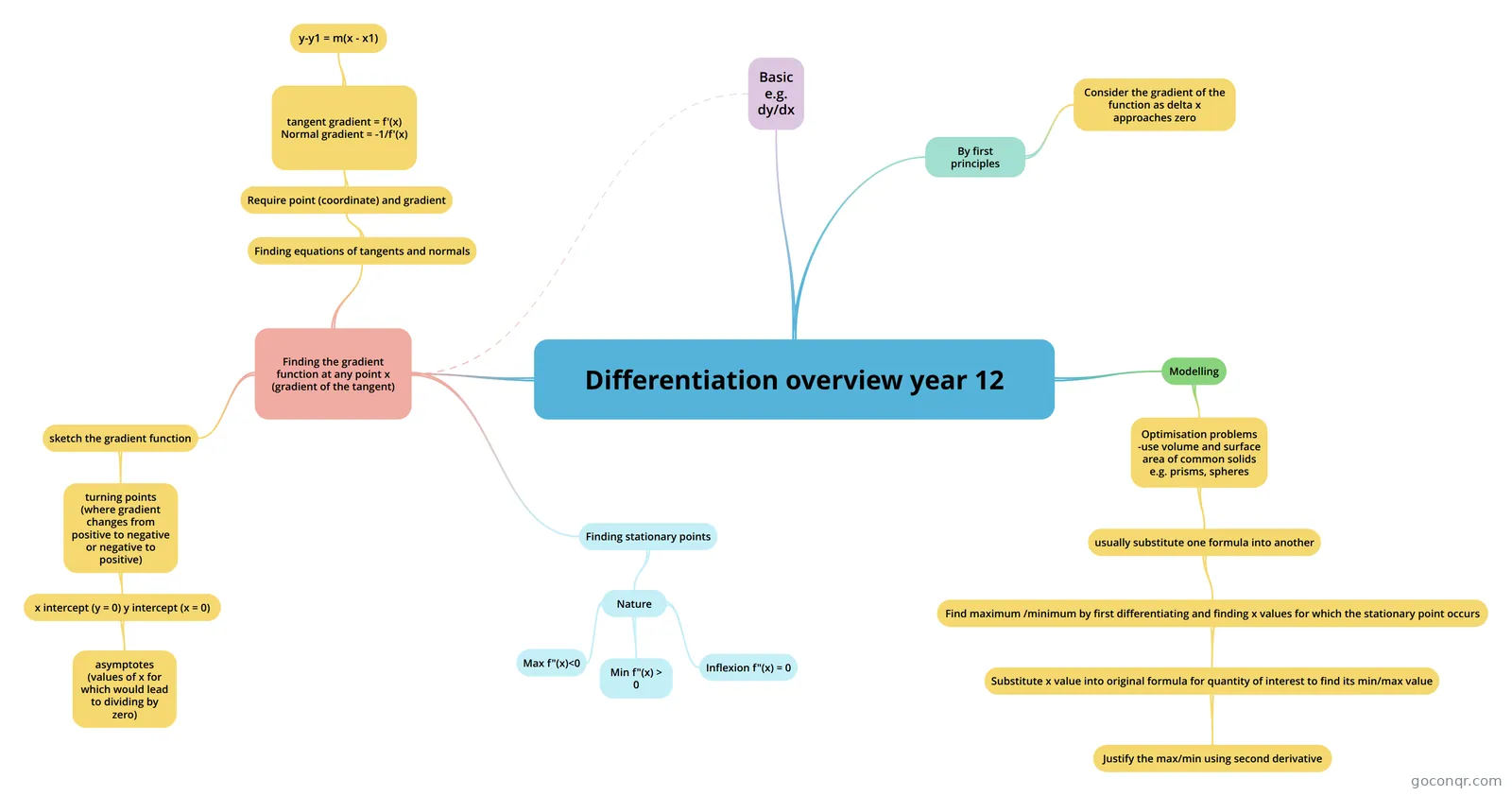
Mind map: Differentiation overview year 12
Map content
Differentiation overview year 12
Finding the gradient function at any point x (gradient of the tangent)
- Finding stationary points
- Nature
- Max f"(x)<0
- Min f"(x) > 0
- Inflexion f"(x) = 0
- Nature
- Finding equations of tangents and normals
- Require point (coordinate) and gradient
- tangent gradient = f'(x) Normal gradient = -1/f'(x)
- y-y1 = m(x - x1)
- tangent gradient = f'(x) Normal gradient = -1/f'(x)
- Require point (coordinate) and gradient
- sketch the gradient function
- turning points (where gradient changes from positive to negative or negative to positive)
- x intercept (y = 0) y intercept (x = 0)
- asymptotes (values of x for which would lead to dividing by zero)
- x intercept (y = 0) y intercept (x = 0)
- turning points (where gradient changes from positive to negative or negative to positive)
- Finding stationary points
Basic e.g. dy/dx
Modelling
- Optimisation problems -use volume and surface area of common solids e.g. prisms, spheres
- usually substitute one formula into another
- Find maximum /minimum by first differentiating and finding x values for which the stationary point occurs
- Substitute x value into original formula for quantity of interest to find its min/max value
- Justify the max/min using second derivative
- Substitute x value into original formula for quantity of interest to find its min/max value
- Find maximum /minimum by first differentiating and finding x values for which the stationary point occurs
- usually substitute one formula into another
- Optimisation problems -use volume and surface area of common solids e.g. prisms, spheres
By first principles
- Consider the gradient of the function as delta x approaches zero
Information
- Description
- Mind Map on Differentiation overview year 12, created by Paul McDonagh on 15/03/2019.
- Created by
- Paul McDonagh
- Views
- 50
- Rating