
Mind map
Evolutionary Biology "Individuals vary, populations evolve"
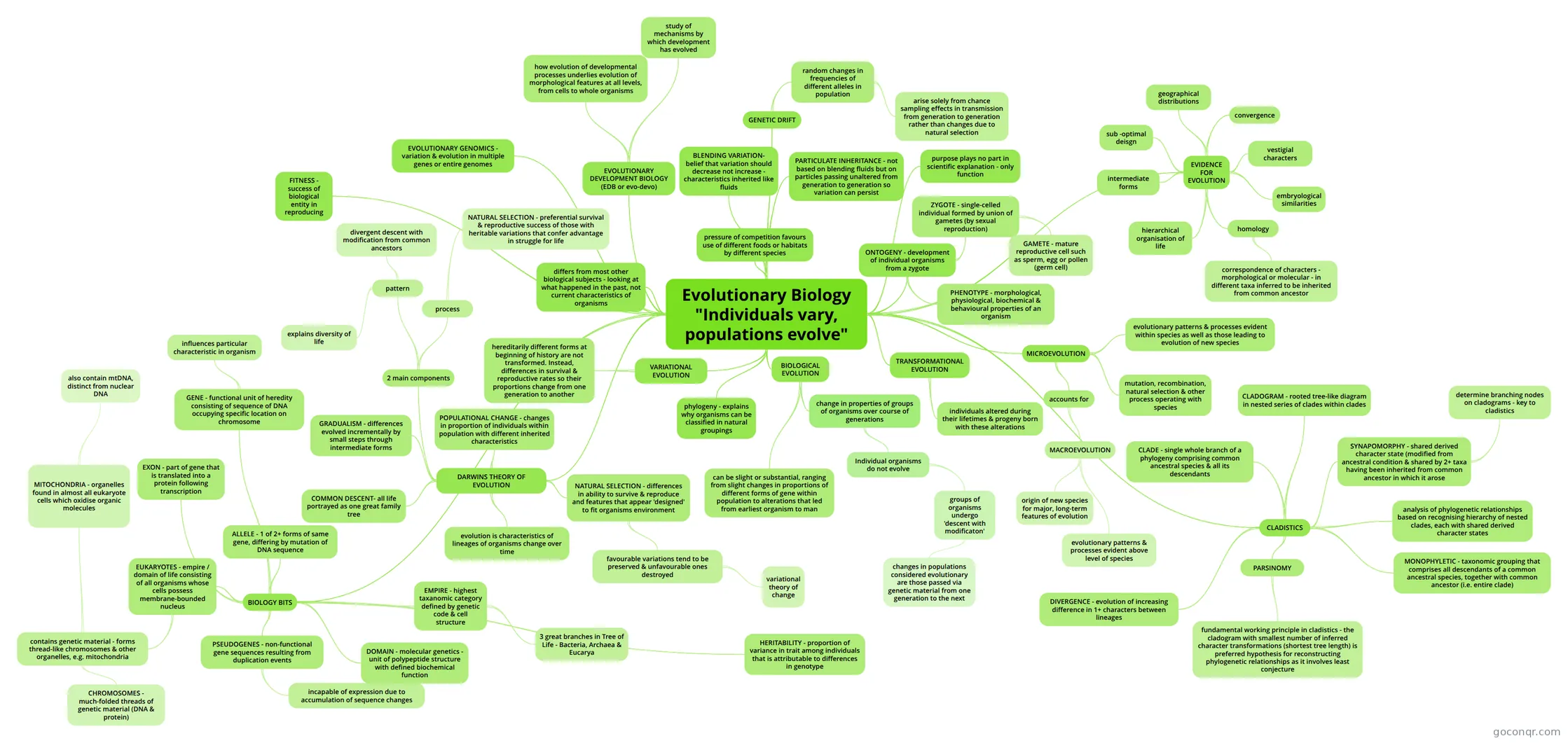
Mind map: Evolutionary Biology: Individuals Vary Populations Evolve
Map content
Evolutionary Biology "Individuals vary, populations evolve"
BIOLOGICAL EVOLUTION
- change in properties of groups of organisms over course of generations
- Individual organisms do not evolve
- groups of organisms undergo 'descent with modificaton'
- changes in populations considered evolutionary are those passed via genetic material from one generation to the next
- groups of organisms undergo 'descent with modificaton'
- Individual organisms do not evolve
- can be slight or substantial, ranging from slight changes in proportions of different forms of gene within population to alterations that led from earliest organism to man
- change in properties of groups of organisms over course of generations
TRANSFORMATIONAL EVOLUTION
- individuals altered during their lifetimes & progeny born with these alterations
VARIATIONAL EVOLUTION
- hereditarily different forms at beginning of history are not transformed. Instead, differences in survival & reproductive rates so their proportions change from one generation to another
differs from most other biological subjects - looking at what happened in the past, not current characteristics of organisms
ONTOGENY - development of individual organisms from a zygote
- ZYGOTE - single-celled individual formed by union of gametes (by sexual reproduction)
- GAMETE - mature reproductive cell such as sperm, egg or pollen (germ cell)
- PHENOTYPE - morphological, physiological, biochemical & behavioural properties of an organism
- ZYGOTE - single-celled individual formed by union of gametes (by sexual reproduction)
DARWINS THEORY OF EVOLUTION
- evolution is characteristics of lineages of organisms change over time
- COMMON DESCENT- all life portrayed as one great family tree
- GRADUALISM - differences evolved incrementally by small steps through intermediate forms
- POPULATIONAL CHANGE - changes in proportion of individuals within population with different inherited characteristics
- NATURAL SELECTION - differences in ability to survive & reproduce and features that appear 'designed' to fit organisms environment
- favourable variations tend to be preserved & unfavourable ones destroyed
- variational theory of change
- favourable variations tend to be preserved & unfavourable ones destroyed
- 2 main components
- pattern
- divergent descent with modification from common ancestors
- explains diversity of life
- process
- NATURAL SELECTION - preferential survival & reproductive success of those with heritable variations that confer advantage in struggle for life
- pattern
pressure of competition favours use of different foods or habitats by different species
PARTICULATE INHERITANCE - not based on blending fluids but on particles passing unaltered from generation to generation so variation can persist
BLENDING VARIATION- belief that variation should decrease not increase - characteristics inherited like fluids
phylogeny - explains why organisms can be classified in natural groupings
MICROEVOLUTION
- mutation, recombination, natural selection & other process operating with species
- accounts for
- MACROEVOLUTION
- origin of new species for major, long-term features of evolution
- evolutionary patterns & processes evident above level of species
- MACROEVOLUTION
- evolutionary patterns & processes evident within species as well as those leading to evolution of new species
EVOLUTIONARY GENOMICS - variation & evolution in multiple genes or entire genomes
EVOLUTIONARY DEVELOPMENT BIOLOGY (EDB or evo-devo)
- how evolution of developmental processes underlies evolution of morphological features at all levels, from cells to whole organisms
- study of mechanisms by which development has evolved
GENETIC DRIFT
- random changes in frequencies of different alleles in population
- arise solely from chance sampling effects in transmission from generation to generation rather than changes due to natural selection
- random changes in frequencies of different alleles in population
purpose plays no part in scientific explanation - only function
EVIDENCE FOR EVOLUTION
- hierarchical organisation of life
- homology
- correspondence of characters - morphological or molecular - in different taxa inferred to be inherited from common ancestor
- embryological similarities
- vestigial characters
- convergence
- sub -optimal deisgn
- geographical distributions
- intermediate forms
CLADISTICS
- analysis of phylogenetic relationships based on recognising hierarchy of nested clades, each with shared derived character states
- CLADOGRAM - rooted tree-like diagram in nested series of clades within clades
- CLADE - single whole branch of a phylogeny comprising common ancestral species & all its descendants
- MONOPHYLETIC - taxonomic grouping that comprises all descendants of a common ancestral species, together with common ancestor (i.e. entire clade)
- SYNAPOMORPHY - shared derived character state (modified from ancestral condition & shared by 2+ taxa having been inherited from common ancestor in which it arose
- determine branching nodes on cladograms - key to cladistics
- PARSINOMY
- fundamental working principle in cladistics - the cladogram with smallest number of inferred character transformations (shortest tree length) is preferred hypothesis for reconstructing phylogenetic relationships as it involves least conjecture
- DIVERGENCE - evolution of increasing difference in 1+ characters between lineages
BIOLOGY BITS
- PSEUDOGENES - non-functional gene sequences resulting from duplication events
- incapable of expression due to accumulation of sequence changes
- EUKARYOTES - empire / domain of life consisting of all organisms whose cells possess membrane-bounded nucleus
- contains genetic material - forms thread-like chromosomes & other organelles, e.g. mitochondria
- CHROMOSOMES - much-folded threads of genetic material (DNA & protein)
- MITOCHONDRIA - organelles found in almost all eukaryote cells which oxidise organic molecules
- also contain mtDNA, distinct from nuclear DNA
- contains genetic material - forms thread-like chromosomes & other organelles, e.g. mitochondria
- ALLELE - 1 of 2+ forms of same gene, differing by mutation of DNA sequence
- DOMAIN - molecular genetics - unit of polypeptide structure with defined biochemical function
- EXON - part of gene that is translated into a protein following transcription
- EMPIRE - highest taxanomic category defined by genetic code & cell structure
- 3 great branches in Tree of Life - Bacteria, Archaea & Eucarya
- GENE - functional unit of heredity consisting of sequence of DNA occupying specific location on chromosome
- influences particular characteristic in organism
- HERITABILITY - proportion of variance in trait among individuals that is attributable to differences in genotype
- PSEUDOGENES - non-functional gene sequences resulting from duplication events
FITNESS - success of biological entity in reproducing
Information
- Description
- Mind Map on Evolutionary Biology "Individuals vary, populations evolve", created by tomking304 on 26/08/2013.
- Created by
- tomking304
- Views
- 42
- Rating