
Mind map
Traditional Marxism
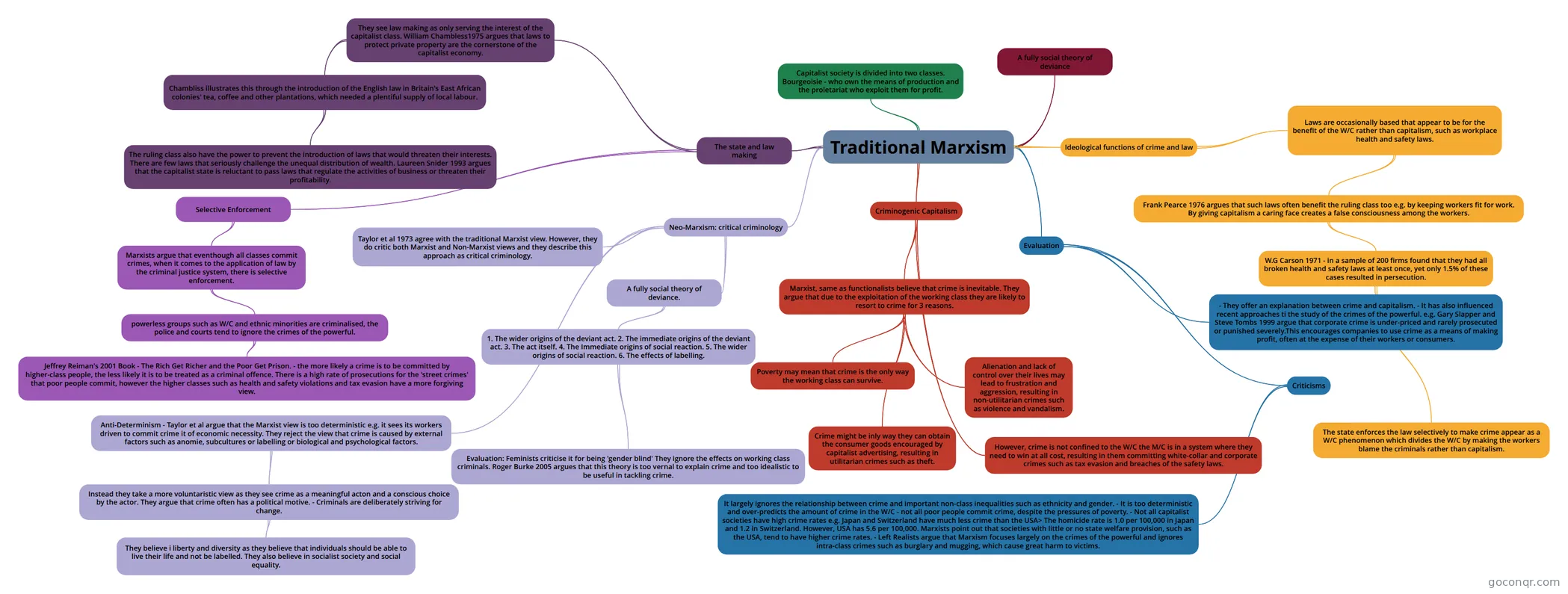
Mind map: Traditional Marxism
Map content
Traditional Marxism
Capitalist society is divided into two classes. Bourgeoisie - who own the means of production and the proletariat who exploit them for profit.
Criminogenic Capitalism
- Marxist, same as functionalists believe that crime is inevitable. They argue that due to the exploitation of the working class they are likely to resort to crime for 3 reasons.
- Poverty may mean that crime is the only way the working class can survive.
- Crime might be inly way they can obtain the consumer goods encouraged by capitalist advertising, resulting in utilitarian crimes such as theft.
- Alienation and lack of control over their lives may lead to frustration and aggression, resulting in non-utilitarian crimes such as violence and vandalism.
- However, crime is not confined to the W/C the M/C is in a system where they need to win at all cost, resulting in them committing white-collar and corporate crimes such as tax evasion and breaches of the safety laws.
- Marxist, same as functionalists believe that crime is inevitable. They argue that due to the exploitation of the working class they are likely to resort to crime for 3 reasons.
The state and law making
- They see law making as only serving the interest of the capitalist class. William Chambless1975 argues that laws to protect private property are the cornerstone of the capitalist economy.
- Chambliss illustrates this through the introduction of the English law in Britain's East African colonies' tea, coffee and other plantations, which needed a plentiful supply of local labour.
- The ruling class also have the power to prevent the introduction of laws that would threaten their interests. There are few laws that seriously challenge the unequal distribution of wealth. Laureen Snider 1993 argues that the capitalist state is reluctant to pass laws that regulate the activities of business or threaten their profitability.
- Chambliss illustrates this through the introduction of the English law in Britain's East African colonies' tea, coffee and other plantations, which needed a plentiful supply of local labour.
- Selective Enforcement
- Marxists argue that eventhough all classes commit crimes, when it comes to the application of law by the criminal justice system, there is selective enforcement.
- powerless groups such as W/C and ethnic minorities are criminalised, the police and courts tend to ignore the crimes of the powerful.
- Jeffrey Reiman's 2001 Book - The Rich Get Richer and the Poor Get Prison. - the more likely a crime is to be committed by higher-class people, the less likely it is to be treated as a criminal offence. There is a high rate of prosecutions for the 'street crimes' that poor people commit, however the higher classes such as health and safety violations and tax evasion have a more forgiving view.
- powerless groups such as W/C and ethnic minorities are criminalised, the police and courts tend to ignore the crimes of the powerful.
- Marxists argue that eventhough all classes commit crimes, when it comes to the application of law by the criminal justice system, there is selective enforcement.
- They see law making as only serving the interest of the capitalist class. William Chambless1975 argues that laws to protect private property are the cornerstone of the capitalist economy.
Ideological functions of crime and law
- Laws are occasionally based that appear to be for the benefit of the W/C rather than capitalism, such as workplace health and safety laws.
- Frank Pearce 1976 argues that such laws often benefit the ruling class too e.g. by keeping workers fit for work. By giving capitalism a caring face creates a false consciousness among the workers.
- W.G Carson 1971 - in a sample of 200 firms found that they had all broken health and safety laws at least once, yet only 1.5% of these cases resulted in persecution.
- The state enforces the law selectively to make crime appear as a W/C phenomenon which divides the W/C by making the workers blame the criminals rather than capitalism.
- W.G Carson 1971 - in a sample of 200 firms found that they had all broken health and safety laws at least once, yet only 1.5% of these cases resulted in persecution.
- Frank Pearce 1976 argues that such laws often benefit the ruling class too e.g. by keeping workers fit for work. By giving capitalism a caring face creates a false consciousness among the workers.
- Laws are occasionally based that appear to be for the benefit of the W/C rather than capitalism, such as workplace health and safety laws.
Evaluation
- - They offer an explanation between crime and capitalism. - It has also influenced recent approaches ti the study of the crimes of the powerful. e.g. Gary Slapper and Steve Tombs 1999 argue that corporate crime is under-priced and rarely prosecuted or punished severely.This encourages companies to use crime as a means of making profit, often at the expense of their workers or consumers.
- Criticisms
- It largely ignores the relationship between crime and important non-class inequalities such as ethnicity and gender. - It is too deterministic and over-predicts the amount of crime in the W/C - not all poor people commit crime, despite the pressures of poverty. - Not all capitalist societies have high crime rates e.g. Japan and Switzerland have much less crime than the USA> The homicide rate is 1.0 per 100,000 in Japan and 1.2 in Switzerland. However, USA has 5.6 per 100,000. Marxists point out that societies with little or no state welfare provision, such as the USA, tend to have higher crime rates. - Left Realists argue that Marxism focuses largely on the crimes of the powerful and ignores intra-class crimes such as burglary and mugging, which cause great harm to victims.
Neo-Marxism: critical criminology
- Taylor et al 1973 agree with the traditional Marxist view. However, they do critic both Marxist and Non-Marxist views and they describe this approach as critical criminology.
- Anti-Determinism - Taylor et al argue that the Marxist view is too deterministic e.g. it sees its workers driven to commit crime it of economic necessity. They reject the view that crime is caused by external factors such as anomie, subcultures or labelling or biological and psychological factors.
- Instead they take a more voluntaristic view as they see crime as a meaningful acton and a conscious choice by the actor. They argue that crime often has a political motive. - Criminals are deliberately striving for change.
- They believe i liberty and diversity as they believe that individuals should be able to live their life and not be labelled. They also believe in socialist society and social equality.
- Instead they take a more voluntaristic view as they see crime as a meaningful acton and a conscious choice by the actor. They argue that crime often has a political motive. - Criminals are deliberately striving for change.
- A fully social theory of deviance.
- 1. The wider origins of the deviant act. 2. The immediate origins of the deviant act. 3. The act itself. 4. The Immediate origins of social reaction. 5. The wider origins of social reaction. 6. The effects of labelling.
- Evaluation: Feminists criticise it for being 'gender blind' They ignore the effects on working class criminals. Roger Burke 2005 argues that this theory is too vernal to explain crime and too idealistic to be useful in tackling crime.
- 1. The wider origins of the deviant act. 2. The immediate origins of the deviant act. 3. The act itself. 4. The Immediate origins of social reaction. 5. The wider origins of social reaction. 6. The effects of labelling.
A fully social theory of deviance
Information
- Description
- Mind Map on Traditional Marxism, created by Natassia Brown on 15/12/2014.
- Created by
- Natassia Brown
- Views
- 6
- Rating
More on Marxist theories of crime