
17979560


Market Segmentation
- Definition
- Dividing a market into distinct groups of buyers with different needs, characteristics
or behaviour who might require separate products or marketing mixes.
- Dividing a market into distinct groups of buyers with different needs, characteristics
or behaviour who might require separate products or marketing mixes.
- Benefits of Segmentation
- Resources
- Uses Finite Marketing Resources more Effectively
- Uses Finite Marketing Resources more Effectively
- Information
- May highlight Potential gaps in the
Market that can be Exploited
- May highlight Potential gaps in the
Market that can be Exploited
- Customer Needs
- Highlighting Segments based on Customer
Needs allows for them to be Better met
- Highlighting Segments based on Customer
Needs allows for them to be Better met
- Resources
- Basis For Segmentation
- Behavioural
- Benefits Sought, Usage Rate (80:20),
Loyalty, Attitude or Ocassions
- Benefits Sought, Usage Rate (80:20),
Loyalty, Attitude or Ocassions
- Demographic
- Age, Gender, Family Size &
Life Cycle, Income,
Occupation/Education, Race,
Nationality or Religion
- Age, Gender, Family Size &
Life Cycle, Income,
Occupation/Education, Race,
Nationality or Religion
- Geographic
- Nations, Regions, Cities
& Neighbourhoods
- Nations, Regions, Cities
& Neighbourhoods
- Psychographic
- Lifestyle & Personality
- Lifestyle & Personality
- Multivariable
- Combination of other Variables,
E.g, Geodemograpic
- Combination of other Variables,
E.g, Geodemograpic
- Behavioural
- Criteria for Successful Segmentation
- Distinctiveness
- Segments must be Different fromm
Eachother. Customers within segment
should be Homogenous
- Segments must be Different fromm
Eachother. Customers within segment
should be Homogenous
- Measurability
- Segmenting Variable must be
Measurable (E.g, Age) As should the
SIze / Purchasing Power of Segment
- Segmenting Variable must be
Measurable (E.g, Age) As should the
SIze / Purchasing Power of Segment
- Accessibility
- Segment can be Reached &
Served. Promotional
Techniques should be CLear
- Segment can be Reached &
Served. Promotional
Techniques should be CLear
- Actionability
- Company must have the
Resources to Exploit the
Opportunities in the Segment
- Company must have the
Resources to Exploit the
Opportunities in the Segment
- Profitibility
- Segments must be Large
enough to serve. Technology
helps 'Micro-Segments' exist
- Segments must be Large
enough to serve. Technology
helps 'Micro-Segments' exist
- Distinctiveness
- Market Positioning
- Successfully Positioning
- Chosen Competitive Advantage / Segment must have:
Clarity, Consistency, Credibility & Competitiveness
- Chosen Competitive Advantage / Segment must have:
Clarity, Consistency, Credibility & Competitiveness
- Developing a Strategy
- Identify Possible Competitive
Advantages, Select Appropriate
CA then Effectively Communicate
Position to Market
- Identify Possible Competitive
Advantages, Select Appropriate
CA then Effectively Communicate
Position to Market
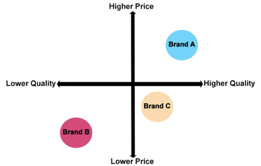
- Perceptual Mapping
- Identify Competitors, Chosen
Attributes & Plot where Consumers
view the Company
- Identify Competitors, Chosen
Attributes & Plot where Consumers
view the Company
- Successfully Positioning
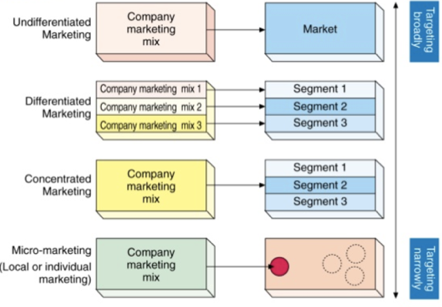
- Market Tagetting
- Customised / Micro-Marketing
- Customers Have Sufficient
Purchasing Power & Unique
Characteristics. Discrete Marketing
Mix for Individual Customer
- Technological Advancements Key to
Strategy. Common in Industrial
Market (Airplane Manufatcuring)
- Customers Have Sufficient
Purchasing Power & Unique
Characteristics. Discrete Marketing
Mix for Individual Customer
- Concentrated Marketing
- Arguably more Efficient as Company Devoted to only One Segment
- Adopting One Marketing Mix to Target One Segment.
Ideal for Companies with Limited Resources
- Arguably more Efficient as Company Devoted to only One Segment
- Differentiated Marketing
- Exploits Differences between Segments by Developing
Specific Marketing Mixes for Each Segment
- Can result in a Break-Down in Economies of Scale. Used in Car Industry
- Exploits Differences between Segments by Developing
Specific Marketing Mixes for Each Segment
- Undifferentiated Marketing
- Absence of Segmentation. No pronounced
differences in Consumer Characteristics
- Least Costly as only One Marketing
Mix needs to be Developed
- Absence of Segmentation. No pronounced
differences in Consumer Characteristics
- Customised / Micro-Marketing
Media attachments
Want to create your own Mind Maps for free with GoConqr? Learn more.