
Mind map
Inventions with offenders
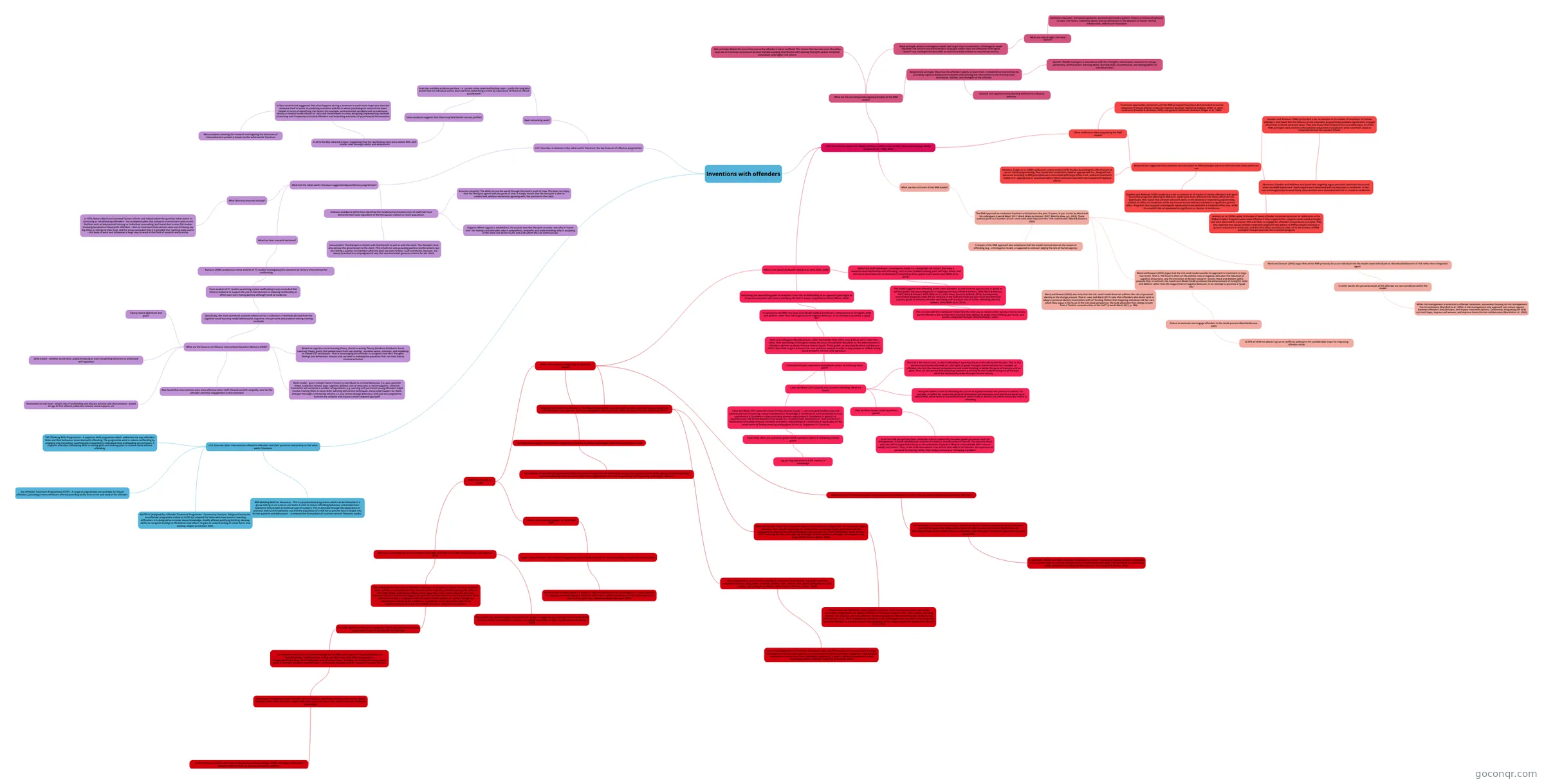
Mind map: Inventions with offenders
Map content
Inventions with offenders
LO1: Describe, in relation to the ‘what works’ literature, the key features of effective programmes
- Does sentencing work?
- Does the available evidence we have, i.e. current crime rates/reoffending rates – justify the long held beliefs that an individual will be deterred from committing a crime by experience of threat of official punishment?
- Some evidence suggests that these long held beliefs are not justified
- In 2016 the MoJ released a report suggesting that the reoffending rates were almost 30%, with similar rates amongst adults and adolescents
- In fact research has suggested that what happens during a sentence is much more important than the sentence itself in terms of predicting outcomes and this is where psychological research has been helpful in terms of identifying risk factors (for example, environmental variables such as substance misuse or mental health issues) for recurrent involvement in crime, designing/implementing methods of working with frequently convicted offenders and evaluating outcomes of psychosocial interventions
- Meta-analyses examing the research investigating the outcomes of interventions in prisons is known as the 'what works' literature
- In fact research has suggested that what happens during a sentence is much more important than the sentence itself in terms of predicting outcomes and this is where psychological research has been helpful in terms of identifying risk factors (for example, environmental variables such as substance misuse or mental health issues) for recurrent involvement in crime, designing/implementing methods of working with frequently convicted offenders and evaluating outcomes of psychosocial interventions
- In 2016 the MoJ released a report suggesting that the reoffending rates were almost 30%, with similar rates amongst adults and adolescents
- Some evidence suggests that these long held beliefs are not justified
- Does the available evidence we have, i.e. current crime rates/reoffending rates – justify the long held beliefs that an individual will be deterred from committing a crime by experience of threat of official punishment?
- What has the 'what works' literature suggested about effective programmes?
- What did early research indicate?
- In 1974, Robert Martinson reviewed “prison reform’ and indeed asked the question ‘what works’ in correcting or rehabilitating offenders – he reviewed studies that looked at interventions used across facilities such as ‘educational training’ or ‘individual counselling’ and found that in over 200 studies involving hundreds of thousands offenders – that no treatment/intervention came out as having any big effect or change to their lives, and his essay concluded that it Is possible that ‘nothing really works’ – this body of work and influenced a huge step forward in this field of research and practice.
- What has later research indicated?
- McGuire (2008) conducted a meta analysis of 75 studies investigating the outcomes of tertiary interventions for reoffending
- From analysis of 11 studies examining violent reoffending it was concluded that there is evidence to support the use of interventions in reducing reoffending as effect sizes were mostly positive although small to moderate
- Specifically, the most consistent outcome effects are for a collection of methods derived from the cognitive social learning model (behavioural, cognitive, interpersonal and problem-solving training methods)
- What are the features of effective interventions based on McGuire (2008)?
- Clearly stated objectives and goals
- Skills-based – whether social skills, problem-solving or even recognising emotions or emotional self-regulation
- Based on cognitive social learning theory, (Social Learning Theory (Bandura) Bandura's Social Learning Theory posits that people learn from one another, via observation, imitation, and modeling) or indeed CBT techniques – that is encouraging the offender to recognise how their thoughts, feelings and behaviours interact and can lead to maladaptive processes that can then lead to criminal activities
- Multi-modal – given multiple factors known to contribute to criminal behaviour (i.e. poor parental rships, substance misuse, poor cognitive abilities, lack of resources or social support) – effective treatments will comprise a number of ingredients, e.g. working with persistent young offenders might involve training them In social skills, learning self-control techniques and provide support for these changes thorough a mentoring scheme. I.e. you cannot change behaviour with just one programme, humans are complex and require a multi targeted approach
- Assessment of risk level – assess risk of reoffending and allocate services and interventions – based on age at first offence, substance misuse, social support, etc
- Also found that interventions were more effective when staff showed warmth, empathy, care for the offender and their engagement in the treatment
- What are the features of effective interventions based on McGuire (2008)?
- Specifically, the most consistent outcome effects are for a collection of methods derived from the cognitive social learning model (behavioural, cognitive, interpersonal and problem-solving training methods)
- From analysis of 11 studies examining violent reoffending it was concluded that there is evidence to support the use of interventions in reducing reoffending as effect sizes were mostly positive although small to moderate
- McGuire (2008) conducted a meta analysis of 75 studies investigating the outcomes of tertiary interventions for reoffending
- Andrews and Bonta (2010) have identified the fundamental characteristics of staff that have demonstrated value regardless of the therapeutic context or client population.
- Accurate empathy: The ability to see the world through the client’s point of view. This does not imply that the therapist agrees with the point of view. It simply means that the therapist is able to understand, without necessarily agreeing with, the position of the client.
- Genuineness: The therapist is honest with him/herself as well as with the client. The therapist must also convey this genuineness to the client. This entails not only providing positive reinforcement, but also telling a woman in treatment what she does not want to hear. Such comments, however, are always provided in a nonjudgmental way that communicates genuine concern for the client.
- Rapport: When rapport is established, the woman sees the therapist as some- one who is “tuned into” her feelings and attitudes; who is sympathetic, empathic and understanding; who is accepting of the client and all her faults; and with whom she can communicate.
- What did early research indicate?
- Does sentencing work?
LO2: Describe the Good Lives Model and how it differs from the Risk, Need, Responsivity Model (Andrews et al., 1990; 2006)
- What are the core empirically based principles of the RNR model?
- Risk principle: Match the level of service to the offender’s risk to reoffend. This means that low-risk cases should be kept out of intensive correctional services thereby avoiding interference with existing strengths and/or increased association with higher risk others.
- Need principle: Assess criminogenic needs and target them in treatment. Criminogenic needs (dynamic risk factors) are characteristics of people and/or their circumstances that signal reward–cost contingencies favorable to criminal activity relative to noncriminal activity.
- What are central eight risk need factors?
- antisocial associates, antisocial cognitions, antisocial personality pattern, history of antisocial behavior (a static risk factor), substance abuse, and circumstances in the domains of family–marital, school–work, and leisure–recreation
- What are central eight risk need factors?
- Responsivity principle: Maximize the offender’s ability to learn from a rehabilitative intervention by providing cognitive behavioral treatment and tailoring the intervention to the learning style, motivation, abilities, and strengths of the offender.
- General: Use cognitive social learning methods to influence behavior.
- Specific: Modify strategies in accordance with the strengths, motivations, readiness to change, personality, mental status, learning ability, learning style, circumstances, and demographics of individual cases.
- What evidence is there supporting the RNR model?
- Treatment approaches consistent with the RNR principles have been demonstrated to lead to reductions in sexual offense recidivism (Hanson, Bourgon, Helmus & Hodgins, 2009), vi- olent recidivism (Dowden & Andrews, 2000), and general recidivism (Andrews, Zinger et al., 1990).
- Research has suggested that treatment services based on RNR principles are more effective than those which are not
- Andrews, Zinger et al. (1990) conducted a meta-analysis of 80 studies examining the effectiveness of correc- tional programming. They found that treatments coded as appropriate (i.e., designed and delivered according to RNR principles) were associated with larger effect sizes, whereas treatments coded as in- appropriate or associated with criminal sanctions were both associated with negative effects.
- Dowden and Andrews (1999) performed a me- ta-analysis on 25 studies of treatment for female offenders, and found that the delivery of any treatment programming yielded a significantly stronger effect than criminal sanctions alone. They also found that treatment services adhering to all of the RNR principles were related to the greatest reductions in recidivism, while treatment rated as inappropriate had the weakest effects.
- Moreover, Dowden and Andrews also found that targeting vague personal/ emotional issues and other non-RNR based treat- ment targets were associated with no reduction in recidivism. In fact, non-criminogenically focused family interventions were associated with an in- crease in recidivism.
- Dowden and Andrews (2000) conducted a me- ta-analysis of 35 studies of violent offenders and again found that programs adhering to RNR prin- ciples were more effective than those which did not. Specifically, they found that criminal sanctions alone, in the absence of treatment programming, yielded no effect on recidivism, while any human service delivery resulted in a significant positive effect. Programs that targeted criminogenic needs were associated with a moderate effect size, while those which did not produced no significant re- duction in recidivism.
- Hanson, et al. (2009) coded 23 studies of sexual offender treatment outcome for adherence to the RNR principles. Programs were more effective if they targeted crim- inogenic needs (need principle) and were delivered in a manner that was likely to engage the offenders (responsivity principle). They also reported that sexual offender treatment programs that adhere to RNR principles resulted in greater reductions in recidivism, and that this effect was linearly relat- ed to the number of RNR principles incorporated into the treatment program
- What are the criticisms of the RNR model?
- The RNR approach to treatment has been criticized over the past 10 years, in par- ticular by Ward and his colleagues (Laws & Ward, 2011; Ward, Mann & Gannon, 2007; Ward & Stew- art, 2003). These authors point to a number of con- cerns with what they term the “risk-need model” (Ward & Stewart, 2003)
- Ward and Stewart (2003) argue that as the RNR primarily focus on individual risk the model views individuals as 'disembodied bearers of risk rather than integrated agent'
- In other words, the personal needs of the offender are not considered within the model
- While risk management is essential to offender treatment, exclusively focusing on risk management has its limitations (Marshall et al., 2005). A risk management only approach can reduce rapport between offenders and clinicians, and impact treatment delivery. Conversely, integrating the GLM can instil hope, improve self-esteem, and improve client-clinician collaboration (Marshall et al., 2005).
- In other words, the personal needs of the offender are not considered within the model
- Ward and Stewart (2003) argue that the risk-need model couches its approach to treatment in nega- tive terms. That is, the focus is often on the elimina- tion of negative attitudes, the reduction of cognitive distortions, and the extinction of deviant sexual in- terests. Ward and Stewart (2003) propose that, in contrast, the Good Lives Model (GLM) promotes the enhancement of strengths, skills and abilities rather than the suppression of negative behavior, in an attempt to promote a “good life.”
- Failure to motivate and engage offenders in the rehab process (Ward & Maruna, 2007)
- 12-50% of child sex abusers go on to reoffend, underpins the considerable scope for improving offender rehab
- Failure to motivate and engage offenders in the rehab process (Ward & Maruna, 2007)
- Ward and Stewart (2003) also note that the risk- need model does not address the role of personal identity in the change process. That is, Laws and Ward (2011) note that offenders who desist tend to adopt a personal identity inconsistent with of- fending. Rather than targeting individual risk fac- tors, which they argue is the focus of the risk-need perspective, the GLM advocates that change results from a “holistic reconstruction of the ‘self’” (Laws & Ward, 2011, p. 189).
- Critiques of the RNR approach also emphasize that the model concentrates on the causes of offending (e.g., criminogenic needs), as opposed to acknowl- edging the role of human agency.
- Ward and Stewart (2003) argue that as the RNR primarily focus on individual risk the model views individuals as 'disembodied bearers of risk rather than integrated agent'
- The RNR approach to treatment has been criticized over the past 10 years, in par- ticular by Ward and his colleagues (Laws & Ward, 2011; Ward, Mann & Gannon, 2007; Ward & Stew- art, 2003). These authors point to a number of con- cerns with what they term the “risk-need model” (Ward & Stewart, 2003)
- What is the Good Life Model? (Ward et al. 2003; 2004; 2006)
- Reframing the overarching goals of treatment from 'risk of reoffending’ to an approach goal might be ‘to become someone who lives a satisfying life that is always respectful of others’ (Mann, 2000).
- In contrast to the RNR, the Good Lives Model (GLM) promotes the enhancement of strengths, skills and abilities rather than the suppression of negative behavior, in an attempt to promote a “good life.”
- Ward and colleagues (Ward & Stewart, 2003; Ward & Marshall, 2004; Laws & Ward, 2011) claim that, rather than addressing criminogenic needs, the focus of treatment should be on the enhancement of offenders’ abilities to obtain Primary Human Goods. These goods, as described by Ward and Maruna (2007), have their origins in human na- ture and have evolved in order to help people es- tablish strong social networks, survive, and reproduce.
- Criminal behaviour represents maladaptive means of achieving these goods
- Laws and Ward (2011) identify two routes to offending. What are these?
- The first is the direct route, in which offending is a primary focus in the individual’s life plan. That is, the person may intentionally seek cer- tain types of goods through criminal activity. For example, an offender may lack the relevant competencies and understanding to obtain the good of intimacy with an adult. Thus, for this person offending may represent a striving for the fundamental good of intimacy which he intentionally seeks through criminal activity.
- Along the indirect route to offending the pursuit of a good increases the pressure to offend. For example, a conflict be- tween the goods of relatedness and autonomy may lead to the break-up of relationship, which leads to loneliness/distress, which leads to alcohol use, which eventually results in offending.
- How do these routes relate to primary goods?
- From the GLM perspective there should be a direct relationship between goods promotion and risk management, in which rehabilitation consists of a holistic reconstruction of the self. For instance, Ward and Laws (2011) argue that a focus on the promotion of goods is likely to automatically elim- inate or modify risk factors. Thus, in the GLM intervention is an activity that adds to an individu- al’s repertoire of personal functioning rather than simply removing or managing a problem
- Laws and Ward (2011) identify two routes to offending. What are these?
- Yates and Willis (2011) describe eleven Primary Human Goods: 1. Life (including healthy living and optimal physical functioning, sexual satisfaction) 2. Knowledge 3. Excellence in work (including mastery experiences) 4. Excellence in play (including mastery experiences) 5. Excellence in agency (i.e., autonomy and self-directedness) 6. Inner peace (i.e., freedom from emotional tur- moil and stress) 7. Relatedness (including intimate, romantic and family relationships) 8. Community 9. Spirituality (in the broad sense of finding meaning and purpose in life) 10. Happiness 11. Creativity
- From these there are secondary goods which represent means of achieving primary goods
- e.g pursing education to fulfil mastery in knowledge
- From these there are secondary goods which represent means of achieving primary goods
- Criminal behaviour represents maladaptive means of achieving these goods
- Ward and colleagues (Ward & Stewart, 2003; Ward & Marshall, 2004; Laws & Ward, 2011) claim that, rather than addressing criminogenic needs, the focus of treatment should be on the enhancement of offenders’ abilities to obtain Primary Human Goods. These goods, as described by Ward and Maruna (2007), have their origins in human na- ture and have evolved in order to help people es- tablish strong social networks, survive, and reproduce.
- In contrast to the RNR, the Good Lives Model (GLM) promotes the enhancement of strengths, skills and abilities rather than the suppression of negative behavior, in an attempt to promote a “good life.”
- What is the evidence supporting the good life model?
- The GLM draws support from research supporting principles of positive psychology linked to the principles of GLM
- For example, in non offender populations there is evidence that greater self determination (a primary good in terms of self agency) is linked to greater personal wellbeing (Deci and Ryan, 2000) which suggests that this may be good target for improving wellbeing in offenders
- GLM has a lot of theoretical support from clinicians and researchers in terms of its potential to improve outcomes for offenders
- For example, in a review of the literature around recovery of 'mentally disordered sexual offenders', Lord (2014) argued that GLMprovide a better fit with the recovery needs of MDSOs than the Risk–Need–Responsivity model because it emphasises approach goals, enhanced responsivity and skills acquisition.
- In particular, MDSOs are likely to be more motivated to remain in treatment leading towards sustainable recovery when they are actively involved in the change process and apply GLM principles to considering viable alternatives to offending (Barnao et al., 2010; Repper & Perkins, 2003).
- For example, in a review of the literature around recovery of 'mentally disordered sexual offenders', Lord (2014) argued that GLMprovide a better fit with the recovery needs of MDSOs than the Risk–Need–Responsivity model because it emphasises approach goals, enhanced responsivity and skills acquisition.
- Research has found that offenders in GLM based programmes value the GLM concepts and find these concepts help with behaviour man- agement (Levenson, Macgowan, Morin, & Cotter, 2009; Levenson, Prescott, & D’Amora, 2010).
- These programmes also increase participant motivation and positively impact pro- gramme completion (Gannon, King, Miles, Lockerbie, & Willis, 2011; Harkins, Flak, Beech, & Woodhams, 2012; Lindsay, Ward, Morgan, & Wilson, 2007; Simons, McCullar, & Tyler, 2006).
- Increased engagement in treatment developed under a GLM framework is consistent with findings that approach-focused interventions are associated with better treatment engagement and genuine motivation to desist from future offending compared to a more traditional avoidance-focused intervention (Mann, Webster, Schofield, & Marshall, 2004).
- Research has also found several positive impacts from treatment programmes for sexual and violent offenders. This includes improving the effectiveness of existing relapse prevention and risk management programmes with challenging cases (Lindsay et al., 2007; Whitehead, Ward, & Collie, 2007), reducing attrition, and reducing the length of time needed by offenders to complete some programmes (Ware & Bright, 2008).
- Research has also found that, when applied in practice, GLM oriented treatment and relapse prevention programmes are equally effective at achieving change in treat- ment targets, including dynamic risk domains, and socio-affective functioning (Barnett, Manderville-Norden, & Rakestrow, 2014; Harkins et al., 2012). Additionally, attendees in the GLM programme may have maintained their functional changes to a greater degree than attendees of the relapse prevention programme (Barnett et al., 2014).
- These programmes also increase participant motivation and positively impact pro- gramme completion (Gannon, King, Miles, Lockerbie, & Willis, 2011; Harkins, Flak, Beech, & Woodhams, 2012; Lindsay, Ward, Morgan, & Wilson, 2007; Simons, McCullar, & Tyler, 2006).
- What are criticism of GLM?
- There is less empirical support for GLM than RNR
- Equally, there has been some evidence suggesting that the GLM principles do not represent good targets for interventions
- the first three of these goods are similar to factors identified as non-criminogenic in extant research. For example, personal dignity is similar to self-esteem, which research previously cited indicates is non-crimino- genic (e.g., Hanson & Morton-Bourgon, 2005).
- Equally, there has been some evidence suggesting that the GLM principles do not represent good targets for interventions
- Moreover, it has been questioned whether GLM adds anything new to RNR model (Looman and Abracen, 2013)
- The GLM proposes that criminal behavior arises from an attempt to relieve a sense of incompe- tence, conflict, or dissatisfaction that arises from not acquiring valued human goods, while, in their RNR model, Andrews and Bonta (2010) argue that crime results when the personal, interpersonal, and community supports for behavior are favorable to crime. If we examine these statements closely it is apparent that the claims of both models are similar, though the assumptions underlying the models (i.e., humanistic in the case of the GLM versus cognitive-behavioral in the case of RNR) may be at odds with one another.
- The GLM identifies eleven “primary goods,” which upon examination have a great deal of inverse overlap with the Big Eight
- For example, the Primary Good of Knowledge has its RNR coun- terpart in “Problems Related to Work/Schooling,” and Excellence in Play and Work have their RNR counterparts in “Employment/Schooling” and “Problematic use of Leisure Time.” Similarly, the GLM Inner Peace primary good is inversely related to the RNR factors of Antisocial Attitudes and An- tisocial Personality Pattern.
- Its concepts, although perhaps framed in terms of deficits, nonetheless address the same or similar concepts as the GLM, and in this regard GLM offers very little that is new, even if couched in different terminology.
- As Wormith et al. (2012) state, some of the professed shortcomings of RNR and alleged differences between RNR and GLM are illusory and mostly semantic.
- Its concepts, although perhaps framed in terms of deficits, nonetheless address the same or similar concepts as the GLM, and in this regard GLM offers very little that is new, even if couched in different terminology.
- For example, the Primary Good of Knowledge has its RNR coun- terpart in “Problems Related to Work/Schooling,” and Excellence in Play and Work have their RNR counterparts in “Employment/Schooling” and “Problematic use of Leisure Time.” Similarly, the GLM Inner Peace primary good is inversely related to the RNR factors of Antisocial Attitudes and An- tisocial Personality Pattern.
- The GLM identifies eleven “primary goods,” which upon examination have a great deal of inverse overlap with the Big Eight
- The need to use approach goals and positive lan- guage as suggested by proponents of the GLM (Ward & Laws, 2010) is a contribution; however, it is simply a reminder of what a good clinician should be doing
- The GLM proposes that criminal behavior arises from an attempt to relieve a sense of incompe- tence, conflict, or dissatisfaction that arises from not acquiring valued human goods, while, in their RNR model, Andrews and Bonta (2010) argue that crime results when the personal, interpersonal, and community supports for behavior are favorable to crime. If we examine these statements closely it is apparent that the claims of both models are similar, though the assumptions underlying the models (i.e., humanistic in the case of the GLM versus cognitive-behavioral in the case of RNR) may be at odds with one another.
- There is less empirical support for GLM than RNR
- The GLM draws support from research supporting principles of positive psychology linked to the principles of GLM
- Within the GLM framework, criminogenic needs (i.e. changeable risk factors that have a demonstrated relationship with offending, such as poor problem solving, poor self-regu- lation, and anti-social associates) act as obstacles to attaining primary goods in pro-social ways (Willis et al., 2014).
- The model suggests that offending arises when offenders do not have the opportunity or ability to achieve goods, thus pursuing goods in inappropriate ways (Ward & Gannon, 2006; Ward & Maruna, 2007; Ward & Stewart, 2003; Willis et al., 2014; Yates, Prescott, & Ward, 2010). Subsequently, intervention designed under the fra- mework of the GLM promotes the pro-social attainment of primary goods to enhance offender well-being and to reduce risk of further offending (Ward & Stewart, 2003; Willis et al., 2014).
- This is in line with the framework’s belief that the best way to create a safer society is not to merely punish offenders, but to help them increase their abilities to adopt more fulfilling, pro-social, and socially integrated lifestyles (Ward & Stewart, 2003).
- The model suggests that offending arises when offenders do not have the opportunity or ability to achieve goods, thus pursuing goods in inappropriate ways (Ward & Gannon, 2006; Ward & Maruna, 2007; Ward & Stewart, 2003; Willis et al., 2014; Yates, Prescott, & Ward, 2010). Subsequently, intervention designed under the fra- mework of the GLM promotes the pro-social attainment of primary goods to enhance offender well-being and to reduce risk of further offending (Ward & Stewart, 2003; Willis et al., 2014).
- Reframing the overarching goals of treatment from 'risk of reoffending’ to an approach goal might be ‘to become someone who lives a satisfying life that is always respectful of others’ (Mann, 2000).
- What are the core empirically based principles of the RNR model?
LO3: Describe other interventions offered to offenders and their potential relationship to the ‘what works’ literature
- TSP (Thinking Skills Programme) – A cognitive skills programme which addresses the way offenders think and their behaviour associated with offending. The programme aims to reduce reoffending by engaging and motivating, coaching and responding to individual need and building on continuity. It supports offenders developing skills in setting goals and making plans to achieve these without offending.
- Sex Offender Treatment Programmes (SOTP) - A range of programmes are available for sexual offenders, providing a menu which are offered according to the level of risk and need of the offender.
- ASOTP-CV (Adapted Sex Offender Treatment Programme - Community Version) - Adapted Community sex offender programme similar to SOTP, but adapted for those who have social or learning difficulties. It is designed to increase sexual knowledge, modify offence-justifying thinking, develop ability to recognise feelings in themselves and others, to gain an understanding of victim harm, and develop relapse prevention skills.
- BSR (Building Skills for Recovery) - This is a psychosocial programme which can be delivered in a group setting or on a one-to-one basis. It aims to reduce offending behaviour and problematic substance misuse with an eventual goal of recovery. This is achieved through the exploration of previous and current substance use and the acquisition of a skill set to prevent future relapse into former patterns and behaviours – in essence the formulation of a person centred 'Recovery toolkit'.
Information
- Description
- Year 3 Forensic Psychology Mind Map on Inventions with offenders, created by Nichola Livermore on 07/05/2019.
- Created by
- Nichola Livermore
- Views
- 0
- Rating
More on Offender Treatment and Rehabilitation