
Mind map
Chemistry
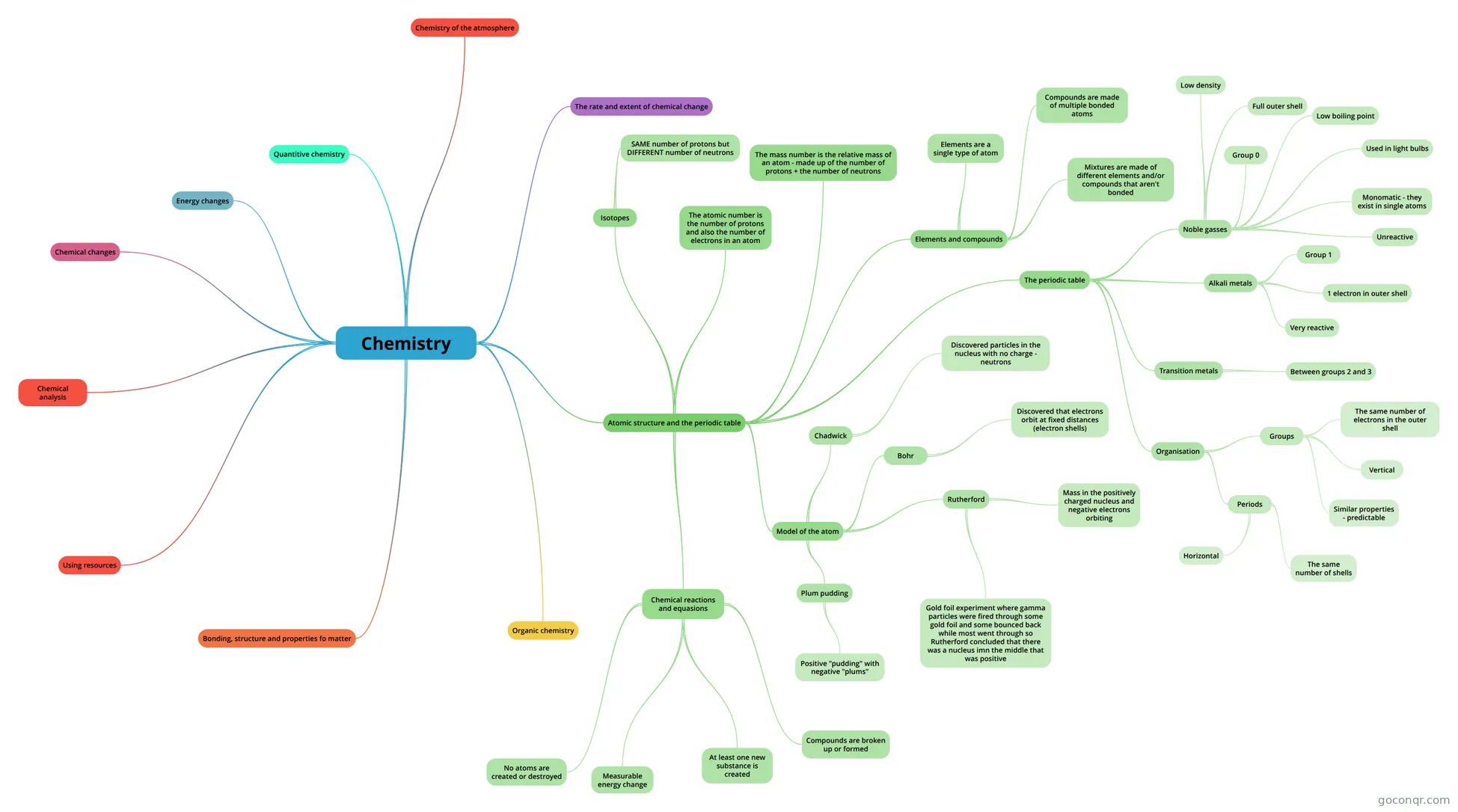
Mind map: Chemistry
Map content
Chemistry
Atomic structure and the periodic table
- Model of the atom
- Plum pudding
- Positive "pudding" with negative "plums"
- Rutherford
- Mass in the positively charged nucleus and negative electrons orbiting
- Gold foil experiment where gamma particles were fired through some gold foil and some bounced back while most went through so Rutherford concluded that there was a nucleus imn the middle that was positive
- Bohr
- Discovered that electrons orbit at fixed distances (electron shells)
- Chadwick
- Discovered particles in the nucleus with no charge - neutrons
- Plum pudding
- Elements and compounds
- Elements are a single type of atom
- Compounds are made of multiple bonded atoms
- Mixtures are made of different elements and/or compounds that aren't bonded
- Chemical reactions and equasions
- Compounds are broken up or formed
- At least one new substance is created
- Measurable energy change
- No atoms are created or destroyed
- The atomic number is the number of protons and also the number of electrons in an atom
- The mass number is the relative mass of an atom - made up of the number of protons + the number of neutrons
- Isotopes
- SAME number of protons but DIFFERENT number of neutrons
- The periodic table
- Noble gasses
- Group 0
- Unreactive
- Used in light bulbs
- Monomatic - they exist in single atoms
- Low boiling point
- Low density
- Full outer shell
- Alkali metals
- Group 1
- 1 electron in outer shell
- Very reactive
- Transition metals
- Between groups 2 and 3
- Organisation
- Groups
- Vertical
- The same number of electrons in the outer shell
- Similar properties - predictable
- Periods
- Horizontal
- The same number of shells
- Groups
- Noble gasses
- Model of the atom
Bonding, structure and properties fo matter
Quantitive chemistry
Chemical changes
Energy changes
The rate and extent of chemical change
Organic chemistry
Chemical analysis
Chemistry of the atmosphere
Using resources