
Mind map
Presentation of the ghost in 'Hamlet'
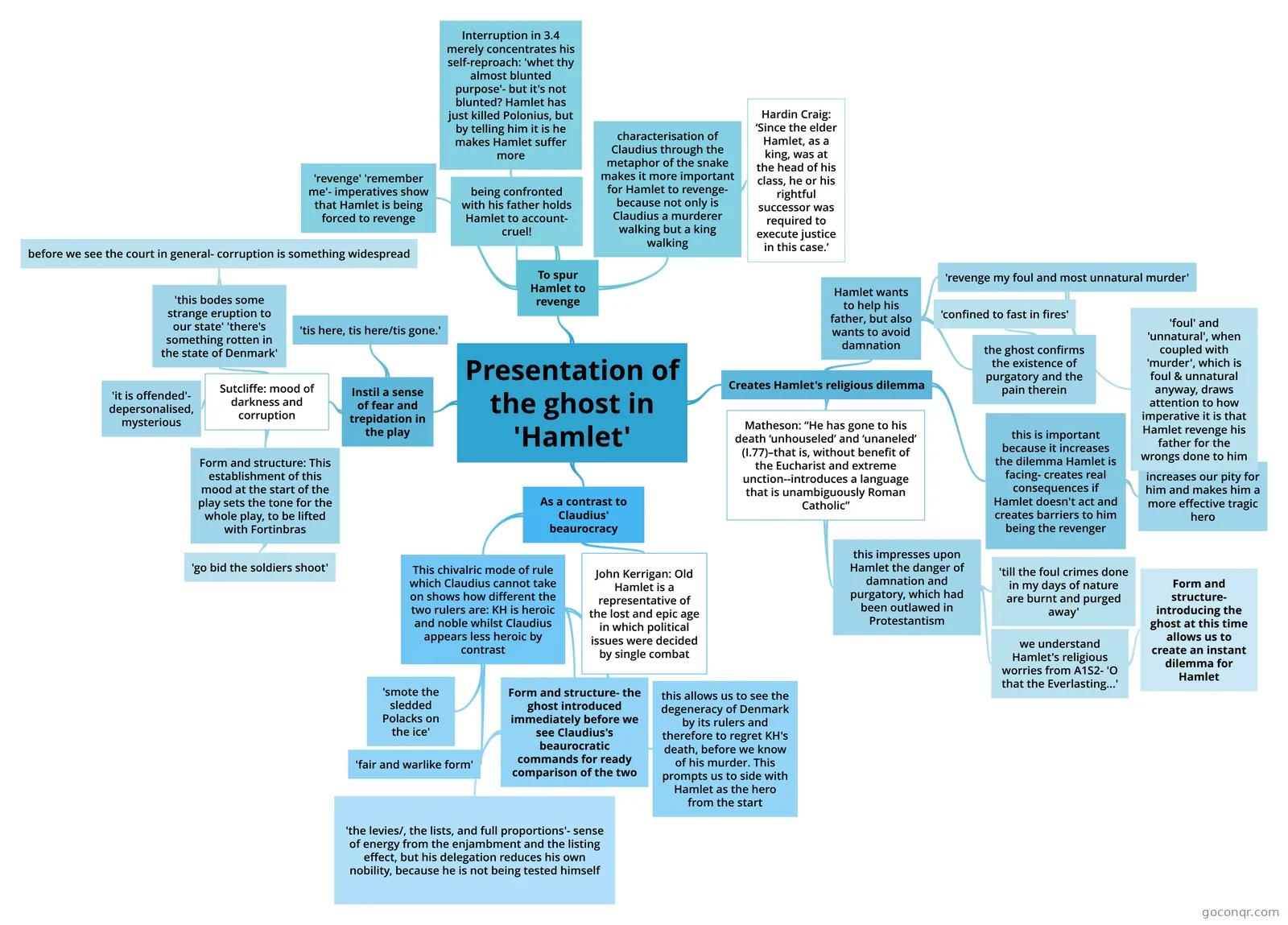
Mind map: the ghost in Hamlet
Map content
Presentation of the ghost in 'Hamlet'
As a contrast to Claudius' beaurocracy
- John Kerrigan: Old Hamlet is a representative of the lost and epic age in which political issues were decided by single combat
- This chivalric mode of rule which Claudius cannot take on shows how different the two rulers are: KH is heroic and noble whilst Claudius appears less heroic by contrast
- 'smote the sledded Polacks on the ice'
- 'fair and warlike form'
- Form and structure- the ghost introduced immediately before we see Claudius's beaurocratic commands for ready comparison of the two
- 'the levies/, the lists, and full proportions'- sense of energy from the enjambment and the listing effect, but his delegation reduces his own nobility, because he is not being tested himself
- this allows us to see the degeneracy of Denmark by its rulers and therefore to regret KH's death, before we know of his murder. This prompts us to side with Hamlet as the hero from the start
To spur Hamlet to revenge
- Interruption in 3.4 merely concentrates his self-reproach: 'whet thy almost blunted purpose'- but it's not blunted? Hamlet has just killed Polonius, but by telling him it is he makes Hamlet suffer more
- 'revenge' 'remember me'- imperatives show that Hamlet is being forced to revenge
- being confronted with his father holds Hamlet to account- cruel!
- characterisation of Claudius through the metaphor of the snake makes it more important for Hamlet to revenge- because not only is Claudius a murderer walking but a king walking
- Hardin Craig: ‘Since the elder Hamlet, as a king, was at the head of his class, he or his rightful successor was required to execute justice in this case.’
Creates Hamlet's religious dilemma
- Hamlet wants to help his father, but also wants to avoid damnation
- the ghost confirms the existence of purgatory and the pain therein
- 'confined to fast in fires'
- 'revenge my foul and most unnatural murder'
- 'foul' and 'unnatural', when coupled with 'murder', which is foul & unnatural anyway, draws attention to how imperative it is that Hamlet revenge his father for the wrongs done to him
- the ghost confirms the existence of purgatory and the pain therein
- Matheson: “He has gone to his death ‘unhouseled’ and ‘unaneled’ (I.77)–that is, without benefit of the Eucharist and extreme unction--introduces a language that is unambiguously Roman Catholic”
- this impresses upon Hamlet the danger of damnation and purgatory, which had been outlawed in Protestantism
- 'till the foul crimes done in my days of nature are burnt and purged away'
- we understand Hamlet's religious worries from A1S2- 'O that the Everlasting...'
- Form and structure- introducing the ghost at this time allows us to create an instant dilemma for Hamlet
- this impresses upon Hamlet the danger of damnation and purgatory, which had been outlawed in Protestantism
- this is important because it increases the dilemma Hamlet is facing- creates real consequences if Hamlet doesn't act and creates barriers to him being the revenger
- increases our pity for him and makes him a more effective tragic hero
- Hamlet wants to help his father, but also wants to avoid damnation
Instil a sense of fear and trepidation in the play
- 'tis here, tis here/tis gone.'
- Sutcliffe: mood of darkness and corruption
- Form and structure: This establishment of this mood at the start of the play sets the tone for the whole play, to be lifted with Fortinbras
- 'go bid the soldiers shoot'
- 'it is offended'- depersonalised, mysterious
- 'this bodes some strange eruption to our state' 'there's something rotten in the state of Denmark'
- before we see the court in general- corruption is something widespread
- Form and structure: This establishment of this mood at the start of the play sets the tone for the whole play, to be lifted with Fortinbras
Information
- Description
- Mind Map on Presentation of the ghost in 'Hamlet', created by Harry Derbyshire on 17/05/2019.
- Created by
- Harry Derbyshire
- Views
- 0
- Rating
More on Characters and Relationships