
Mind map
Chemistry 10
Map content
Chemistry 10
What is Chemistry?
- Chemistry is the science of matter and the change it undergoes.
- Physical and Chemical Properties
- Physical properties describe the physical appearance and composition of a substance
- Eg. Colour, ductility, malleable, lustre, etc.
- Chemical properties describe the behavior of a substance in the presence of other substances.
- Eg. Combustibility, flash point, reaction with acids, behavior in air, reaction with water.
- Physical properties describe the physical appearance and composition of a substance
- Classifying Matter
- Matter
- Pure Substances
- Elements
- 92 naturally occurring elements One type of atom /element Organized on the periodic table
- Compounds
- atoms of two or more elements bonded together. Ionic Compounds: Form when electrons are transferred. Molecular Compounds: Form when electrons are shared.
- Elements
- Mixtures
- Homogeneous Mixtures
- Solutions: -gas/gas -gas/liquid -liquid/liquid -solid/liquid -solid/solid --> alloys
- Heterogeneous Mixtures
- Mechanical mixtures Suspensions (muddy water) Colloids (milk)
- Homogeneous Mixtures
- Pure Substances
- Matter
- Chemical Reactions
- Examples: - change in color - change in odour - formation of gases - heat produced (exothermic) or absorbed (endothermic) - light or sound given off - formation of solid precipitate - the decomposition of organic matter
- In order to determine the chemical properties of a substance, you must observe a chemical change. The process by which a substance undergoes a chemical change is called a chemical reaction.
- Always involve the formation of new substances
- Types
- Type 1: Simple composition (Synthesis or Formation) A (element) + B (element) = AB
- Type 2: Simple Decomposition AB ---> A + B
- Type 3: Single Replacement A (metal) + BC (ionic compound) = AC (ionic compound) + B (metal)
- Type 4: Double Replacement AB (ionic compound) + CD (ionic compound) = AC + BD
- Type 5: Hydrocarbon Combustion CxHx (this represents a hydrocarbon) + O2 (oxygen gas) = CO2 + H2O
- Type 6: Neutralization Hx (represents an acid) + YOH (represents a base) = Yx + HOH Acids and bases neutralize each other to form a salt (ionic compound) and water.
Atomic Theory
- Atoms
- Elements are made up of atoms
- Atoms form the building blocks of all matter in the universe.
- Composed of 3 subatomic particles
- Protons (+) - Found in nucleus Neutrons (+/-) - Found in nucleus Electrons (-) - Found in electron clouds outside the nucleus
- Nucleus
- Is tiny compared to the size of the atom (only 1% of its volume) but contains almost all of the mass.
- Electron Energy Levels
- Electrons occupy specific orbitals at certain energy levels as discussed earlier. The number of electrons that exist in different energy levels vary.
- Valence Electrons
- Electrons that sit in the outermost energy level. Elements in the same period or family contain the same amount of valence electrons.
- Mass Number
- Both a proton and a neutron have mass, although the quantity of each mass is extremely small. The total number of protons and neutrons of the nucleus is known as an atoms mass number.
- Isotopes
- -Atoms of the same element, which means they have the same number of protons, that have different number of neutrons, are called isotopes.
- -Since isotopes differ in the number of neutrons, they also differ in their atomic masses.
- -All isotopes of an element have the same atomic number but different mass numbers.
- Atomic Mass
- Weighted averages are used on the periodic table of all the isotopes for that element.
- Calculating atomic mass: % of abundance * mass number
- Moles
- The unit we use for counting atoms, ions, or molecules is the mole.
- 1 mole is equal to the number of atoms in exactly 12 grams of carbon-12 6.02 * 10^23
- Atomic Molar Mass
- The mass of one mole of an elements atoms.
- Finding: It is the sum of the molar masses of all its atoms.
- Formulas
- To solve for moles: n (moles) = m (mass in g) / M (molar mass)
- To solve for mass: m (mass in g) = n (moles) * M (molar mass)
- History
- Aristotle
- Pictured all substances on Earth as mixtures of 4 elements.
- Democritus
- Concluded that matter could not be divided into smaller and smaller pieces forever. Used "atomos" to describe the smallest possible piece of matter.
- John Dalton
- -1808 -"Billiard Ball Model" of the atom -The size of the atom determines the element type -Also created symbols for each of the elements.
- Atomic Theory: 1. All elements are composed of indivisible particles called atoms. 2. Atoms of the same element are exactly alike. 3. Atoms of different elements are different. 4. Compounds are formed by joining atoms of two or more elements.
- J.J. Thomson
- -Discovered the electron in 1897. -"Raisin Bun Model" -Considered an atom as being composed of a positively charged (matrix) material with the negatively charged electrons scattered throughout it.
- Ernest Rutherford
- -Discovered the nucleus in 1908. -"Nuclear Model" proposed that an atom is mostly empty space and that there is a small, positive nucleus with the negatively charged electrons scattered around the outside edge. -"Gold Foil Experiment"
- Niels Bohr
- -In 1913, proposed the "orbital model" of the atom. -Suggested that electrons move in definite orbits around the nucleus like planets around the sun. -Also proposed that each electron moves in a orbital fashion at specific energy levels...the more energy an electron has the further it is from the nucleus.
- James Chadwick
- -Discovered the neutron in 1935. -Proposed the nucleus consists of positively charged protons and neutral neutrons surrounded by orbiting negatively charged electrons.
- de Broglie & Schrodinger
- -1923 de Broglie discovered the wave motion of electrons. -1926, Schrodinger used the wave model to create the "Quantum Mechanics" model of the atom. It proposed that electrons have no definite path, or orbit, around a nucleus but exist in electron clouds, called orbitals around the nucleus.
- Aristotle
- Atoms
Electron Configurations
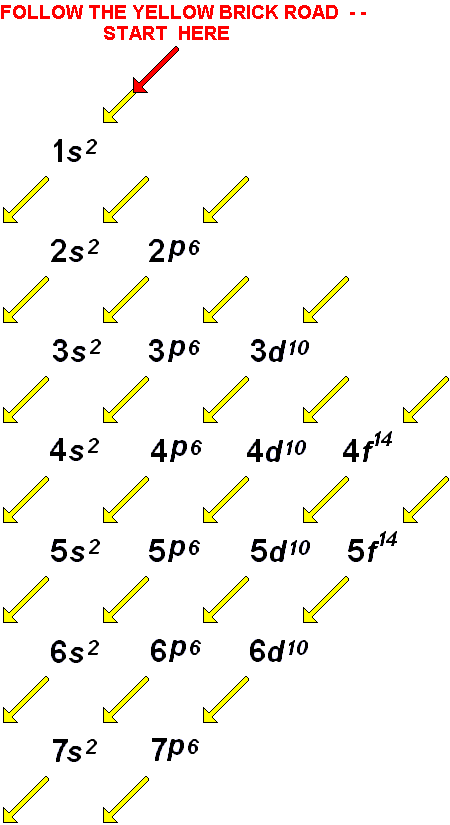
- 2, 8, 8, 18
- An electron's orbit can also be described in terms of letters and numbers. This description is known as an electron configuration, which describes how an atoms electrons orbit its nucleus.
The Periodic Table & Elements
- Mendeleev
- -1805 -Set himself about arranging the elements in order of their atomic weight. -His first row consisted of: Li, Be, B, C, N, O, F, Ne. When he began the next column he noticed that the properties of the elements in each column were similar.
- Organizes elements according to similar chemical properties.
- Metals
- Located on the left side of the "staircase"
- Non-Metals
- Located on the right side of the "staircase"
- Metalloids
- Those that are located near the "staircase"
- 7 rows, called periods
- 18 columns, called groups or families
- -Group 1: Alkali Metals -Group 2: Alkali Earth-Metals -Group 17: Halogens Group 18: Noble Gases
- Diatomic Atoms
- 7 Diatomics: Hydrogen, Nitrogen, Oxygen, Fluorine, Chlorine, Bromine, and Iodine. Exist in pairs when alone.
- Ionization Energy
- The energy required to remove an electron from an atom. Decreases as you move down a group and increases as you move across a period.
- Electronegativity
- Measure of the ability of an atom to attract electrons. Increases as you move towards fluorine.
- Atomic Radius
- Increases as you move down a group and decreases as you move across a period.
- Reactivity
- Metals: Increase as you move left and down. (Towards francium) Non-Metals: Increases as you move right and up. (Towards fluorine)
- Mendeleev
Ions and Chemical Compounds
- Ions
- Atoms of most elements can either gain or lose electrons in a process called ionization.
- If an atom loses electrons, it becomes a positively charged ion, or cation.
- If an atom gains electrons, it becomes a negatively charged ion, or anion.
- Metals
- Metals will lose electrons in order to have a stable electron configuration.
- Non-Metals
- Non-metals will gain electrons in order to have a stable electron configuration.
- Noble gases do not form ions since they already have stable electron configurations
- Ions
Compounds
- Ionic
- An ionic compound is formed when metal atoms transfer their valence electrons to non-metal atoms.
- The metal atoms become positively charged, the non-metal atoms becomes negatively charged, and an electrostatic attraction creates an ionic bond between them.
- They are solid at room temp, have high melting points, dissolve in water to produce conducting solutions, and form crystal lattice structures.
- Writing Formulas
- Contains element symbols that identify each type of ion present. Subscripts are also used to indicate the ratio of ions in the compound
- Eg: NaCl
- Contains element symbols that identify each type of ion present. Subscripts are also used to indicate the ratio of ions in the compound
- Molecular
- If no atoms are present to give electrons to non-metal atoms, the non-metal atoms share electrons to fill their outer energy level.
- The bond which forms when electrons are shared is called a covalent bond.
- Covalent Compounds
- Exist as separate molecules, unlike the crystal lattice formation of ionic compounds.
- Naming
- (Numerical prefix) first name (numerical prefix) second name (ide)
- Prefixes
- 1 - Mono 2 - Di 3 - Tri 4 - Tetra 5 - Penta 6 - Hexa 7 - Hepta 8 - Octa 9 - Nona 10 - Deca
- Hydrated Compounds
- Hydrated ionic compounds are those ionic compounds which contain water inside of their crystal lattice structures. The water is not chemically bonded to the crystal in any way, and may be driven off by heat.
- Ionic
Acids and Bases
- Acids
- pH Scale: Measures acidity: 0-6.9 is considered acidic.
- 1. They are solids, liquids or gases that are soluble in water. 2. They react with metals to produce hydrogen gas. 3. They taste sour. 4. They turn blue litmus paper red and bromothymol blue yellow. 5. They neutralize bases.
- Naming: (starts with 'H' or ends in 'COOH' 1. Hydrogen ___ide --> hydro__ic acid 2. Hydrogen ___ate --> _____ic acid 3. Hydrogen ____ite --> ___ous acid
- Bases
- - Usually they are solids that are soluble in water - They do not react with metals - Taste bitter, feel slippery - Turn red litmus paper blue, bromothymol blue green, and phenolphthalein pink.
- pH Scale: 8.0-14.0 considered basic.
- Acids
Images and files in the map
Information
- Description
- Mind Map on Chemistry 10, created by cschmidt1050 on 01/20/2015.
- Created by
- cschmidt1050
- Views
- 8
- Rating