
Mind map
Three Approaches to Argument
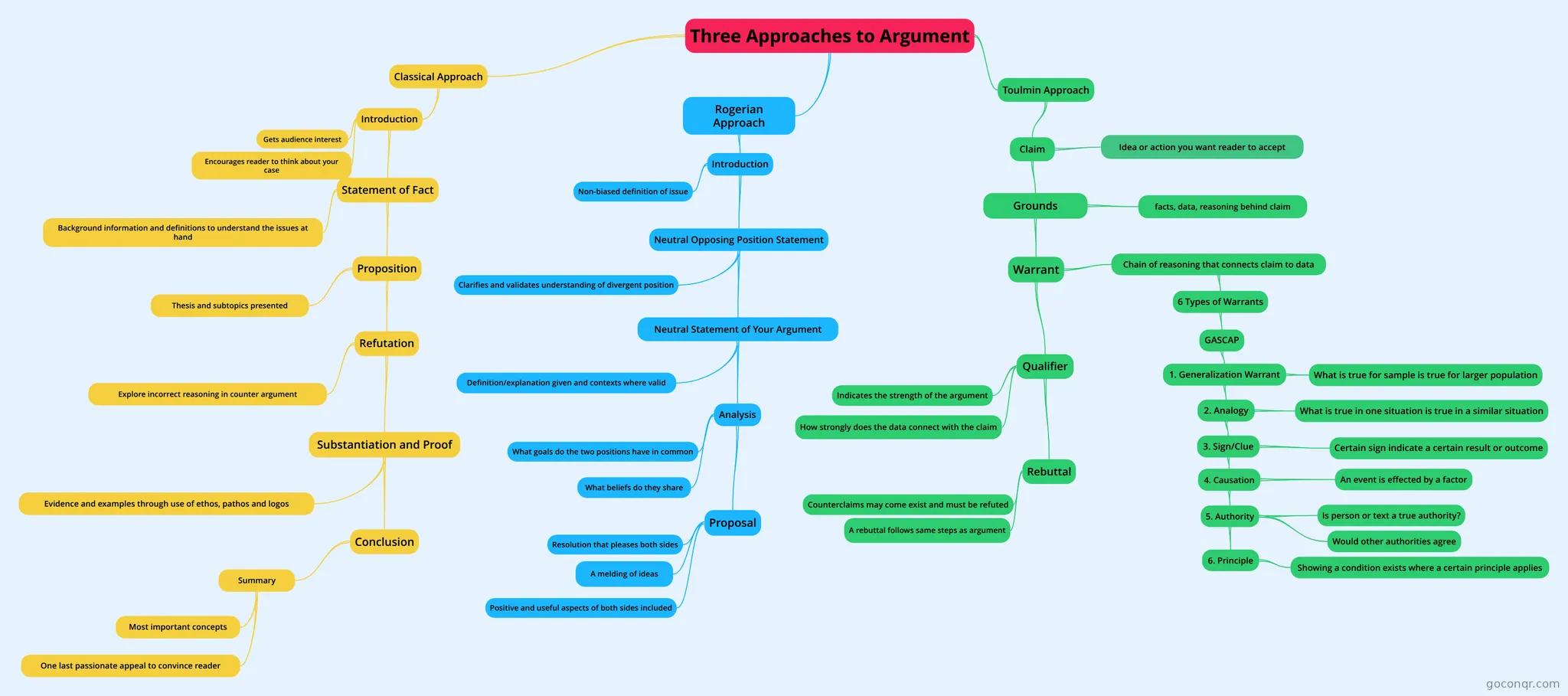
Mind map: Three Approaches to Argument
Map content
Three Approaches to Argument
Classical Approach
- Introduction
- Gets audience interest
- Encourages reader to think about your case
- Statement of Fact
- Background information and definitions to understand the issues at hand
- Proposition
- Thesis and subtopics presented
- Refutation
- Explore incorrect reasoning in counter argument
- Substantiation and Proof
- Evidence and examples through use of ethos, pathos and logos
- Conclusion
- Summary
- Most important concepts
- One last passionate appeal to convince reader
- Summary
- Introduction
Toulmin Approach
- Claim
- Idea or action you want reader to accept
- Grounds
- facts, data, reasoning behind claim
- Warrant
- Chain of reasoning that connects claim to data
- 6 Types of Warrants
- GASCAP
- 1. Generalization Warrant
- What is true for sample is true for larger population
- 2. Analogy
- What is true in one situation is true in a similar situation
- 3. Sign/Clue
- Certain sign indicate a certain result or outcome
- 4. Causation
- An event is effected by a factor
- 5. Authority
- Is person or text a true authority?
- Would other authorities agree
- 6. Principle
- Showing a condition exists where a certain principle applies
- 1. Generalization Warrant
- GASCAP
- 6 Types of Warrants
- Qualifier
- Indicates the strength of the argument
- How strongly does the data connect with the claim
- Rebuttal
- Counterclaims may come exist and must be refuted
- A rebuttal follows same steps as argument
- Chain of reasoning that connects claim to data
- Claim
Rogerian Approach
- Introduction
- Non-biased definition of issue
- Neutral Opposing Position Statement
- Clarifies and validates understanding of divergent position
- Neutral Statement of Your Argument
- Definition/explanation given and contexts where valid
- Analysis
- What goals do the two positions have in common
- What beliefs do they share
- Proposal
- Resolution that pleases both sides
- A melding of ideas
- Positive and useful aspects of both sides included
- Introduction
Information
- Description
- Maria Ali Language Arts 11 Mrs. Hetzel 2-1-15
- Created by
- 1053971
- Views
- 11
- Rating