
Mind map
Rivers
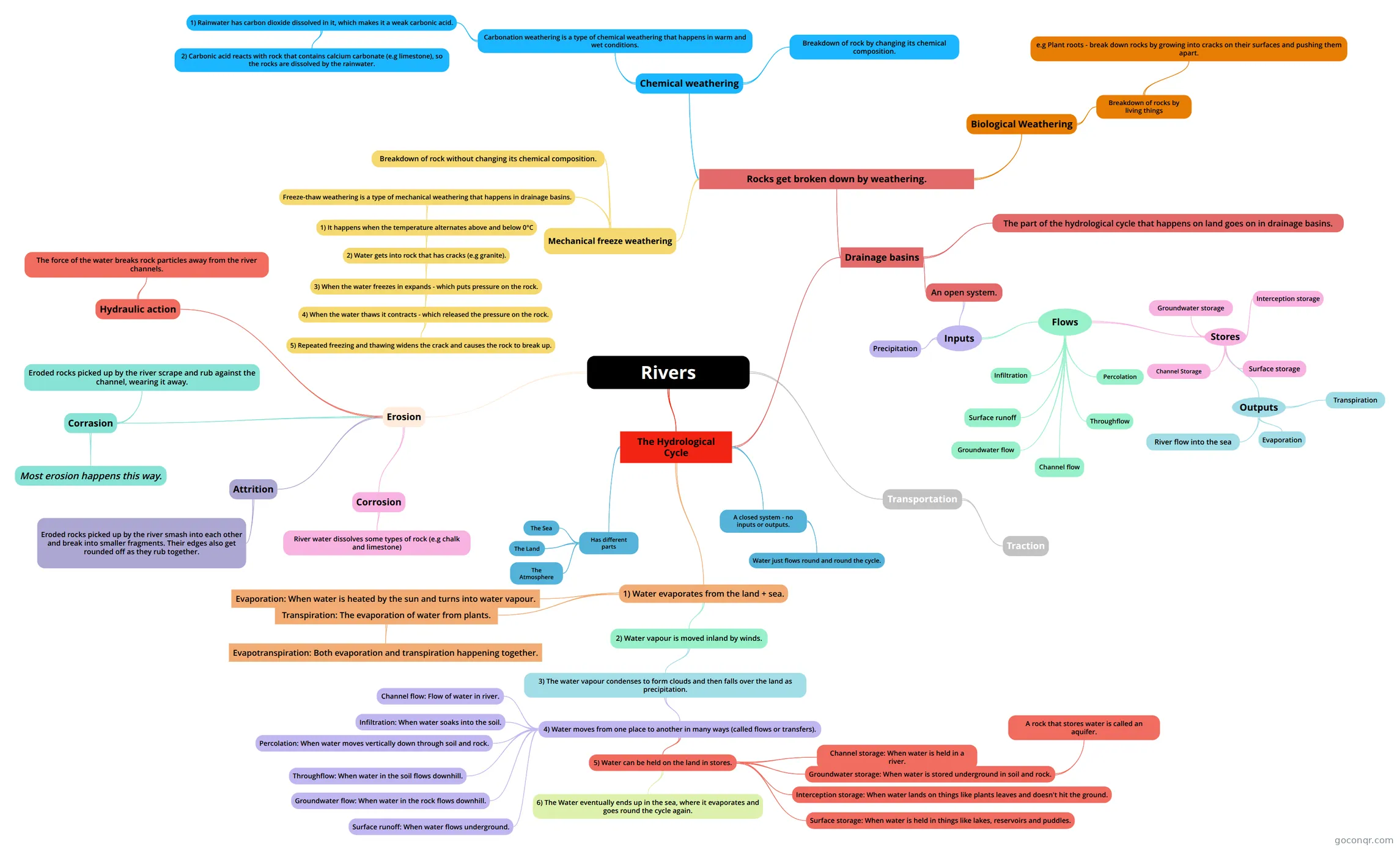
Mind map: Rivers
Map content
Rivers
The Hydrological Cycle
- Has different parts
- The Sea
- The Land
- The Atmosphere
- A closed system - no inputs or outputs.
- Water just flows round and round the cycle.
- 1) Water evaporates from the land + sea.
- Evaporation: When water is heated by the sun and turns into water vapour.
- Transpiration: The evaporation of water from plants.
- Evapotranspiration: Both evaporation and transpiration happening together.
- 2) Water vapour is moved inland by winds.
- 3) The water vapour condenses to form clouds and then falls over the land as precipitation.
- 4) Water moves from one place to another in many ways (called flows or transfers).
- Infiltration: When water soaks into the soil.
- Percolation: When water moves vertically down through soil and rock.
- Throughflow: When water in the soil flows downhill.
- Groundwater flow: When water in the rock flows downhill.
- Surface runoff: When water flows underground.
- Channel flow: Flow of water in river.
- 5) Water can be held on the land in stores.
- Channel storage: When water is held in a river.
- Groundwater storage: When water is stored underground in soil and rock.
- A rock that stores water is called an aquifer.
- Interception storage: When water lands on things like plants leaves and doesn't hit the ground.
- Surface storage: When water is held in things like lakes, reservoirs and puddles.
- 6) The Water eventually ends up in the sea, where it evaporates and goes round the cycle again.
- 4) Water moves from one place to another in many ways (called flows or transfers).
- 3) The water vapour condenses to form clouds and then falls over the land as precipitation.
- Drainage basins
- The part of the hydrological cycle that happens on land goes on in drainage basins.
- An open system.
- Inputs
- Precipitation
- Flows
- Surface runoff
- Channel flow
- Infiltration
- Throughflow
- Groundwater flow
- Percolation
- Stores
- Channel Storage
- Groundwater storage
- Interception storage
- Surface storage
- Outputs
- Evaporation
- Transpiration
- River flow into the sea
- Inputs
- Rocks get broken down by weathering.
- Mechanical freeze weathering
- Breakdown of rock without changing its chemical composition.
- Freeze-thaw weathering is a type of mechanical weathering that happens in drainage basins.
- 1) It happens when the temperature alternates above and below 0°C
- 2) Water gets into rock that has cracks (e.g granite).
- 3) When the water freezes in expands - which puts pressure on the rock.
- 4) When the water thaws it contracts - which released the pressure on the rock.
- 5) Repeated freezing and thawing widens the crack and causes the rock to break up.
- 4) When the water thaws it contracts - which released the pressure on the rock.
- 3) When the water freezes in expands - which puts pressure on the rock.
- 2) Water gets into rock that has cracks (e.g granite).
- 1) It happens when the temperature alternates above and below 0°C
- Chemical weathering
- Breakdown of rock by changing its chemical composition.
- Carbonation weathering is a type of chemical weathering that happens in warm and wet conditions.
- 1) Rainwater has carbon dioxide dissolved in it, which makes it a weak carbonic acid.
- 2) Carbonic acid reacts with rock that contains calcium carbonate (e.g limestone), so the rocks are dissolved by the rainwater.
- 1) Rainwater has carbon dioxide dissolved in it, which makes it a weak carbonic acid.
- Biological Weathering
- Breakdown of rocks by living things
- e.g Plant roots - break down rocks by growing into cracks on their surfaces and pushing them apart.
- Breakdown of rocks by living things
- Mechanical freeze weathering
- Has different parts
Erosion
- Hydraulic action
- The force of the water breaks rock particles away from the river channels.
- Corrasion
- Eroded rocks picked up by the river scrape and rub against the channel, wearing it away.
- Most erosion happens this way.
- Attrition
- Eroded rocks picked up by the river smash into each other and break into smaller fragments. Their edges also get rounded off as they rub together.
- Corrosion
- River water dissolves some types of rock (e.g chalk and limestone)
- Hydraulic action
Transportation
- Traction
Information
- Description
- Mind Map on Rivers, created by iamlucyseddon on 08/02/2015.
- Created by
- iamlucyseddon
- Views
- 0
- Rating
More on Water Cycle and Drainage Basins