
Mind map
SPECIATION 5
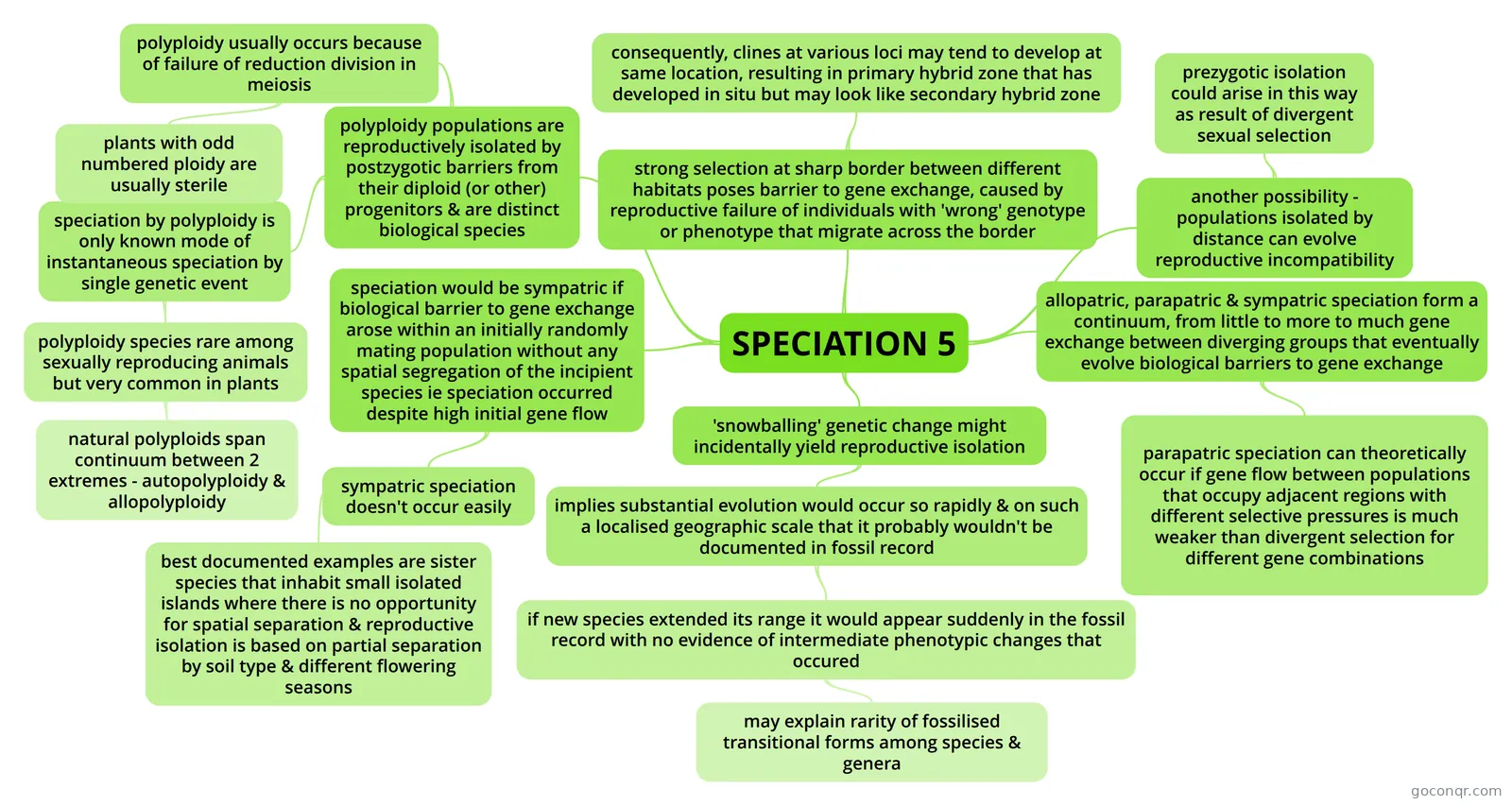
Mind map: speciation
Map content
SPECIATION 5
'snowballing' genetic change might incidentally yield reproductive isolation
- implies substantial evolution would occur so rapidly & on such a localised geographic scale that it probably wouldn't be documented in fossil record
- if new species extended its range it would appear suddenly in the fossil record with no evidence of intermediate phenotypic changes that occured
- may explain rarity of fossilised transitional forms among species & genera
- if new species extended its range it would appear suddenly in the fossil record with no evidence of intermediate phenotypic changes that occured
- implies substantial evolution would occur so rapidly & on such a localised geographic scale that it probably wouldn't be documented in fossil record
allopatric, parapatric & sympatric speciation form a continuum, from little to more to much gene exchange between diverging groups that eventually evolve biological barriers to gene exchange
- parapatric speciation can theoretically occur if gene flow between populations that occupy adjacent regions with different selective pressures is much weaker than divergent selection for different gene combinations
strong selection at sharp border between different habitats poses barrier to gene exchange, caused by reproductive failure of individuals with 'wrong' genotype or phenotype that migrate across the border
- consequently, clines at various loci may tend to develop at same location, resulting in primary hybrid zone that has developed in situ but may look like secondary hybrid zone
another possibility - populations isolated by distance can evolve reproductive incompatibility
- prezygotic isolation could arise in this way as result of divergent sexual selection
speciation would be sympatric if biological barrier to gene exchange arose within an initially randomly mating population without any spatial segregation of the incipient species ie speciation occurred despite high initial gene flow
- sympatric speciation doesn't occur easily
- best documented examples are sister species that inhabit small isolated islands where there is no opportunity for spatial separation & reproductive isolation is based on partial separation by soil type & different flowering seasons
- sympatric speciation doesn't occur easily
polyploidy populations are reproductively isolated by postzygotic barriers from their diploid (or other) progenitors & are distinct biological species
- speciation by polyploidy is only known mode of instantaneous speciation by single genetic event
- polyploidy species rare among sexually reproducing animals but very common in plants
- natural polyploids span continuum between 2 extremes - autopolyploidy & allopolyploidy
- polyploidy species rare among sexually reproducing animals but very common in plants
- polyploidy usually occurs because of failure of reduction division in meiosis
- plants with odd numbered ploidy are usually sterile
- speciation by polyploidy is only known mode of instantaneous speciation by single genetic event
Information
- Description
- Mind Map on SPECIATION 5, created by tomking304 on 09/09/2013.
- Created by
- tomking304
- Views
- 59
- Rating