
Mind map
Trade mark subject matter
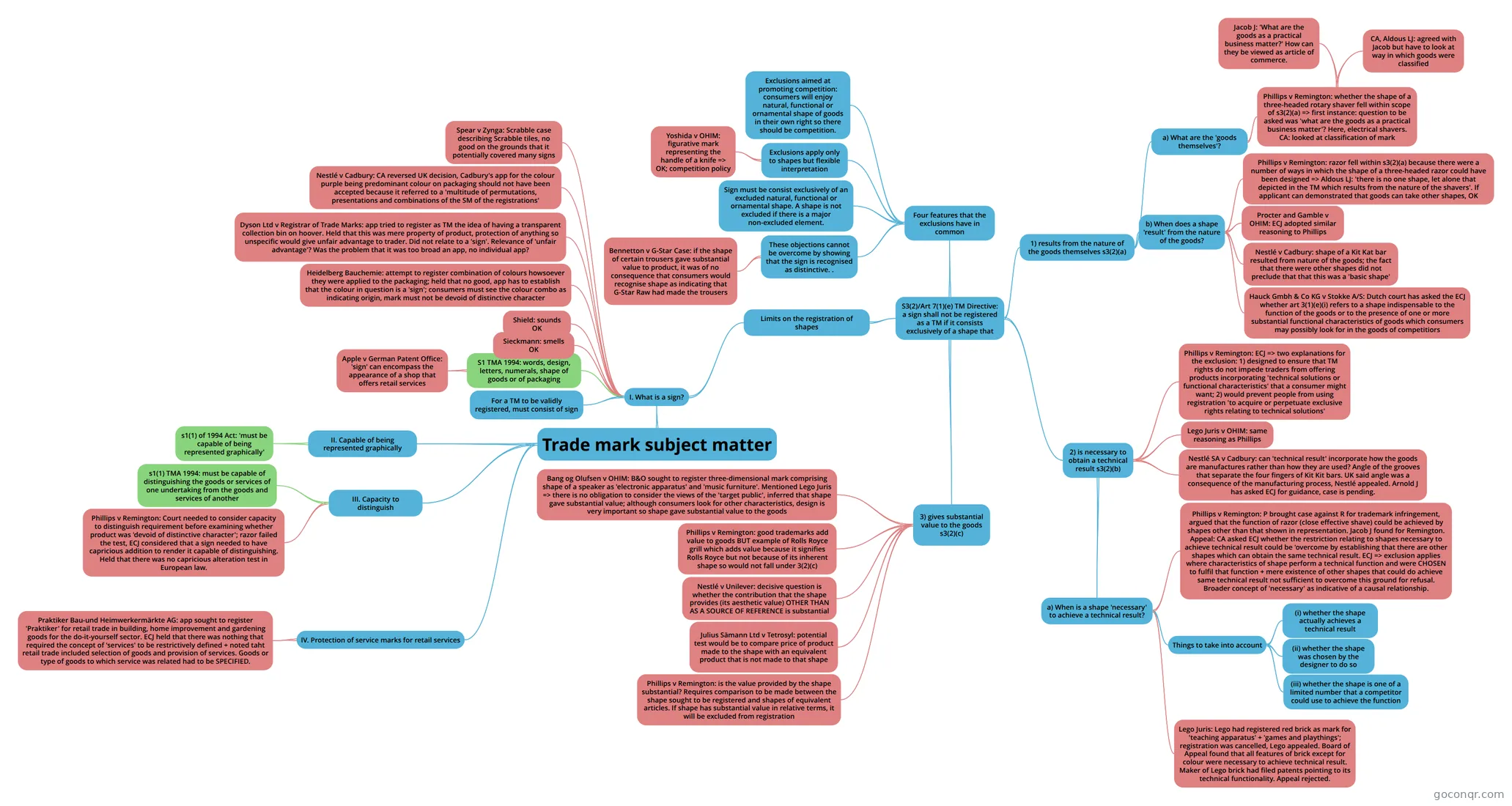
Mind map: Trade mark subject matter
Map content
Trade mark subject matter
I. What is a sign?
- For a TM to be validly registered, must consist of sign
- S1 TMA 1994: words, design, letters, numerals, shape of goods or of packaging
- Apple v German Patent Office: 'sign' can encompass the appearance of a shop that offers retail services
- Sieckmann: smells OK
- Shield: sounds OK
- Heidelberg Bauchemie: attempt to register combination of colours howsoever they were applied to the packaging; held that no good, app has to establish that the colour in question is a 'sign'; consumers must see the colour combo as indicating origin, mark must not be devoid of distinctive character
- Dyson Ltd v Registrar of Trade Marks: app tried to register as TM the idea of having a transparent collection bin on hoover. Held that this was mere property of product, protection of anything so unspecific would give unfair advantage to trader. Did not relate to a 'sign'. Relevance of 'unfair advantage'? Was the problem that it was too broad an app, no individual app?
- Nestlé v Cadbury: CA reversed UK decision, Cadbury's app for the colour purple being predominant colour on packaging should not have been accepted because it referred to a 'multitude of permutations, presentations and combinations of the SM of the registrations'
- Spear v Zynga: Scrabble case describing Scrabble tiles, no good on the grounds that it potentially covered many signs
- Limits on the registration of shapes
- S3(2)/Art 7(1)(e) TM Directive: a sign shall not be registered as a TM if it consists exclusively of a shape that
- 1) results from the nature of the goods themselves s3(2)(a)
- a) What are the 'goods themselves'?
- Phillips v Remington: whether the shape of a three-headed rotary shaver fell within scope of s3(2)(a) => first instance: question to be asked was 'what are the goods as a practical business matter'? Here, electrical shavers. CA: looked at classification of mark
- Jacob J: 'What are the goods as a practical business matter?' How can they be viewed as article of commerce.
- CA, Aldous LJ: agreed with Jacob but have to look at way in which goods were classified
- Phillips v Remington: whether the shape of a three-headed rotary shaver fell within scope of s3(2)(a) => first instance: question to be asked was 'what are the goods as a practical business matter'? Here, electrical shavers. CA: looked at classification of mark
- b) When does a shape 'result' from the nature of the goods?
- Phillips v Remington: razor fell within s3(2)(a) because there were a number of ways in which the shape of a three-headed razor could have been designed => Aldous LJ: 'there is no one shape, let alone that depicted in the TM which results from the nature of the shavers'. If applicant can demonstrated that goods can take other shapes, OK
- Procter and Gamble v OHIM: ECJ adopted similar reasoning to Phillips
- Nestlé v Cadbury: shape of a Kit Kat bar resulted from nature of the goods; the fact that there were other shapes did not preclude that that this was a 'basic shape'
- Hauck Gmbh & Co KG v Stokke A/S: Dutch court has asked the ECJ whether art 3(1)(e)(i) refers to a shape indispensable to the function of the goods or to the presence of one or more substantial functional characteristics of goods which consumers may possibly look for in the goods of competitiors
- a) What are the 'goods themselves'?
- 2) is necessary to obtain a technical result s3(2)(b)
- Phillips v Remington: ECJ => two explanations for the exclusion: 1) designed to ensure that TM rights do not impede traders from offering products incorporating 'technical solutions or functional characteristics' that a consumer might want; 2) would prevent people from using registration 'to acquire or perpetuate exclusive rights relating to technical solutions'
- Lego Juris v OHIM: same reasoning as Phillips
- Nestlé SA v Cadbury: can 'technical result' incorporate how the goods are manufactures rather than how they are used? Angle of the grooves that separate the four fingers of Kit Kit bars. UK said angle was a consequence of the manufacturing process, Nestlé appealed. Arnold J has asked ECJ for guidance, case is pending.
- a) When is a shape 'necessary' to achieve a technical result?
- Phillips v Remington: P brought case against R for trademark infringement, argued that the function of razor (close effective shave) could be achieved by shapes other than that shown in representation. Jacob J found for Remington. Appeal: CA asked ECJ whether the restriction relating to shapes necessary to achieve technical result could be 'overcome by establishing that there are other shapes which can obtain the same technical result. ECJ => exclusion applies where characteristics of shape perform a technical function and were CHOSEN to fulfil that function + mere existence of other shapes that could do achieve same technical result not sufficient to overcome this ground for refusal. Broader concept of 'necessary' as indicative of a causal relationship.
- Things to take into account
- (i) whether the shape actually achieves a technical result
- (ii) whether the shape was chosen by the designer to do so
- (iii) whether the shape is one of a limited number that a competitor could use to achieve the function
- Lego Juris: Lego had registered red brick as mark for 'teaching apparatus' + 'games and playthings'; registration was cancelled, Lego appealed. Board of Appeal found that all features of brick except for colour were necessary to achieve technical result. Maker of Lego brick had filed patents pointing to its technical functionality. Appeal rejected.
- 3) gives substantial value to the goods s3(2)(c)
- Bang og Olufsen v OHIM: B&O sought to register three-dimensional mark comprising shape of a speaker as 'electronic apparatus' and 'music furniture'. Mentioned Lego Juris => there is no obligation to consider the views of the 'target public', inferred that shape gave substantial value; although consumers look for other characteristics, design is very important so shape gave substantial value to the goods
- Phillips v Remington: good trademarks add value to goods BUT example of Rolls Royce grill which adds value because it signifies Rolls Royce but not because of its inherent shape so would not fall under 3(2)(c)
- Nestlé v Unilever: decisive question is whether the contribution that the shape provides (its aesthetic value) OTHER THAN AS A SOURCE OF REFERENCE is substantial
- Julius Sämann Ltd v Tetrosyl: potential test would be to compare price of product made to the shape with an equivalent product that is not made to that shape
- Phillips v Remington: is the value provided by the shape substantial? Requires comparison to be made between the shape sought to be registered and shapes of equivalent articles. If shape has substantial value in relative terms, it will be excluded from registration
- Four features that the exclusions have in common
- Exclusions aimed at promoting competition: consumers will enjoy natural, functional or ornamental shape of goods in their own right so there should be competition.
- Exclusions apply only to shapes but flexible interpretation
- Yoshida v OHIM: figurative mark representing the handle of a knife => OK; competition policy
- Sign must be consist exclusively of an excluded natural, functional or ornamental shape. A shape is not excluded if there is a major non-excluded element.
- These objections cannot be overcome by showing that the sign is recognised as distinctive. .
- Bennetton v G-Star Case: if the shape of certain trousers gave substantial value to product, it was of no consequence that consumers would recognise shape as indicating that G-Star Raw had made the trousers
- 1) results from the nature of the goods themselves s3(2)(a)
- S3(2)/Art 7(1)(e) TM Directive: a sign shall not be registered as a TM if it consists exclusively of a shape that
II. Capable of being represented graphically
- s1(1) of 1994 Act: 'must be capable of being represented graphically'
III. Capacity to distinguish
- s1(1) TMA 1994: must be capable of distinguishing the goods or services of one undertaking from the goods and services of another
- Phillips v Remington: Court needed to consider capacity to distinguish requirement before examining whether product was 'devoid of distinctive character'; razor failed the test, ECJ considered that a sign needed to have capricious addition to render it capable of distinguishing. Held that there was no capricious alteration test in European law.
IV. Protection of service marks for retail services
- Praktiker Bau-und Heimwerkermärkte AG: app sought to register 'Praktiker' for retail trade in building, home improvement and gardening goods for the do-it-yourself sector. ECJ held that there was nothing that required the concept of 'services' to be restrictively defined + noted taht retail trade included selection of goods and provision of services. Goods or type of goods to which service was related had to be SPECIFIED.
Information
- Description
- Law second year Intellectual property law (Trade marks: registration and subject-matter) Mind Map on Trade mark subject matter, created by Emilie Schou on 18/02/2015.
- Created by
- Emilie Schou
- Views
- 2
- Rating