
Mind map
Research Proposals
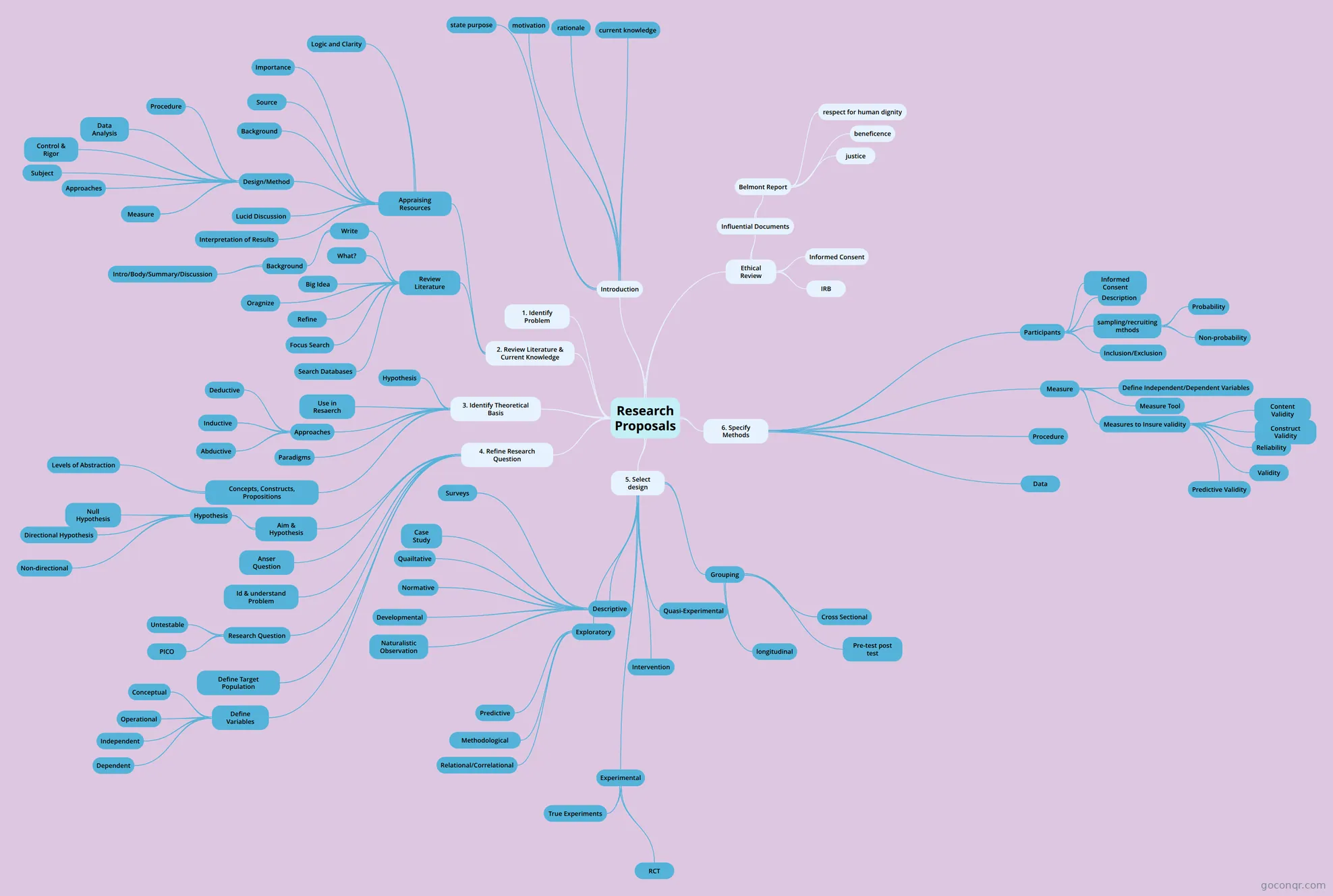
Mind map: Research Proposals Structure and Components
Map content
Research Proposals
1. Identify Problem
2. Review Literature & Current Knowledge
- We conduct lit reviews to determine existing knowledge (what do we alrady know? has someone else answered the question? what did they find? how well? important?
- Appraising Resources
- Source
- peer reviewed? impact factors expertise of author convergence of evidence
- Importance
- new, novel? innovative? contributes to knowledge base? impact of human condition supports theory?
- Logic and Clarity
- purpose laid out logically? key conceps defined? research question and hypotheses clearly stated?
- Background
- provides rational ideas supported with relevant background appropriate references
- Design/Method
- appropriate design choice, variables clearly defined, level of control
- Subject
- Measure
- Procedure
- Data Analysis
- Control & Rigor
- control of extraneous or confounding variables threats to validity (poor measure, experiemnt set-up) threats to reliability
- Approaches
- Interpretation of Results
- statistics appropriate, correct interpretation, results support conclusion means, SD, test statistic, significance level, effect size
- Lucid Discussion
- summarizes key findings interpret results compare to precious studies acknowledge implications present future directions
- Source
- Review Literature
- What?
- Big Idea
- Refine
- Focus Search
- Search Databases
- Oragnize
- Write
- Background
- Create Roadmap; organize and outline witih headings, referencing, keeping good notes
- Intro/Body/Summary/Discussion
- Intro: topic, define key terms, overview, importance, motivation, roadmap Body: organize, synthesize, state of current knowledge Summary: 1 page, key themes Discussion: what it all means, conclusoin, implications, suggest future research
- Background
3. Identify Theoretical Basis
- Primary theory or model key concepts of the theory application to research topic summarize, provide framework, predict, development of new knowledge
- Use in Resaerch
- frames questions, conceptual clarity, basis for interpretations of observations, bridge old and new knowledge, test therory (deductive) develop theory (inductive)
- Paradigms
- Paradigms – world view; set of assumptions about the world and human behavior. Guide research process, methods and decisions. Ontology – What is reality?Epistemology – How do we come to know it?Positivism – there is a “reality” that can be studied and known. Nature is ordered and regular. Objective reality independent of human observation.Often associated with determinism –phenomena have causes that can be dentified and understood. Not haphazard or random. Also associated with reductionism – big phenomena can be reduced to their component parts and understood by studying those component parts.
- Approaches
- Deductive
- develop specific predictions from general principles or a theory. Used to describe, or predict the application of theory and rules to a specific phenomena. Often associated with positivistic methods (quant). Goes from general to specific.
- Inductive
- develop generalizations from specific observations (Specific to General - go bigger). Often fitting observations into existing frameworks or theories and then modifying them. Often associated with naturalistic methods
- Abductive
- abductive – theory generating. Data analyzed for their own patterns. Uncover of reveal theory, rules and processes. Often associated with naturalistic methods (Grounded Theory in partic)
- Deductive
- Concepts, Constructs, Propositions
- Levels of Abstraction
- levels of abstraction within theories: Concepts: symbolic representation of observable or experienced referent (dog, person). If a concept can be assigned a value or has different ‘levels’ it can become a Variable Constructs: symbolic representation of non-observable or directly experienced referent,such as a category (fear, health status)Relationships: Association of two or more concepts or constructs (person and health status)Principles/Propositions: Statement that governs set of relationships and gives them structure.Predictive. (persons health status influenced by participation in meaningfuloccupations Higherthe level of abstraction, the more complex the research design
- Levels of Abstraction
- Hypothesis
4. Refine Research Question
- Id & understand Problem
- Research Question
- defines PICO, specifies variables and their relationship, constrain the design and analysis
- Untestable
- not statements of relations construct and variables are difficult to define in a way that acn be mmeasured or manipulated
- PICO
- Define Target Population
- all people affected by study, sample represents target population, careful definitions of inclusion and exclusion
- Define Variables
- Property that can differentiate members of a group, set, or event nRepresents a concept, construct or facto nMay have different values at different points in time depending on the conditions
- Independent
- Variable in experimental studies manipulated by the investigato In descriptive studies the independent variables are the “grouping” variables used for comparisonsqlevelnAlso known as a “predictor” variable
- Dependent
- outcome variable, used to determine response or effect of independent variable, change in value of dependent variable is assumed to be due to independent variable
- Operational
- defines variables according to its meaning within study, defined by researcher, defined within unique meaning within study,
- Conceptual
- dictionary definitions; general terms with no specific reference to methodological use
- Aim & Hypothesis
- aims are clear staememnt of what the resaerch will accomplish (population, dependent/in variables, measurements) Hypothesis: declarative statement predicitng relationship between variables
- Hypothesis
- exresses relation that can be measured declarative statements, conjectural (prediction of relatinship between 2+ variables)
- Null Hypothesis
- lastatement of no difference or no relationship between variables; the statistical hypothesis Difference between groups occurred by chance, as a result of a sampling error No matter the hypothesis is states, the researcher’s goal is always be to statistically test the null hypothesis The difference in the mean is the alternativ hypothesis
- Directional Hypothesis
- research hypothesis (or alternative hypothesis) that predicts the direction of a relationship between two variables •i.e. patients with chronic plantar fasciitis who are manage with a structure specific plantar fascia stretching program for eight weeks have a better functional outcome than do patinets managed with the standard achilles tendon stretching protocol
- Non-directional
- tutoring will change scores. no indication of improve of lowering
- Anser Question
- describe characteristics, how varibales correlate, difference between groups, or between interventions
5. Select design
- Descriptive
- Developmental
- Description of developmental change and sequence of behaviors of people over time. i.e. sequencing of motor development among infants longitudinal & cross-secitonal studies
- Normative
- Describes typical standard values for characteristics of given population norms expressed as average validity if important samples must be large, random, and representative of heterogeneous population
- Quailtative
- seeks to describe complex nature of humans and how individuals perceive their own experiences within a specific social context
- Naturalistic Observation
- qualitative observationand intervention with subjects in their own natural environment
- Case Study
- In-depth description of an individual condition or response to TX. can focus on a group or other social unit
- Surveys
- data gathered by asking questions of respondents
- Developmental
- Exploratory
- Find relatioships systematic investigation of relationships among two or more variables To predict effect of 1 variable on another, test relationshp supported by clinical theory usually longitudinal or cross-sectional gather existing data ores dimensions of phenomenon and its relationship to other factors
- Relational/Correlational
- dependence of one variable on another. Correlational designs are helpful in identifying the relation of one variable to another, and seeing the frequency of co-occurrence in two natural groups. Generates hypothesis ie perception of fatigue in chronicaly ill patients who were undergoing long-term mechanical ventilation. Correlation between fatigue and depression
- Predictive
- designed to predict behavior or response based on observed relationship between that behavior and other variables
- Methodological
- Involves development and tests measuring instruments for use in research or clinical practice. Emphasize use of outcome instruments as way of indicating quality of care and quality of life Assessment Validation: process to compare and evaluate assessment methods, procedures and decisions to ensure that tools provided are valid, reliable, sufficient, and current
- Experimental
- Cause & Effect Clinical Trials Therapeutic or Preventative controlled comparison of 2+ conditions
- RCT
- gold standard
- True Experiments
- subjects randomly assigned to at least 2 comparison groups
- Quasi-Experimental
- No RCT or comparison groups accodate for limitations of natural settings Needs to use blinding as much as possible
- Grouping
- Cross Sectional
- stratified group at one point in time comparing chracteristics of population strata
- longitudinal
- follows cohort over time
- Pre-test post test
- ¢basic structure of RCT. Compare 2+ groups formed by RCT. Control & experimental group. Both receive test before intervention except control. Then test again after application of independent variable.
- Cross Sectional
- Intervention
- Intervention research entails the empirical study of professional intervention behavior in the human services. Purpose: knowledge development, knowledge utilization, and design and development
- Descriptive
6. Specify Methods
- so that it can be replicated and evaluated for soundness
- Participants
- Description
- #, category/clinical pop/age gender
- sampling/recruiting mthods
- Probability
- purpose is to select group of subjects representative of the larger group of subjects from which they are selected
- Non-probability
- lpurpose is to select subjects that can be informative about research issue Probability of selecting participant is unknown and you chose info-rich participants
- Probability
- Inclusion/Exclusion
- Inclusion: characteristics that prospective subjects must have if they are to be included in study lExclusion: traits that disqualify subjects inclusion in study
- Informed Consent
- voluntary agreement to participant in research.process in which person has understanding of research and its risks
- Description
- Measure
- Define Independent/Dependent Variables
- Measure Tool
- Description, Scores, Psychometric data
- Measures to Insure validity
- Content Validity
- Construct Validity
- Reliability
- Validity
- Predictive Validity
- Procedure
- Setting, equipment & apparatus, instruction to participants, sequence & timing, data collection methods, debriefing, steps to reduce threats to validity
- Data
- restate research design, describe specific procedure for coding, storing, and reducing data, describe statistial procedures for analyzing variables
Ethical Review
- Influential Documents
- Belmont Report
- Application of Principles: Informed Consent: right to participate and withdrawAssessment of Risk and Benefit: by IRB;affiliated with IRB to review every research proposal impartially; IRB of organization who are judged to be impartial Selection of Subjects: NIH brand will require selection of subjects that represent population
- respect for human dignity
- right to refuse, be informed, be taken careof;full disclosure
- beneficence
- minimize harm, maximize benefits,
- justice
- right to fair treatment and right to privacy
- Belmont Report
- Informed Consent
- Purpose of the Research Procedures: from participants perspective, what will they do? How long will it take? Risks and Discomforts: potential physical and emotional riskss;Alternatives to participation (treatment) Confidentiality: how records kept, protected Request for more information: info on where to get more info, IRB Refusal or Withdrawal: right to refuse or withdraw at anytime w/o prejudice against you; Injury statement: if you do come to harm who do you contact;Consent statement
- IRB
- Influential Documents
Introduction
- motivation
- describe importance/relevance to society, logical argument, summarize/synthesize existing evidence or lack of evidence
- rationale
- current knowledge
- state purpose
- Id central constructs/concepts clearly and state research questions. State research questions and uses the word "purpose"
- motivation
Information
- Description
- Mind Map on Research Proposals, created by jensikle on 18/02/2015.
- Created by
- jensikle
- Views
- 20
- Rating