
Mind map
(4) Stalin methods of control.
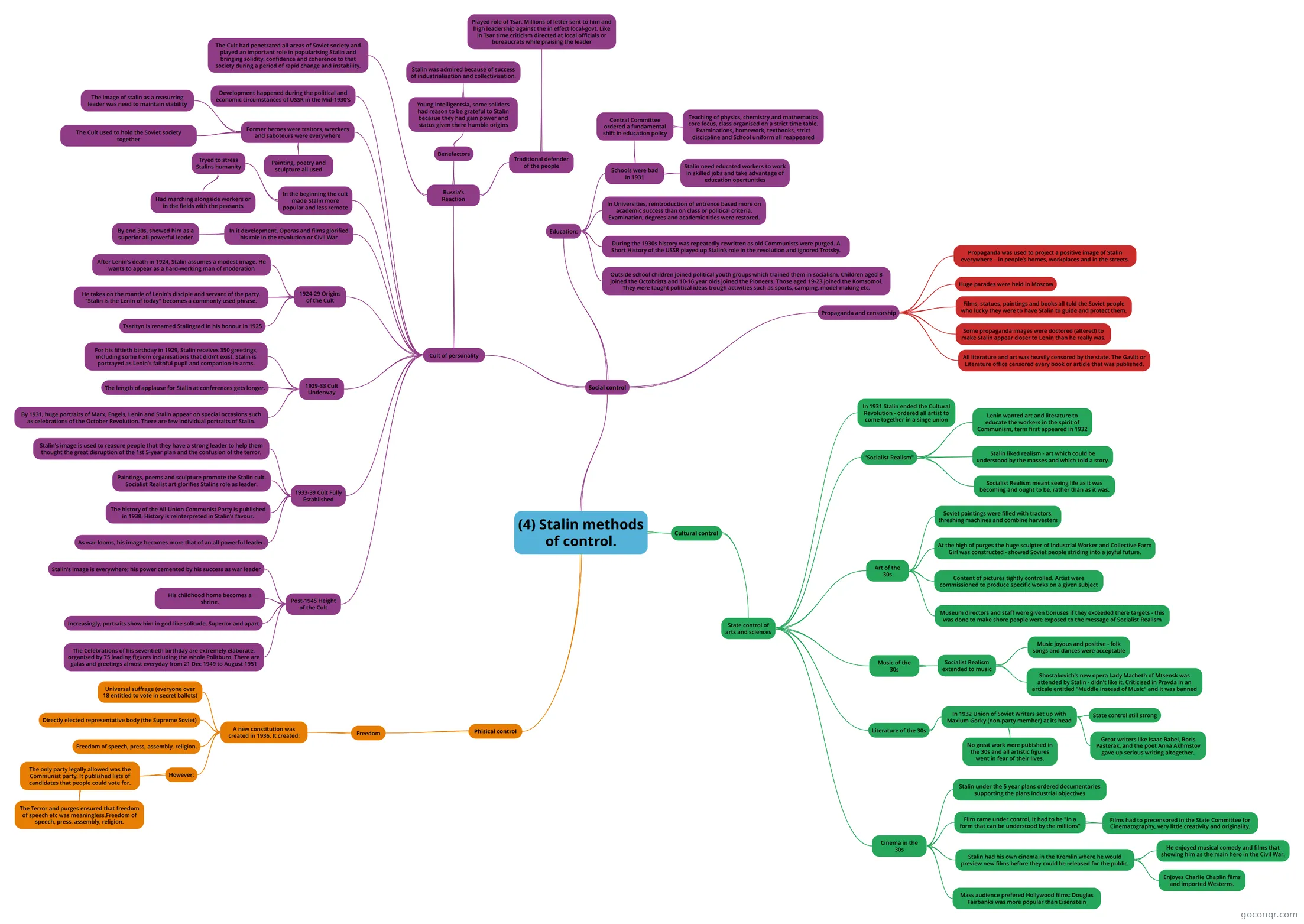
Mind map: Stalin methods of control
Map content
(4) Stalin methods of control.
Social control
- Cult of personality
- Development happened during the political and economic circumstances of USSR in the Mid-1930's
- Former heroes were traitors, wreckers and saboteurs were everywhere
- The image of stalin as a reasurring leader was need to maintain stability
- The Cult used to hold the Soviet society together
- Painting, poetry and sculpture all used
- In the beginning the cult made Stalin more popular and less remote
- Tryed to stress Stalins humanity
- Had marching alongside workers or in the fields with the peasants
- Tryed to stress Stalins humanity
- In it development, Operas and films glorified his role in the revolution or Civil War
- By end 30s, showed him as a superior all-powerful leader
- 1924-29 Origins of the Cult
- After Lenin's death in 1924, Stalin assumes a modest image. He wants to appear as a hard-working man of moderation
- He takes on the mantle of Lenin's disciple and servant of the party. "Stalin is the Lenin of today" becomes a commonly used phrase.
- Tsarityn is renamed Stalingrad in his honour in 1925
- 1929-33 Cult Underway
- For his fiftieth birthday in 1929, Stalin receives 350 greetings, including some from organisations that didn't exist. Stalin is portrayed as Lenin's faithful pupil and companion-in-arms.
- The length of applause for Stalin at conferences gets longer.
- By 1931, huge portraits of Marx, Engels, Lenin and Stalin appear on special occasions such as celebrations of the October Revolution. There are few individual portraits of Stalin.
- 1933-39 Cult Fully Established
- Stalin's image is used to reasure people that they have a strong leader to help them thought the great disruption of the 1st 5-year plan and the confusion of the terror.
- Paintings, poems and sculpture promote the Stalin cult. Socialist Realist art glorifies Stalins role as leader.
- The history of the All-Union Communist Party is published in 1938. History is reinterpreted in Stalin's favour.
- As war looms, his image becomes more that of an all-powerful leader.
- Post-1945 Height of the Cult
- Stalin's image is everywhere; his power cemented by his success as war leader
- His childhood home becomes a shrine.
- Increasingly, portraits show him in god-like solitude, Superior and apart
- The Celebrations of his seventieth birthday are extremely elaborate, organised by 75 leading figures including the whole Politburo. There are galas and greetings almost everyday from 21 Dec 1949 to August 1951
- Russia's Reaction
- Benefactors
- Young intelligentsia, some soliders had reason to be grateful to Stalin becasue they had gain power and status given there humble origins
- Stalin was admired because of success of industrialisation and collectivisation.
- Young intelligentsia, some soliders had reason to be grateful to Stalin becasue they had gain power and status given there humble origins
- Traditional defender of the people
- Played role of Tsar. Millions of letter sent to him and high leadership against the in effect local-govt. Like in Tsar time criticism directed at local officials or bureaucrats while praising the leader
- The Cult had penetrated all areas of Soviet society and played an important role in popularising Stalin and bringing solidity, confidence and coherence to that society during a period of rapid change and instability.
- Benefactors
- Propaganda and censorship
- Propaganda was used to project a positive image of Stalin everywhere – in people’s homes, workplaces and in the streets.
- Huge parades were held in Moscow
- Films, statues, paintings and books all told the Soviet people who lucky they were to have Stalin to guide and protect them.
- Some propaganda images were doctored (altered) to make Stalin appear closer to Lenin than he really was.
- All literature and art was heavily censored by the state. The Gavlit or Literature office censored every book or article that was published.
- Education:
- Schools were bad in 1931
- Stalin need educated workers to work in skilled jobs and take advantage of education opertunities
- Central Committee ordered a fundamental shift in education policy
- Teaching of physics, chemistry and mathematics core focus, class organised on a strict time table. Examinations, homework, textbooks, strict discicpline and School uniform all reappeared
- In Universities, reintroduction of entrence based more on academic success than on class or political criteria. Examination, degrees and academic titles were restored.
- During the 1930s history was repeatedly rewritten as old Communists were purged. A Short History of the USSR played up Stalin’s role in the revolution and ignored Trotsky.
- Outside school children joined political youth groups which trained them in socialism. Children aged 8 joined the Octobrists and 10-16 year olds joined the Pioneers. Those aged 19-23 joined the Komsomol. They were taught political ideas trough activities such as sports, camping, model-making etc.
- Schools were bad in 1931
- Cult of personality
Cultural control
- State control of arts and sciences
- In 1931 Stalin ended the Cultural Revolution - ordered all artist to come together in a singe union
- "Socialist Realism"
- Lenin wanted art and literature to educate the workers in the spirit of Communism, term first appeared in 1932
- Stalin liked realism - art which could be understood by the masses and which told a story.
- Socialist Realism meant seeing life as it was becoming and ought to be, rather than as it was.
- Art of the 30s
- Soviet paintings were filled with tractors, threshing machines and combine harvesters
- At the high of purges the huge sculpter of Industrial Worker and Collective Farm Girl was constructed - showed Soviet people striding into a joyful future.
- Content of pictures tightly controlled. Artist were commissioned to produce specific works on a given subject
- Museum directors and staff were given bonuses if they exceeded there targets - this was done to make shore people were exposed to the message of Socialist Realism
- Music of the 30s
- Socialist Realism extended to music
- Music joyous and positive - folk songs and dances were acceptable
- Shostakovich's new opera Lady Macbeth of Mtsensk was attended by Stalin - didn't like it. Criticised in Pravda in an articale entitled "Muddle instead of Music" and it was banned
- Socialist Realism extended to music
- Literature of the 30s
- In 1932 Union of Soviet Writers set up with Maxium Gorky (non-party member) at its head
- State control still strong
- Great writers like Isaac Babel, Boris Pasterak, and the poet Anna Akhmstov gave up serious writing altogether.
- No great work were pubished in the 30s and all artistic figures went in fear of their lives.
- In 1932 Union of Soviet Writers set up with Maxium Gorky (non-party member) at its head
- Cinema in the 30s
- Stalin under the 5 year plans ordered documentaries supporting the plans industrial objectives
- Film came under control, it had to be "in a form that can be understood by the millions"
- Films had to precensored in the State Committee for Cinematography, very little creativity and originality.
- Stalin had his own cinema in the Kremlin where he would preview new films before they could be released for the public.
- He enjoyed musical comedy and films that showing him as the main hero in the Civil War.
- Enjoyes Charlie Chaplin films and imported Westerns.
- Mass audience prefered Hollywood films: Douglas Fairbanks was more popular than Eisenstein
- State control of arts and sciences
Phisical control
- Freedom
- A new constitution was created in 1936. It created:
- Universal suffrage (everyone over 18 entitled to vote in secret ballots)
- Directly elected representative body (the Supreme Soviet)
- Freedom of speech, press, assembly, religion.
- However:
- The only party legally allowed was the Communist party. It published lists of candidates that people could vote for.
- The Terror and purges ensured that freedom of speech etc was meaningless.Freedom of speech, press, assembly, religion.
- The only party legally allowed was the Communist party. It published lists of candidates that people could vote for.
- A new constitution was created in 1936. It created:
- Freedom
Information
- Description
- A level Russia History ((7) Stalin) Mind Map on (4) Stalin methods of control., created by Marcus Danvers on 23/02/2015.
- Created by
- Marcus Danvers
- Views
- 11
- Rating
More on Stalin's Dictatorship and Control