
Mind map
Surgical Endodontics (RCS)
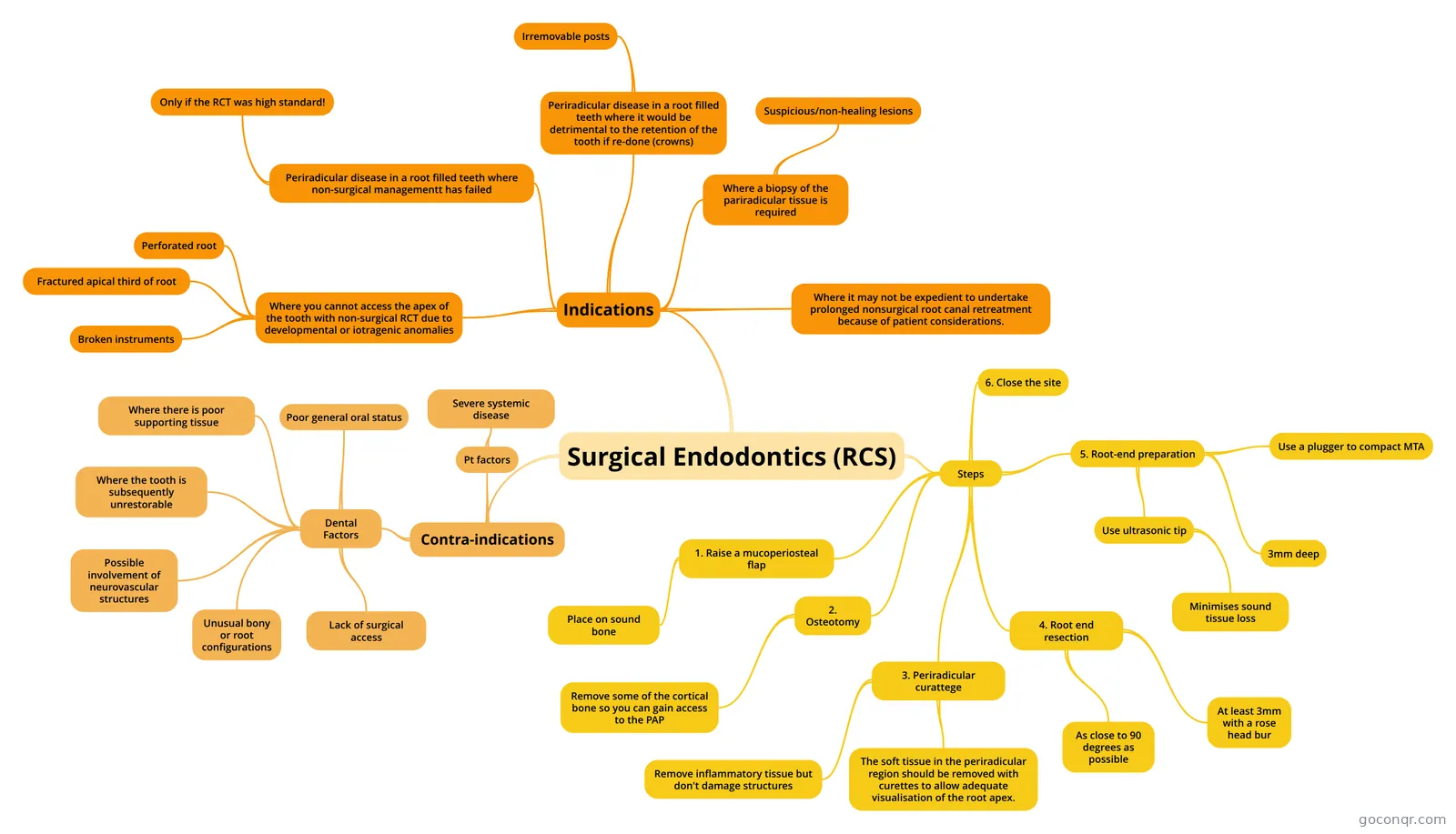
Mind map: Surgical Endodontics (RCS)
Map content
Surgical Endodontics (RCS)
Indications
- Where you cannot access the apex of the tooth with non-surgical RCT due to developmental or iotragenic anomalies
- Perforated root
- Broken instruments
- Fractured apical third of root
- Periradicular disease in a root filled teeth where non-surgical managementt has failed
- Only if the RCT was high standard!
- Periradicular disease in a root filled teeth where it would be detrimental to the retention of the tooth if re-done (crowns)
- Irremovable posts
- Where a biopsy of the pariradicular tissue is required
- Suspicious/non-healing lesions
- Where it may not be expedient to undertake prolonged nonsurgical root canal retreatment because of patient considerations.
- Where you cannot access the apex of the tooth with non-surgical RCT due to developmental or iotragenic anomalies
Contra-indications
- Pt factors
- Severe systemic disease
- Dental Factors
- Lack of surgical access
- Possible involvement of neurovascular structures
- Where the tooth is subsequently unrestorable
- Poor general oral status
- Where there is poor supporting tissue
- Unusual bony or root configurations
- Pt factors
Steps
- 1. Raise a mucoperiosteal flap
- Place on sound bone
- 2. Osteotomy
- Remove some of the cortical bone so you can gain access to the PAP
- 3. Periradicular curattege
- The soft tissue in the periradicular region should be removed with curettes to allow adequate visualisation of the root apex.
- Remove inflammatory tissue but don't damage structures
- 4. Root end resection
- As close to 90 degrees as possible
- At least 3mm with a rose head bur
- 5. Root-end preparation
- 3mm deep
- Use ultrasonic tip
- Minimises sound tissue loss
- Use a plugger to compact MTA
- 6. Close the site
- 1. Raise a mucoperiosteal flap
Information
- Description
- Oral Surgery Mind Map on Surgical Endodontics (RCS), created by Zainab Patel on 03/03/2020.
- Created by
- Zainab Patel
- Views
- 0
- Rating