
Mind map
FORMS OF INTELLECTUAL PROPERTY
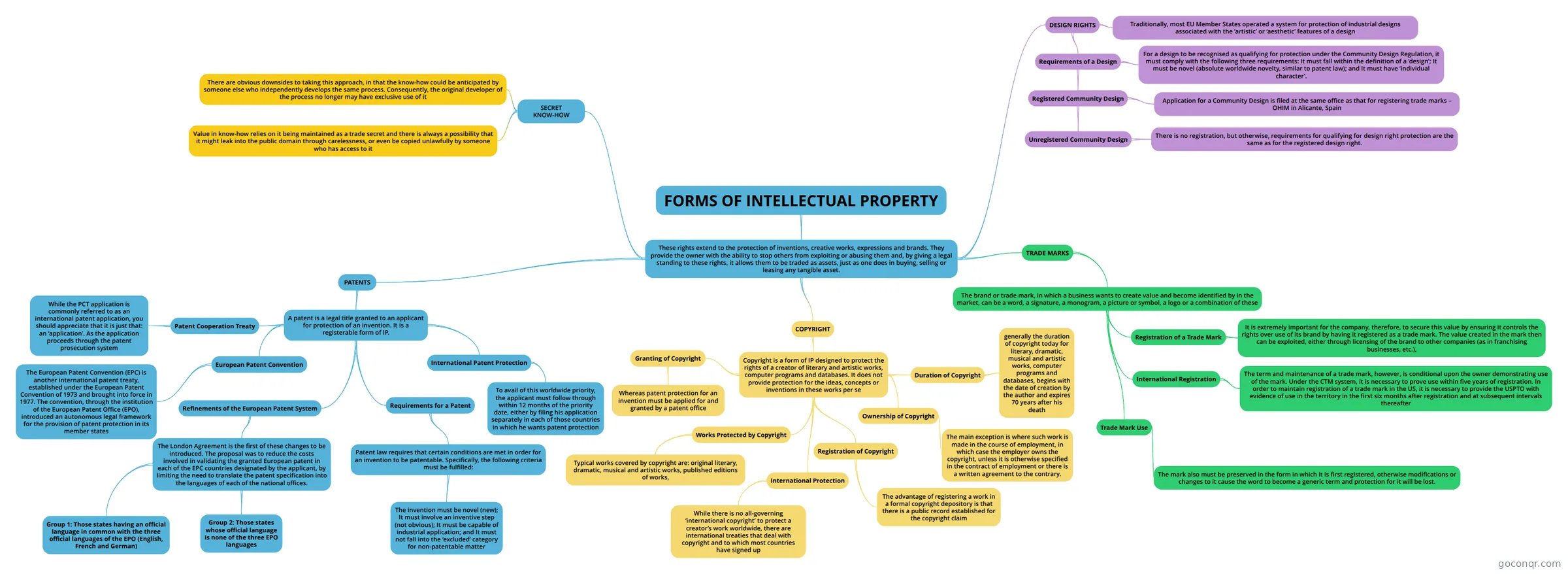
Mind map: Forms of intellectual property
Map content
FORMS OF INTELLECTUAL PROPERTY
These rights extend to the protection of inventions, creative works, expressions and brands. They provide the owner with the ability to stop others from exploiting or abusing them and, by giving a legal standing to these rights, it allows them to be traded as assets, just as one does in buying, selling or leasing any tangible asset.
- PATENTS
- A patent is a legal title granted to an applicant for protection of an invention. It is a registerable form of IP.
- Patent Cooperation Treaty
- While the PCT application is commonly referred to as an international patent application, you should appreciate that it is just that: an ‘application’. As the application proceeds through the patent prosecution system
- European Patent Convention
- The European Patent Convention (EPC) is another international patent treaty, established under the European Patent Convention of 1973 and brought into force in 1977. The convention, through the institution of the European Patent Office (EPO), introduced an autonomous legal framework for the provision of patent protection in its member states
- Refinements of the European Patent System
- The London Agreement is the first of these changes to be introduced. The proposal was to reduce the costs involved in validating the granted European patent in each of the EPC countries designated by the applicant, by limiting the need to translate the patent specification into the languages of each of the national offices.
- Group 1: Those states having an official language in common with the three official languages of the EPO (English, French and German)
- Group 2: Those states whose official language is none of the three EPO languages
- The London Agreement is the first of these changes to be introduced. The proposal was to reduce the costs involved in validating the granted European patent in each of the EPC countries designated by the applicant, by limiting the need to translate the patent specification into the languages of each of the national offices.
- Requirements for a Patent
- Patent law requires that certain conditions are met in order for an invention to be patentable. Specifically, the following criteria must be fulfilled:
- The invention must be novel (new); It must involve an inventive step (not obvious); It must be capable of industrial application; and It must not fall into the ‘excluded’ category for non-patentable matter
- Patent law requires that certain conditions are met in order for an invention to be patentable. Specifically, the following criteria must be fulfilled:
- International Patent Protection
- To avail of this worldwide priority, the applicant must follow through within 12 months of the priority date, either by filing his application separately in each of those countries in which he wants patent protection
- Patent Cooperation Treaty
- A patent is a legal title granted to an applicant for protection of an invention. It is a registerable form of IP.
- COPYRIGHT
- Copyright is a form of IP designed to protect the rights of a creator of literary and artistic works, computer programs and databases. It does not provide protection for the ideas, concepts or inventions in these works per se
- Granting of Copyright
- Whereas patent protection for an invention must be applied for and granted by a patent office
- Works Protected by Copyright
- Typical works covered by copyright are: original literary, dramatic, musical and artistic works, published editions of works,
- International Protection
- While there is no all-governing ‘international copyright’ to protect a creator’s work worldwide, there are international treaties that deal with copyright and to which most countries have signed up
- Registration of Copyright
- The advantage of registering a work in a formal copyright depository is that there is a public record established for the copyright claim
- Ownership of Copyright
- The main exception is where such work is made in the course of employment, in which case the employer owns the copyright, unless it is otherwise specified in the contract of employment or there is a written agreement to the contrary.
- Duration of Copyright
- generally the duration of copyright today for literary, dramatic, musical and artistic works, computer programs and databases, begins with the date of creation by the author and expires 70 years after his death
- Granting of Copyright
- Copyright is a form of IP designed to protect the rights of a creator of literary and artistic works, computer programs and databases. It does not provide protection for the ideas, concepts or inventions in these works per se
- TRADE MARKS
- The brand or trade mark, in which a business wants to create value and become identified by in the market, can be a word, a signature, a monogram, a picture or symbol, a logo or a combination of these
- Registration of a Trade Mark
- It is extremely important for the company, therefore, to secure this value by ensuring it controls the rights over use of its brand by having it registered as a trade mark. The value created in the mark then can be exploited, either through licensing of the brand to other companies (as in franchising businesses, etc.),
- International Registration
- The term and maintenance of a trade mark, however, is conditional upon the owner demonstrating use of the mark. Under the CTM system, it is necessary to prove use within five years of registration. In order to maintain registration of a trade mark in the US, it is necessary to provide the USPTO with evidence of use in the territory in the first six months after registration and at subsequent intervals thereafter
- Trade Mark Use
- The mark also must be preserved in the form in which it is first registered, otherwise modifications or changes to it cause the word to become a generic term and protection for it will be lost.
- Registration of a Trade Mark
- The brand or trade mark, in which a business wants to create value and become identified by in the market, can be a word, a signature, a monogram, a picture or symbol, a logo or a combination of these
- DESIGN RIGHTS
- Traditionally, most EU Member States operated a system for protection of industrial designs associated with the ‘artistic’ or ‘aesthetic’ features of a design
- Requirements of a Design
- For a design to be recognised as qualifying for protection under the Community Design Regulation, it must comply with the following three requirements: It must fall within the definition of a ‘design’; It must be novel (absolute worldwide novelty, similar to patent law); and It must have ‘individual character’.
- Registered Community Design
- Application for a Community Design is filed at the same office as that for registering trade marks – OHIM in Alicante, Spain
- Unregistered Community Design
- There is no registration, but otherwise, requirements for qualifying for design right protection are the same as for the registered design right.
- SECRET KNOW-HOW
- There are obvious downsides to taking this approach, in that the know-how could be anticipated by someone else who independently develops the same process. Consequently, the original developer of the process no longer may have exclusive use of it
- Value in know-how relies on it being maintained as a trade secret and there is always a possibility that it might leak into the public domain through carelessness, or even be copied unlawfully by someone who has access to it
- PATENTS
Information
- Description
- Mind Map on FORMS OF INTELLECTUAL PROPERTY, created by Juan Carlos Ordonez on 05/03/2020.
- Created by
- Juan Carlos Ordonez
- Views
- 1
- Rating
More on Types of Intellectual Property