
Mind map
Psych Exam 2
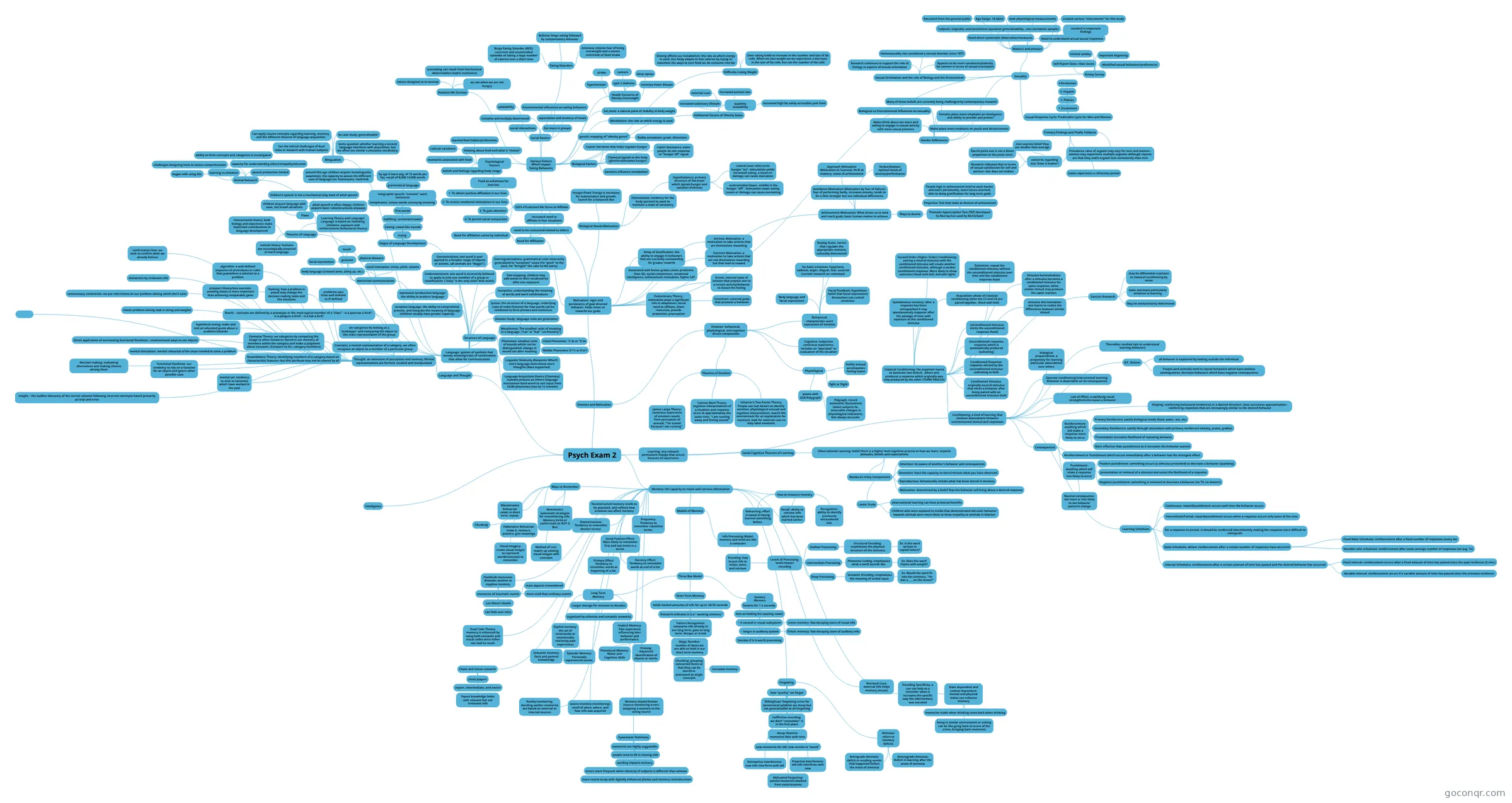
Mind map: Psych exam 2
Map content
Psych Exam 2
Learning: any relevant permanent change that occurs because of experience
- Conditioning: a kind of learning that involves associations between environmental stimuli and responses
- Classical Conditioning: the organism learns to associate two stimuli , where one produces a response which originally was only produced by the other (THINK PAVLOV)
- Unconditioned stimulus: elicits the unconditioned response (food)
- Unconditioned response: response which is automatically produced (salivating)
- Conditioned Stimulus: originally neutral stimulus that elicits a behavior after being paired with an unconditioned stimulus (bell)
- Conditioned Response: response elicited by the unconditioned stimulus (salivating to bell)
- Acquisition: phase of classical conditioning when the CS and US are paired together. (food with bell)
- Extinction: repeat the conditioned stimulus without the unconditioned stimulus over time and the conditioned response stops
- Spontaneous recovery: after a response has been extinguished it may spontaneously reappear after the passage of time with exposure to the conditioned stimulus
- Second Order (Higher Order) Conditioning: pairing a neutral stimulus with the conditioned stimulus will create another conditioned stimulus, although a weaker conditioned response. More likely to show extinction (food with bell, bell with light)
- Stimulus Generalization: after a stimulus becomes a conditioned stimulus for some response, other, similar stimuli may produce the same reaction
- stimulus discrimination: one learns to realize the differences between similar stimuli
- Garcia's Research
- may be differential reactions to classical conditioning by sense
- taste aversions particularly sensitive to learning
- May be evolutionarily determined
- biological preparedness: a propensity for learning particular associations over others
- Operant conditioning/instrumental learning: Behavior is dependent on its consequences
- Thorndike: studied cats to understand learning behaviors
- Law of Effect: a satisfying result strengthens/increases a behavior
- B.F. Skinner
- all behavior is explained by looking outside the individual
- People (and animals) tend to repeat behaviors which have positive consequences; decrease behaviors which have negative consequences
- Consequences
- Neutral consequence: not more or less likely to see behavior patterns change
- Reinforcement: anything which will make a response more likely to occur
- Primary Reinforcers: satisfy biological needs (food, water, sex, etc)
- Secondary Reinforcers: satisfy through association with primary reinforcers (money, praise, grades)
- Presentation increases likelihood of repeating behavior
- More effective than punishment as it increases the behavior wanted
- Punishment: anything which will make a response less likely to occur
- presentation or removal of a stimulus decreases the likelihood of a response
- Positive punishment: something occurs (a stimulus presented) to decrease a behavior (spanking)
- Negative punishment: something is removed to decrease a behavior (no TV, no dessert)
- Reinforcement or Punishment which occurs immediately after a behavior has the strongest effect.
- Learning Schedules
- Continuous: reward/punishment occurs each time the behavior occurs
- Intermittent/Partial: reward/punishment occurs when a response occurs only some of the time
- Ratio Schedules: deliver reinforcement after a certain number of responses have occurred
- Fixed Ratio Schedules: reinforcement after a fixed number of responses (every 4x)
- Variable ratio schedules: reinforcement after some average number of responses (on avg. 7x)
- Interval Schedules: reinforcement after a certain amount of time has passed and the desired behavior has occurred
- Fixed interval: reinforcement occurs after a fixed amount of time has passed since the past reinforcer (5 min.)
- Variable interval: reinforcement occurs if a variable amount of time has passed since the previous reinforcer
- For a response to persist, it should be reinforced intermittently making the response more difficult to extinguish.
- Shaping: reinforcing behavioral tendencies in a desired direction. Uses successive approximation - reinforcing responses that are increasingly similar to the desired behavior
- Classical Conditioning: the organism learns to associate two stimuli , where one produces a response which originally was only produced by the other (THINK PAVLOV)
- Social Cognitive Theories of Learning
- Observational Learning: belief there is a higher level cognitive process to how we learn; impacts attitudes, beliefs and expectations
- Bandura's 4 Key Components
- Attention: be aware of another's behavior and consequences
- Retention: have the capacity to store/retrieve what you have observed
- Reproduction: behaviorally imitate what has been stored in memory
- Motivation: determined by a belief that the behavior will bring about a desired response
- Lassie Study
- observational learning can have prosocial benefits
- Children who were exposed to media that demonstrated altruistic behavior towards animals were more likely to show empathy to animals in distress
- Bandura's 4 Key Components
- Observational Learning: belief there is a higher level cognitive process to how we learn; impacts attitudes, beliefs and expectations
- Conditioning: a kind of learning that involves associations between environmental stimuli and responses
Memory: the capacity to retain and retrieve information
- How to measure memory
- Recall: ability to retrieve info which has been learned earlier.
- Recognition: ability to identify previously encountered info.
- Relearning: effort is saved in having learned something before.
- Models of Memory
- Info Processing Model: memory and mind are like a computer
- Encoding: how to put info in, retain, store, and retrieve.
- Levels of Processing: levels impact encoding
- Shallow Processing:
- Structural Encoding: emphasizes the physical structure of the stimulus
- Ex: Is the word written in capital letters?
- Structural Encoding: emphasizes the physical structure of the stimulus
- Intermediate Processing
- Phonemic Coding: emphasizes what a word sounds like.
- Ex: Does the word rhyme with weight?
- Phonemic Coding: emphasizes what a word sounds like.
- Deep Processing
- Semantic Encoding: emphasizes the meaning of verbal input.
- Ex: Would the word fit into the sentence, "He met a ___ on the street?"
- Semantic Encoding: emphasizes the meaning of verbal input.
- Shallow Processing:
- Levels of Processing: levels impact encoding
- Encoding: how to put info in, retain, store, and retrieve.
- Three Box Model
- Sensory Memory
- Retains for 1-2 seconds
- Acts as holding bin (waiting room)
- ~ ½ second in visual subsystem
- iconic memory: fast-decaying store of visual info
- ~ longer in auditory system
- Echoic memory: fast-decaying store of auditory info
- Decides if it is worth processing
- Short Term Memory
- holds limited amounts of info for up to 20/30 seconds
- Research indicates it is a “ working memory"
- Pattern Recognition: compares info already in our long term, goes to long term, decays, or is lost
- Magic Number: number of items we are able to hold in our short term memory
- Chunking: grouping connected items so that they can be stored or processed as single concepts
- increases memory
- holds limited amounts of info for up to 20/30 seconds
- Long Term Memory
- Longer storage for minutes to decades
- organized by schemas and semantic networks
- Explicit memory: the act of consciously or intentionally retrieving past experiences
- Semantic memory: facts and general knowlecdge
- Episodic Memory: Personally experienced events.
- Implicit Memory: Past experience influencing later behavior and performance.
- Procedural Memory: Motor and Cognitive Skills
- Priming: Advanced identification of objects or words.
- Sensory Memory
- Info Processing Model: memory and mind are like a computer
- Serial Position Effect: More likely to remember first and last items in a series.
- Recency Effect: Tendency to remember words at end of a list.
- Primary Effect: Tendency to remember words at beginning of a list.
- Frequency: Tendency to remember repetitive terms.
- Distinctiveness: Tendency to remember distinct terms/.
- Reconstructed memory needs to be assessed, and reflects how schemas can affect memory
- Ways to Remember
- Chunking
- Maintenance Rehearsal: retain in short term, repeat.
- Elaborative Rehearsal: know it, review it, practice, give meanings
- Visual Imagery: create visual images to represent words/concepts to remember
- Method of Loci: match up existing visual images with concepts
- Mnemonics: systematic strategies for remembering info. Memory tricks or useful tools (ie ROY G Biv)
- Dual Code Theory: memory is enhanced by using both semantic and visual codes since either can lead to recall.
- Chase and Simon research
- chess players
- Expert knowledge helps with relevant but not irrelevant info
- expert, intermediate, and novice
- Flashbulb memories: dramatic positive or negative memory.
- memories of traumatic events
- more vivid than ordinary events
- main aspects remembered
- can distort details
- can fade over time
- memories of traumatic events
- Eyewitness Testimony
- memories are highly suggestible
- errors more frequent when ethnicity of subjects is different than witness
- people tend to fill in missing info
- wording impacts memory
- more recent study with digitally enhanced photos and memory reconstruction
- memories are highly suggestible
- Reality monitoring: deciding wether memories are based on external or internal sources
- source memory (monitoring): recall of when, where, and how info was acquired
- Memory misattribution (source monitoring error): assigning a memory to the wrong source
- Forgetting
- how "quickly" we forget
- Ebbinghuas' forgetting curve for nonsensical syllables are steep but not generalizable to all forgetting
- ineffective encoding: we don't "remember" it in the first place
- decay theories: memories fade with time
- new memories for old: new version is "saved"
- Retroactive Interference: new info interferes with old
- Proactive Interference: old info interferes with new
- Motivated Forgetting: painful memories blocked from consciousness
- Amnesia: refers to memory deficits
- Retrograde Amnesia: deficit in recalling events that happened before the onset of amnesia
- Anterograde Amnesia: Deficit in learning after the onset of amnesia
- Retrieval Cues: external info helps memory (music)
- Encoding Specificity: a cue can help as a reminder when it recreates the specific way the info/memory was encoded
- State dependent and context dependent: mental and physical states can enhance memory
- memories made when drinking come back when drinking
- being in similar environment or setting can be like going back to scene of the crime, bringing back memories
- State dependent and context dependent: mental and physical states can enhance memory
- How to measure memory
Emotion and Motivation
- Emotion: behavioral, physiological, and cognitive driven components
- Cognitive: Subjective conscious experience, includes an "appraisal" or evaluation of the situation
- Physiological
- bodily arousal accompanies feeling states
- fight or flight
- assess with GSR/Polygraph
- Polgraph: record autonomic fluctuations (when subjects lie, noticeable changes in physiological indicators). Not always accurate.
- Behavioral: characteristic overt expression of emotion
- Body language and facial expressions
- Six basic emotions: happiness, sadness, anger, disgust, fear, surprise (current research on contempt)
- Facial Feedback Hypothesis: belief that facial expressions themselves can control emotions.
- Display Rules: norms that regulate the appropriate motions; culturally determined
- Theories of Emotion
- James-Lange Theory: conscious experience of emotion results from perception of arousal; "I'm scared because I am running".
- Cannon-Bard Theory: cognitive interpretations of a situation and response occur at approximately the same time; "I am running away and feeling scared"
- Schacter's Two-Factor Theory: People use two factors to identify emotion; physiological arousal and cognitive interpretation; search the environment for an explanation for reactions; look for external cues to help label emotions
- Motivation: vigor and persistence of goal directed behavior, helps move us towards our goals
- Evolutionary Theory: motivation plays a significant role in adaptation; social need to affiliate, share resources, provide protection, procreation
- Drives: internal state of tension that propels one to a certain activity/behavior to lessen the feeling
- Incentives: external goals that promote a behavior
- Intrinsic Motivation: a motivation to take actions that are themselves rewarding
- Extrinsic Motivation: a motivation to take actions that are not themselves rewarding but that lead to reward
- Delay of Gratification: the ability to engage in behaviors that are currently unrewarding for greater rewards
- Associated with better grades (more predictive than IQ), social competence, emotional intelligence, achievement motivation, higher SAT
- Biological Needs/Motivation
- Homeostasis: tendency for the body (person) to want to maintain a state of constancy
- Hunger/Food: Energy is necessary for maintenance and growth. Search for a balanced diet
- Hypothalamus: primary structure of the brain which signals hunger and satiation (fullness)
- Lateral (near side) turns hunger "on". stimulation yields increased eating. a lesion or damage can cause starvation
- ventromedial (lower, middle) is the hunger "off". Stimulation stops eating. Lesion or damage can cause overeating.
- Various Factors Which Impact Eating Behaviors
- Biological Factors
- Genetics influence metabolism
- Bodily sensations: growl, distension
- Chemical signals to the body (ghrelin-stimulates hunger)
- Leptin: hormone that helps regulate hunger
- Leptin Resistance: some people do not response to "hunger off" signal
- genetic mapping of "obesity genes"
- Social Factors
- Environmental influences on eating behaviors
- Complex and multiply determined
- Eat more in groups
- expectation and memory of meals
- palatability
- social interactions
- Psychological Factors
- thinking about food and what it "means"
- learned food habits/preferences
- memories associated with food
- beliefs and feelings regarding body image
- cultural variations
- Food as substitute for love/sex
- Health Concerns of Obesity Overweight
- coronary heart disease
- type 2 diabetes
- cancers
- hypertension
- stroke
- sleep apnea
- Reasons We Overeat
- overeating can result from biochemical abnormalities (leptin resistance)
- we eat when we are not hungry
- nature designed us to overeat
- Additional Factors of Obesity Rates
- quantity availability
- increased high fat easily accessible junk food
- Increased portion size
- increased sedentary lifestyle
- external cues
- quantity availability
- Difficulty Losing Weight
- Over eating leads to increase in the number and size of fat cells. When we lose weight we we experience a decrease in the size of fat cells, but not the number of fat cells
- Dieting affects our metabolism; the rate at which energy is used. Our body adapts to less calories by trying to maximize the ways to turn food we do consume into fat
- Metabolism: the rate at which energy is used
- Set point: a natural point of stability in body weight
- Eating Disorders
- Anorexia: intense fear of being overweight and a severe restriction of food intake
- Bulimia: binge eating followed by compensatory behavior
- Binge Eating Disorder (BED): recurrent and uncontrolled episodes of eating a large number of calories over a short time
- Biological Factors
- Sexuality
- Kinsey Survey
- Identified sexual behaviors/preferences
- Self-Report Data—bias issues
- limited validity
- important beginning
- Masters and Johnson
- Need to understand actual sexual responses
- Need direct systematic observation/measures
- Subjects: originally used prostitutes (question generalizability...non-normative sample)
- Recruited from the general public
- Age Range: 18-60ish
- took physiological measurements
- created various "instruments" for this study
- resulted in important findings
- Sexual Response Cycle: Predictable Cycle for Men and Women
- 1. Excitement
- 2. Plateau
- 3. Orgasm
- 4 Resolution
- Primary Findings and Phallic Fallacies
- males experience a refractory period
- Prevalence rates of orgasm may vary for men and women - women may experience multiple orgasms although reports are that they reach orgasm less consistently than men
- concerns regarding size: Does it matter?
- flaccid penis size is not a direct proportion to the penis erect
- men express belief they are smaller than average
- Research indicates that in terms of sexual satisfaction for self and partner: size does not matter
- 1. Excitement
- Gender Differences
- Males think about sex more and willing to engage in sexual activity with more casual partners
- Males place more emphasis on youth and attractiveness
- Females place more emphasis on intelligence and ability to provide and protect
- Biological vs Environmental influences on sexuality
- Many of these beliefs are currently being challenged by contemporary research
- Sexual Orientation and the role of Biology and the Environment
- Research continues to support the role of biology in aspects of sexual orientation
- Appears to be more variations/plasticity for women in terms of sexual orientation
- Homosexuality not considered a mental disorder since 1973
- Kinsey Survey
- Need for Affiliation
- need to be connected/related to others
- Need for affiliation varies by individual
- Increased need to affiliate in fear situations
- Hill's 4 Functions We Strive to Affiliate
- 1. To obtain positive affiliation in our lives
- 2. To receive emotional stimulation in our lives
- 3. To gain attention
- 4. To permit social comparison
- Achievement Motivation: What drives us to seek and reach goals; basic human motive to achieve.
- Approach Motivation (Motivation to Success): thrill at mastery, sense of achievement
- Avoidance Motivation (Motivation by fear of failure): fear of performing badly, increases anxiety, tends to be a little stronger but see individual differences
- Yerkes/Dodson: optimal levels of anxiety/performance
- Ways to Assess
- Thematic Apperception Test (TAT) developed by Murray but used by McClelland
- Projective Test that looks at themes of achievement
- People high in achievement tend to work harder and more persistently, more future oriented, able to delay gratification for long term goals
- Thematic Apperception Test (TAT) developed by Murray but used by McClelland
- Emotion: behavioral, physiological, and cognitive driven components
Language and Thought
- Language: system of symbols that convey meaning/rules of combination that allow for communication
- Linguistic Relativity (Benjamin Whorf): one's language determines one's thoughts (data supported)
- Language Acquisition Device (Chomsky): humans possess an inborn language mechanism hard-wired to sort input from 20-80 phonemes (lose by 12 months)
- Structure of Language
- Phonemes: smallest units of sounds which can be distinguished; change in sound can alter meaning
- Middle Phonemes: b"i"t or b"a"t
- Initial Phonemes: "c"at or "b"at
- Morphemes: The smallest units of meaning in a language. ("cat" or "bat" "un-friend-ly")
- Phonemes: smallest units of sounds which can be distinguished; change in sound can alter meaning
- Semantics: understanding the meaning of words and word combinations
- Syntax: the structure of a language, underlying rules of order/function for how words can be combined to form phrases and sentences
- Gleason Study: language rules are generative
- Overregularizations: grammatical rules incorrectly generalized to “exception” cases (He "goed" to the park; He "bringed" the cake to the party)
- Fast-mapping: children may add words to their vocabularies after one exposure
- Overextensions: one word is over applied to a broader range of objects or actions. (all animals are "doggie")
- Underextensions: one word is incorrectly believed to apply to only one member of a group or classification. ("sissy" is the only sister that exists)
- expressive (productive) language: the ability to produce language
- receptive language: the ability to comprehend, process, and integrate the meaning of language (children usually have greater capacity)
- Stages of Language Development
- crying
- Cooing: vowel-like sounds
- babbling: consonant/vowel
- first words
- holophrases: simple words conveying meaning
- telegraphic speech: "content" word sentences
- grammatical language
- by age 6 learn avg. of 15 words per fay, vocab of 8,000-14,000 words
- around this age children acquire metalinguistic awareness: the capacity to assess the different uses of language (ex: homonyms; read/red)
- Nonverbal communication
- vocal intonation: stress, pitch, volume
- body language (crossed arms, siting up, etc.)
- gestures
- physical distance
- facial expressions
- touch
- Theories of Language
- Learning Theory and Language: Language is based on modeling, imitation, exposure and reinforcement (behaviorist theory)
- Flaws
- children acquire language with ease, not broad variations
- adult speech is often sloppy; children acquire basic rules/structures anyways
- children's speech is not a mechanical play back of adult speech
- Flaws
- nativist theory: humans are neurologically prewired to learn language
- Interactionist theory: both biology and experience make important contributions to language development
- Learning Theory and Language: Language is based on modeling, imitation, exposure and reinforcement (behaviorist theory)
- Bilngualism
- Some question whether learning a second language interferes with acquisition, but we often see similar cumulative vocabulary
- See the ethical challenges of dual roles in research with human subjects
- Can apply course concepts regarding learning, memory, and the different theories of language acquisition
- As case study: generalizable?
- Animal Research
- speech production limited
- challenges designing tests to assess comprehension
- capacity for understanding others/empathy/altruism
- learning vs imitation
- ability to form concepts and categories is investigated
- began with using ASL
- Thought: an extension of perception and memory. Mental representations are formed, recalled and manipulated
- Concepts; a mental representation of a category; we often recognize an object as a member of a particular group
- Resemblance Theory: identifying members of a category based on characteristic features--but this attribute may not be shared by all
- Exemplar Theory: we categorize by comparing the image to other instances stored in our memory of members within the category and make a judgment about inclusion. (Compare to ALL category members)
- we categorize by looking at a "prototype" and comparing the object to this main representation of the group
- Rosch: - concepts are defined by a prototype or the most typical member of a "class" - is a sparrow a bird? - is a penguin a bird? - is a bat a bird?
- problems vary from well defined to ill defined
- framing: how a problem is posed may change the decision making tasks and the solutions
- prospect theory/loss aversion: avoiding losses is more important than achieving comparable gains
- algorithm: a well-defined sequence of procedures or rules that guarantees a solution to a problem
- hyptohesis tesing: make and test an educated guess about a problem/solution
- mental simulation: mental rehearsal of the steps needed to solve a problem
- mental set: tendency to stick to solutions which have worked in the past
- functional fixedness: our tendency to rely on a function for an object and ignore other possible uses
- classic problem solving task is string and weights
- Direct application of overcoming functional fixedness : creative/novel ways to use objects
- confirmation bias: we seek to confirm what we already believe
- distraction by irrelevant info
- unnecessary constraints: we put restrictions on our problem solving which don't exist
- insight: - the sudden discovery of the correct solution following incorrect attempts based primarily on trial and error
- decision making: evaluating alternatives and making choices among them
- Language: system of symbols that convey meaning/rules of combination that allow for communication
Intelligence
Information
- Description
- Mind Map on Psych Exam 2, created by C DS on 11/03/2020.
- Created by
- C DS
- Views
- 0
- Rating