
Mind map
ANCIENT PHILOSOPHICAL INFLUENCES
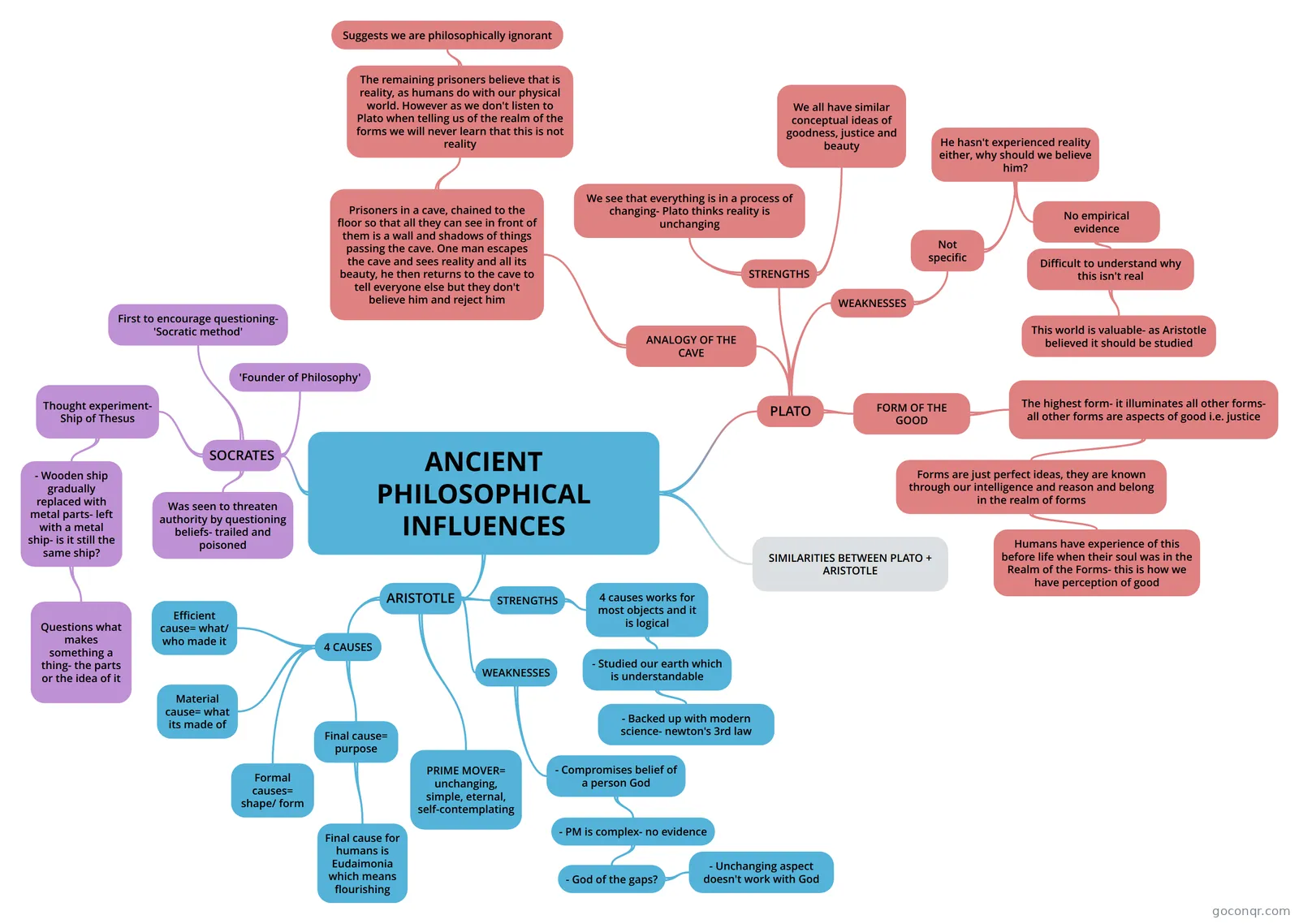
Mind map: ancient philosophical influences
Map content
ANCIENT PHILOSOPHICAL INFLUENCES
ARISTOTLE
- 4 CAUSES
- Efficient cause= what/ who made it
- Material cause= what its made of
- Formal causes= shape/ form
- Final cause= purpose
- Final cause for humans is Eudaimonia which means flourishing
- PRIME MOVER= unchanging, simple, eternal, self-contemplating
- STRENGTHS
- 4 causes works for most objects and it is logical
- - Studied our earth which is understandable
- - Backed up with modern science- newton's 3rd law
- - Studied our earth which is understandable
- 4 causes works for most objects and it is logical
- WEAKNESSES
- - Compromises belief of a person God
- - PM is complex- no evidence
- - God of the gaps?
- - Unchanging aspect doesn't work with God
- - God of the gaps?
- - PM is complex- no evidence
- - Compromises belief of a person God
- 4 CAUSES
PLATO
- FORM OF THE GOOD
- The highest form- it illuminates all other forms- all other forms are aspects of good i.e. justice
- Forms are just perfect ideas, they are known through our intelligence and reason and belong in the realm of forms
- Humans have experience of this before life when their soul was in the Realm of the Forms- this is how we have perception of good
- Forms are just perfect ideas, they are known through our intelligence and reason and belong in the realm of forms
- The highest form- it illuminates all other forms- all other forms are aspects of good i.e. justice
- ANALOGY OF THE CAVE
- Prisoners in a cave, chained to the floor so that all they can see in front of them is a wall and shadows of things passing the cave. One man escapes the cave and sees reality and all its beauty, he then returns to the cave to tell everyone else but they don't believe him and reject him
- The remaining prisoners believe that is reality, as humans do with our physical world. However as we don't listen to Plato when telling us of the realm of the forms we will never learn that this is not reality
- Suggests we are philosophically ignorant
- The remaining prisoners believe that is reality, as humans do with our physical world. However as we don't listen to Plato when telling us of the realm of the forms we will never learn that this is not reality
- Prisoners in a cave, chained to the floor so that all they can see in front of them is a wall and shadows of things passing the cave. One man escapes the cave and sees reality and all its beauty, he then returns to the cave to tell everyone else but they don't believe him and reject him
- STRENGTHS
- We see that everything is in a process of changing- Plato thinks reality is unchanging
- We all have similar conceptual ideas of goodness, justice and beauty
- WEAKNESSES
- Not specific
- He hasn't experienced reality either, why should we believe him?
- No empirical evidence
- Difficult to understand why this isn't real
- This world is valuable- as Aristotle believed it should be studied
- Difficult to understand why this isn't real
- No empirical evidence
- He hasn't experienced reality either, why should we believe him?
- Not specific
- FORM OF THE GOOD
SOCRATES
- 'Founder of Philosophy'
- First to encourage questioning- 'Socratic method'
- Was seen to threaten authority by questioning beliefs- trailed and poisoned
- Thought experiment- Ship of Thesus
- - Wooden ship gradually replaced with metal parts- left with a metal ship- is it still the same ship?
- Questions what makes something a thing- the parts or the idea of it
- - Wooden ship gradually replaced with metal parts- left with a metal ship- is it still the same ship?
SIMILARITIES BETWEEN PLATO + ARISTOTLE