
Mind map
Urolithiasis
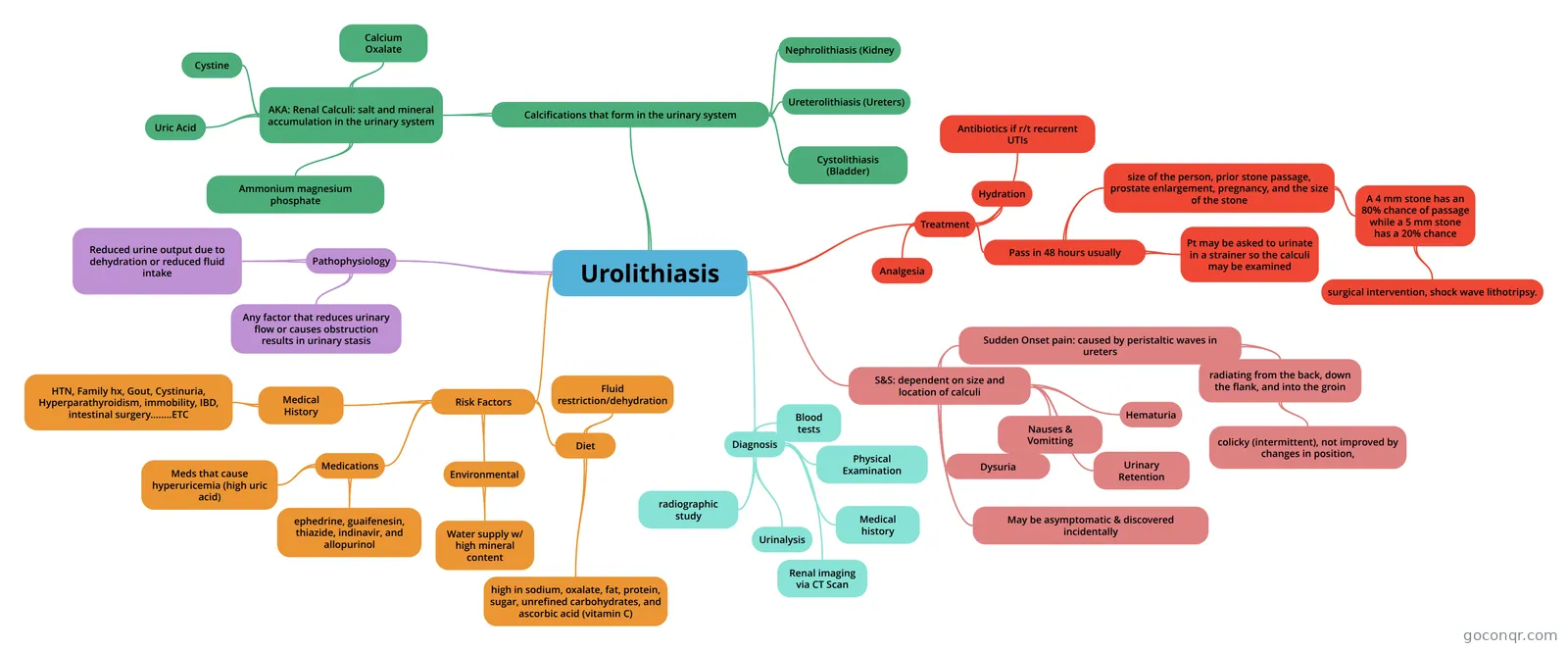
Mind map: urolithiasis
Map content
Urolithiasis
Calcifications that form in the urinary system
- Nephrolithiasis (Kidney
- Ureterolithiasis (Ureters)
- Cystolithiasis (Bladder)
- AKA: Renal Calculi: salt and mineral accumulation in the urinary system
- Calcium Oxalate
- Cystine
- Uric Acid
- Ammonium magnesium phosphate
Pathophysiology
- Any factor that reduces urinary flow or causes obstruction results in urinary stasis
- Reduced urine output due to dehydration or reduced fluid intake
Treatment
- Hydration
- Analgesia
- Pass in 48 hours usually
- size of the person, prior stone passage, prostate enlargement, pregnancy, and the size of the stone
- A 4 mm stone has an 80% chance of passage while a 5 mm stone has a 20% chance
- surgical intervention, shock wave lithotripsy.
- A 4 mm stone has an 80% chance of passage while a 5 mm stone has a 20% chance
- Pt may be asked to urinate in a strainer so the calculi may be examined
- size of the person, prior stone passage, prostate enlargement, pregnancy, and the size of the stone
- Antibiotics if r/t recurrent UTIs
S&S: dependent on size and location of calculi
- Sudden Onset pain: caused by peristaltic waves in ureters
- radiating from the back, down the flank, and into the groin
- colicky (intermittent), not improved by changes in position,
- radiating from the back, down the flank, and into the groin
- Dysuria
- Hematuria
- Urinary Retention
- Nauses & Vomitting
- May be asymptomatic & discovered incidentally
- Sudden Onset pain: caused by peristaltic waves in ureters
Diagnosis
- Urinalysis
- Renal imaging via CT Scan
- Blood tests
- Physical Examination
- Medical history
- radiographic study
Risk Factors
- Medical History
- HTN, Family hx, Gout, Cystinuria, Hyperparathyroidism, immobility, IBD, intestinal surgery........ETC
- Environmental
- Water supply w/ high mineral content
- Diet
- Fluid restriction/dehydration
- high in sodium, oxalate, fat, protein, sugar, unrefined carbohydrates, and ascorbic acid (vitamin C)
- Medications
- Meds that cause hyperuricemia (high uric acid)
- ephedrine, guaifenesin, thiazide, indinavir, and allopurinol
- Medical History
Information
- Description
- Mind Map on Urolithiasis, created by Mercedes Dysseri on 26/02/2015.
- Created by
- Mercedes Dysseri
- Views
- 21
- Rating