
Urinary Tract and Male Genitourinary Disorders
433 resources created by 304 users
This Urinary Tract and Male Genitourinary Disorders page on GoConqr gathers community-made mind maps, flashcards, quizzes, flowcharts and notes, from urolithiasis and urinary tract infections to bladder cancer, prostate disease and testicular torsion. It's built for university students and professional candidates revising pathology and clinical signs, and for teachers after ready-made material. There are over 400 resources here, including more than 60 quizzes and over 250 mind maps. Pick a topic, try a quiz to find your gaps, then make your own cards.
Select topic
Top Urinary Tract and Male Genitourinary Disorders resources
-
12 cardsGenitourinary System: Acute and Chronic Urinary Retention Causes of acute urinary retention.
-
Mind map Urinary Bladder Cancer
-
Mind map Passing dark colored urine
-
Mind map Benign prostatic hyperplasia
-
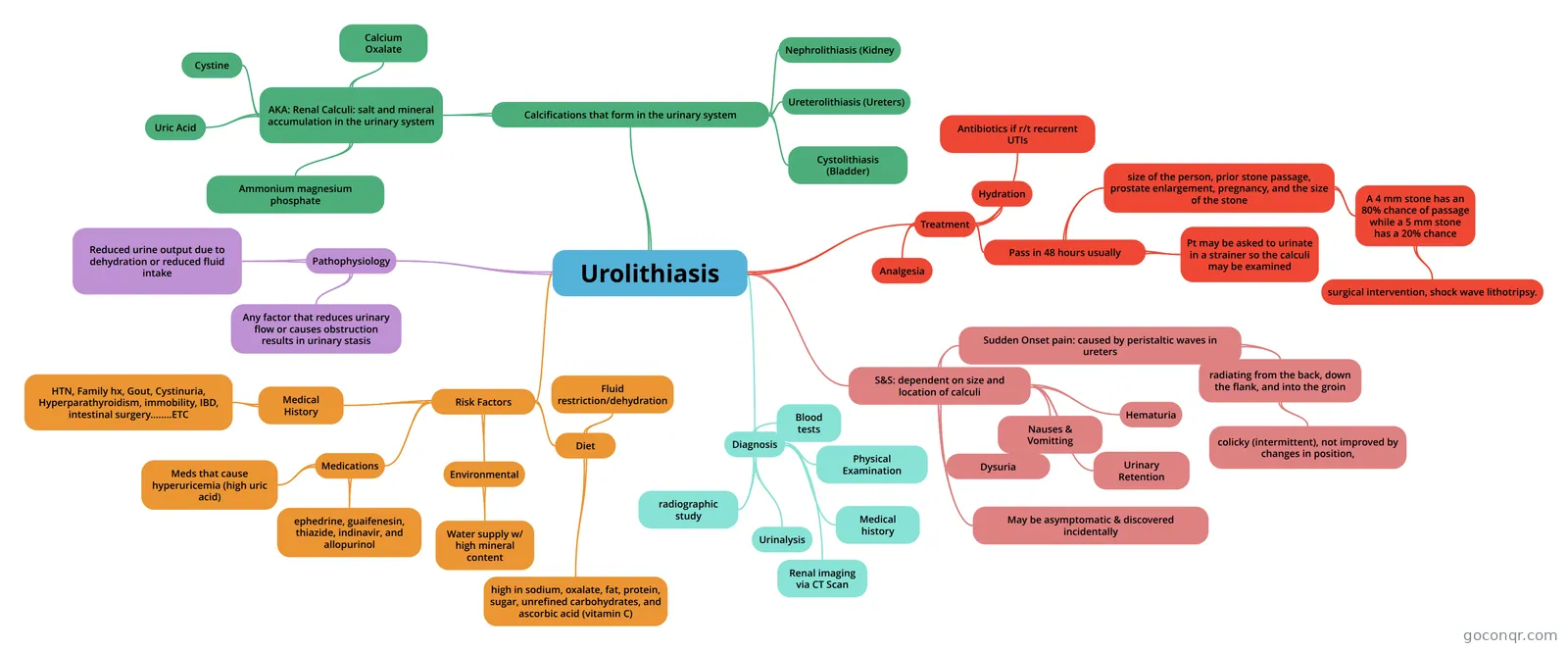 Mind map Urolithiasis
-
Mind map Bladder cancer
-
Mind map KIDNEY STONES
-
14 cardsGenitourinary System: Prostatic Hypertrophy and Prostate Cancer SGUL LOB's for Genitourinary System: Prostatic Hypertrophy and Prostate Cancer.
Quizzes
See all 65 quizzesMind maps
See all 253 mind maps-
Urinary Bladder Cancer
-
Passing dark colored urine
-
Benign prostatic hyperplasia
-
Urolithiasis
-
Bladder cancer
-
KIDNEY STONES
-
URINARY TRACT INFECTION AND NEUROGENIC BLADDER (NGB)
-
Urinary Tract Infections in Children Mapa Mental en Urinary Tract Infections in Children, creado por Isabella Rosillo en 05/10/2018.
Flashcards
See all 99 flashcards-
12 cardsGenitourinary System: Acute and Chronic Urinary Retention Causes of acute urinary retention.
-
14 cardsGenitourinary System: Prostatic Hypertrophy and Prostate Cancer SGUL LOB's for Genitourinary System: Prostatic Hypertrophy and Prostate Cancer.
-
28 cardsPostrate Cancer (PC) [1] For an American male, the lifetime risk of developing prostate cancer is ----- %, but the risk of dying of ...
-
9 cardsGenitourinary System: Urinary Tract Stones SGUL LOB's for Genitourinary System: Urinary Tract Stones.
-
5 cardsGenitourinary System: Ureteric Obstruction Causes of ureteric obstruction.
Topics in Urinary Tract and Male Genitourinary Disorders
More Internal medicine, pathology and clinical semiology topics
About Urinary Tract and Male Genitourinary Disorders
GoConqr OriginalWhat this unit covers
The page brings together the urinary tract and the male genital tract. On the urinary side you will find urolithiasis, urinary tract infections, pyelonephritis, incontinence, haematuria and bladder cancer. On the male side there are benign prostatic hyperplasia, prostate cancer, testicular cancer, torsion and diseases of the penis and testis.
Where to start
Begin with the flashcard deck Genitourinary System: Acute and Chronic Urinary Retention. It runs through causes, signs, diagnosis and emergency management in short question-and-answer form. Then open the Urolithiasis mind map, which separates stones by site: kidney, ureter and bladder.
Next, follow a sensible order:
- Infections: the UTIs flashcards, the Pyelonephritis mind map and the UTI decision map flowchart.
- Bladder and haematuria: the Urinary Bladder Cancer mind map, which defines haematuria and classifies it, and the Hematuria flowchart.
- Prostate: the Benign prostatic hyperplasia mind map, which starts from anatomy, histology and development, then Prostate cancer detection and Prostate Staging.
- Testis: Testicular torsion, Testicular Cancer and the Testicular/scrotal lump differential map.
Using quizzes and maps together
Read a mind map first to see how a topic hangs together. Then take a quiz on the same subject, such as Renal calculi, and note which answers you missed. Go back to the map or flashcards for those points only. Flowcharts are useful for rehearsing the steps of a work-up, from symptoms to investigation to management.
Where it sits
This unit belongs to the strand Renal, Endocrine, Metabolic and Reproductive Medicine, within Internal medicine, pathology and clinical semiology. All of it was made by GoConqr users, so styles and depth vary. Teachers can pick out the decks and maps that suit a class.
Choose one topic today, try its quiz, and see what you can add in your own notes.
Frequently asked questions
Which resource should I open first?
Start with the flashcard deck on acute and chronic urinary retention. It covers causes, signs, diagnosis and emergency management in short prompts. After that, move to the Urolithiasis mind map, then to the infection resources, and finish with prostate and testis topics.
What do the mind maps cover?
There are over 250 mind maps. They cover urolithiasis, bladder cancer, benign prostatic hyperplasia, incontinence, pyelonephritis, UTIs, prostate cancer, testicular torsion and testicular neoplasms. Some begin with anatomy and histology before moving to signs, investigations and management.
Are the resources free to use?
Yes. Every resource listed here is free to open, study and take, with no account needed. They were made by GoConqr users rather than by GoConqr itself, so it is worth comparing a few on the same topic.
Who is this page for?
It suits university students and professional candidates revising urinary and male genital pathology, plus teachers who want ready-made material. Students can practise with quizzes and flashcards, while teachers can pick maps or flowcharts to share.
Can I save my quiz scores or make my own material?
A free account saves your quiz scores and lets you make your own quizzes, mind maps, flashcards and notes. It is a handy way to turn gaps found in the quizzes into personal revision cards.
What if my topic is missing?
Look through the related titles first, since some topics sit inside broader resources, such as the Urology decks or the Male Genital Tract mind map. If nothing fits, make your own map or flashcards on it.