
Mind map
Approach To Otitis
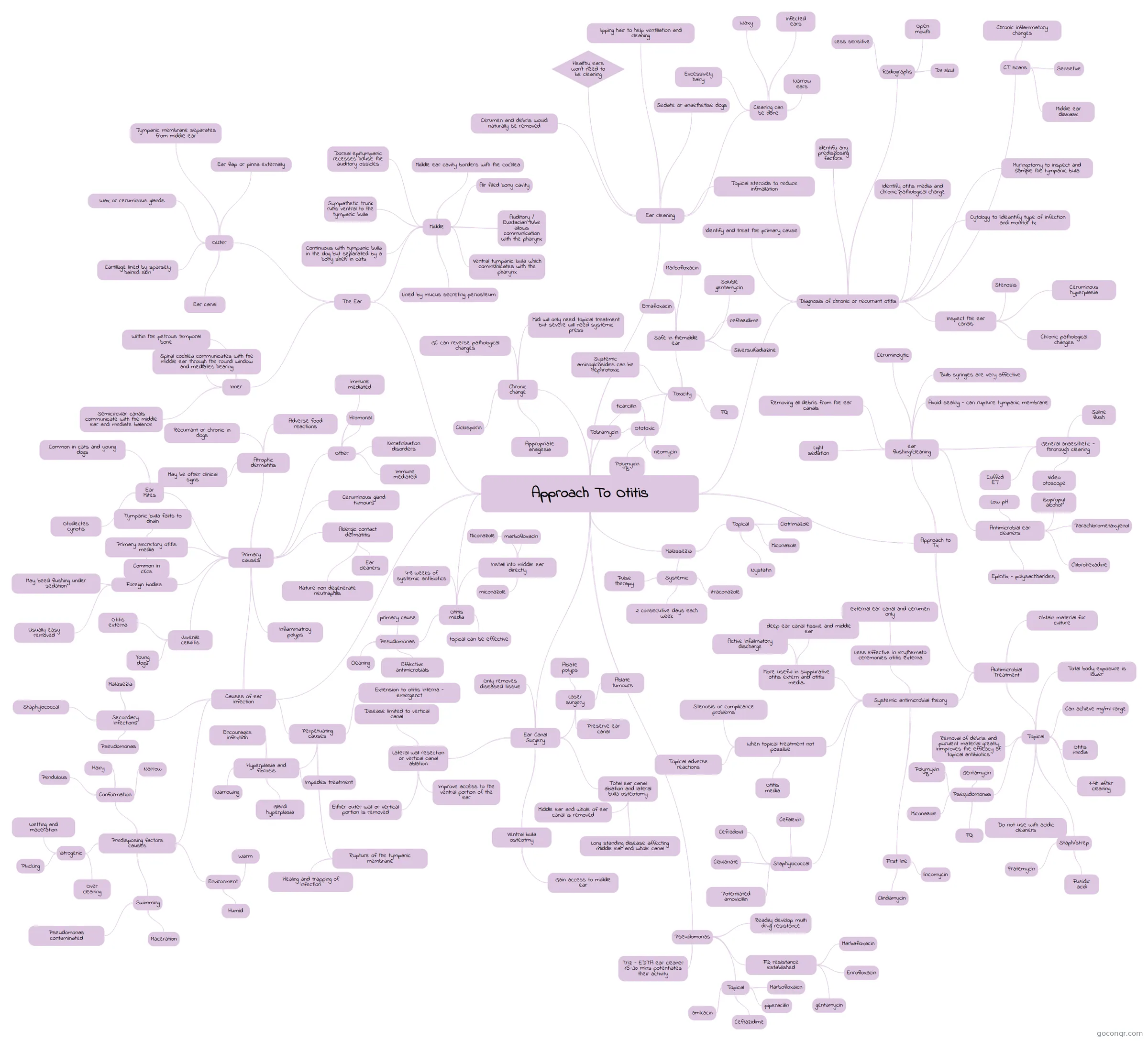
Mind map: Approach to otitis
Map content
Approach To Otitis
The Ear
- OUter
- Ear canal
- L shaped tube
- Ear flap or pinna externally
- Cartillage lined by sparsely haired skin
- Wax or ceruminous glands
- Tympanic membrane separates from middle ear
- Ear canal
- Middle
- Ventral tympanic bulla which communicates with the pharynx
- Air filled bony cavity
- Auditory / Eustacian tube allows communication with the pharynx
- Middle ear cavity borders with the cochlea
- Dorsal epitympanic recesses house the auditory ossicles
- Sympathetic trunk runs ventral to the tympanic bulla
- CN VII
- Continuous with tympanic bulla in the dog but separated by a bony shelf in cats
- Lined by mucus secreting periosteum
- Inner
- Within the petrous temporal bone
- Spiral cochlea communicates with the middle ear through the round window and mediates hearing
- Semicircular canals communicate with the middle ear and mediate balance
- OUter
Approach to Tx
- ear flushing/cleaning
- Removing all debris from the ear canals
- Light sedation
- Ceruminolytic
- Bulb syringes are very affective
- Avoid sealing - can rupture tympanic membrane
- General anaesthetic - throrough cleaning
- Cuffed ET
- Video otoscope
- Saline flush
- Antimicrobial ear cleaners
- Isopropyl alcohol
- Parachlorometaxylenol
- Chlorohexadine
- Low pH
- EpiOtix - polysachharides,
- ANtimicrobial Treatment
- Systemic antimicrobial theory
- Less effective in erythemato ceremonies otitis externa
- external ear canal and cerumen only
- More useful in suppurative otitis extern and otitis media.
- Active infallmatory discharge
- deep ear canal tissue and middle ear
- When topical treatment not possible
- Stenosis or complicance problems
- Topical adverse reactions
- Otitis media
- Staphylococcal
- Cefradoxil
- Cefalexin
- Claulanate
- Potentiated amoxicillin
- First line
- resistance may limit efficacy
- lincomycin
- Clindamycin
- Less effective in erythemato ceremonies otitis externa
- Topical
- Can achieve mg/ml range
- Total body exposure is lower
- Psequdomonas
- Polymyxin B
- Miconazole
- FQ
- can lead to resistance
- Gentamycin
- Staph/strep
- Fratemycin
- Fusidic acid
- Removal of debris and purulent material greatly inmproves the efficacy of topical antibiotics
- aminoglycosides, polymixin b
- Do not use with acidic cleaners
- 1-4h after cleaning
- Otitis media
- risk of irritant or adverse reactions
- Obtain material for culture
- Systemic antimicrobial theory
- ear flushing/cleaning
Ear cleaning
- Healthy ears won't need to be cleaning
- Cerumen and debris would naturally be removed
- Earwax, also known by the medical term cerumen, is a yellowish waxy substance secreted in the ear canal of humans and other mammals. It protects the skin of the human ear canal, assists in cleaning and lubrication, and also provides some protection from bacteria, fungi, insects and water.
- Cleaning can be done
- Excessively hairy
- Waxy
- Narrow ears
- Infected ears
- lipping hair to help ventillation and cleaning
- Sedate or anaethetise dogs
- Topical steroids to reduce infmallation
Causes of ear infection
- Primary causes
- The trigger factor
- Foreign bodies
- Grass seeds
- May beed flushing under sedation
- Usually easy removed
- Ear Mites
- Otodectes cynotis
- Common in cats and young dogs
- Atrophic dermatitis
- Adverse food reactions
- Recurrant or chronic in dogs
- May be other clinical signs
- Juvenile cellulitis
- Otitis externa
- Young dogs
- Other
- Hromonal
- Keratinisation disorders
- immune mediated
- Immune mediated
- Ceruminous gland tumours
- Obstruct the ear canal
- Aklergic contact dermatitis
- Ear cleaners
- Mature non degenerate neutraphils
- Inflammatroy polyps
- Primary secretory otitis media
- Common in cKcs
- Tympanic bulla failts to drain
- Perpetuating causes
- Make otitis more likely to develop or be more severe
- Hyperplasia and fibrosis
- Narrowing
- Gland hyperplasia
- Encourages infextion
- Impedes treatment
- Rupture of the tympanic membrane
- Healing and trapping of infection
- Extension to otitis interna - emergenct
- Predisposing factors causes
- Prevent resolution or trigger recurrance
- Conformation
- Pendulous
- Narrow
- Hairy
- Environment
- Warm
- Humid
- Iatrogenic
- Over cleaning
- Plucking
- Wetting and maceration
- Swimming
- Maceration
- Pseudomonas contaminated
- Secondary infections
- Staphylococcal
- Mallasezia
- Pseudomonas
- Primary causes
Diagnosis of chronic or recurrant otitis
- Identify and treat the primary cause
- Identify any predisposing factors
- Cytology to iideantify type of infection and monitor tx
- Identify otitis media and chronic pathological change
- Myringotomy to inspect and sample the tympanic bulla
- CT scans
- Sensetive
- Middle ear disease
- Chronic inflammatory changes
- Radiographs
- DV skull
- Open mouth
- Less sensitive
- Inspect the ear canals
- Ceruminous hyperplasia
- Stenosis
- Chronic pathological changes
Pseudomonas
- Readily develop multi drug resistance
- FQ resistance established
- Marbafloxacin
- Enrofloxacin
- 1:4 with saline - care at high doses
- gentamycin
- care ototoxicity
- Topical
- Marbofloxaicn
- piperacillin
- Ceftazidime
- amikacin
- Triz - EDTA ear cleaner 15-20 mins potentiates their activity
Malassezia
- Topical
- Clotrimazole
- Safe and non ototoxic in the middle ear
- Miconazole
- Safe and non ototoxic in the middle ear
- Nystatin
- Clotrimazole
- Systemic
- Pulse therapy
- Itraconazole
- 2 consecutive days each week
- Topical
Otitis media
- 4-8 weeks of systemic antibiotics
- problem if parenterals used
- Pesudomonas
- Cleaning
- primary cause
- Effective antimicrobials
- Install into middle ear directly
- 3-10d
- Miconazole
- marbofloxacin
- miconazole
- topical can be effective
- 4-8 weeks of systemic antibiotics
Chronic change
- GC can reverse pathological changes
- Mild will only need topical treatment but severe will need systemic press
- Ciclosporin
- evere
- Appropriate analgesia
Toxicity
- Ototoxic
- use with care if the tympanic membrane is ruptured
- neomycin
- ticarcillin
- Polymyxin B
- Tobramycin
- Safe in themiddle ear
- Enrafloxacin
- Marbofloxacin
- Soluble gentamycin
- ceftazidime
- Silversulfadiazine
- Systemic aminoglicosides can be nephrotoxic
- FQ
- Cartillage damage and neurological signs at high doses, blindness in cats
- Ototoxic
Ear Canal Surgery
- Last resort where medical treatment has failed and is inappropriate
- Lateral wall resection or vertical canal ablation
- Improve accèss to the ventral portion of the ear
- Either outer wall or vertical portion is removed
- Disease limited to vertical canal
- Total ear canal ablation and lateral bulla osteotomy
- Middle ear and whole of ear canal is removed
- Long standing disease affecting middle ear and whole canal
- Laser surgery
- Ablate polyps
- Ablate tumours
- Preserve ear canal
- Ventral bulla osteotmy
- Gain access to middle ear
- Only removes diseased tissue
Information
- Description
- Degree - Professional Dog and Cat (Soft Tissue) Mind Map on Approach To Otitis, created by Charlotte Stephe on 27/02/2015.
- Created by
- Charlotte Stephe
- Views
- 2
- Rating