
Mind map
Consumer Behavior induced by product nationality
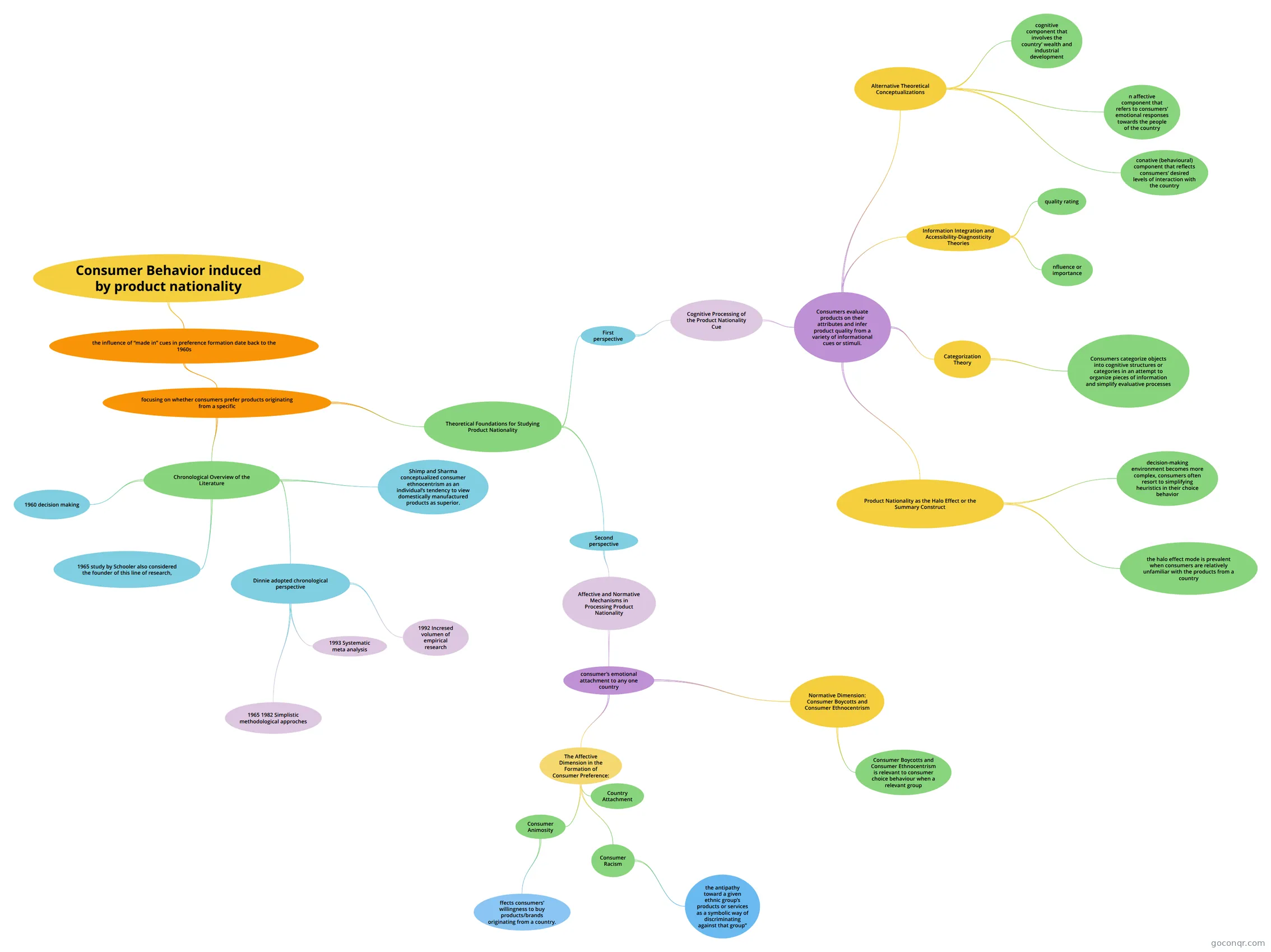
Mind map: Consumer behavior induced by product nationality
Map content
Consumer Behavior induced by product nationality
the influence of “made in” cues in preference formation date back to the 1960s
- focusing on whether consumers prefer products originating from a specific
- Chronological Overview of the Literature
- 1960 decision making
- 1965 study by Schooler also considered the founder of this line of research,
- Dinnie adopted chronological perspective
- 1965 1982 Simplistic methodological approches
- 1992 Incresed volumen of empirical research
- 1993 Systematic meta analysis
- Shimp and Sharma conceptualized consumer ethnocentrism as an individual’s tendency to view domestically manufactured products as superior.
- Theoretical Foundations for Studying Product Nationality
- First perspective
- Cognitive Processing of the Product Nationality Cue
- Consumers evaluate products on their attributes and infer product quality from a variety of informational cues or stimuli.
- Information Integration and Accessibility-Diagnosticity Theories
- quality rating
- nfluence or importance
- Categorization Theory
- Consumers categorize objects into cognitive structures or categories in an attempt to organize pieces of information and simplify evaluative processes
- Product Nationality as the Halo Effect or the Summary Construct
- decision-making environment becomes more complex, consumers often resort to simplifying heuristics in their choice behavior
- the halo effect mode is prevalent when consumers are relatively unfamiliar with the products from a country
- Alternative Theoretical Conceptualizations
- cognitive component that involves the country’ wealth and industrial development
- n affective component that refers to consumers’ emotional responses towards the people of the country
- conative (behavioural) component that reflects consumers’ desired levels of interaction with the country
- Information Integration and Accessibility-Diagnosticity Theories
- Consumers evaluate products on their attributes and infer product quality from a variety of informational cues or stimuli.
- Cognitive Processing of the Product Nationality Cue
- Second perspective
- Affective and Normative Mechanisms in Processing Product Nationality
- consumer’s emotional attachment to any one country
- The Affective Dimension in the Formation of Consumer Preference:
- Consumer Animosity
- ffects consumers’ willingness to buy products/brands originating from a country.
- Consumer Racism
- the antipathy toward a given ethnic group’s products or services as a symbolic way of discriminating against that group”
- Country Attachment
- Consumer Animosity
- Normative Dimension: Consumer Boycotts and Consumer Ethnocentrism
- Consumer Boycotts and Consumer Ethnocentrism is relevant to consumer choice behaviour when a relevant group
- The Affective Dimension in the Formation of Consumer Preference:
- consumer’s emotional attachment to any one country
- Affective and Normative Mechanisms in Processing Product Nationality
- First perspective
- Chronological Overview of the Literature
- focusing on whether consumers prefer products originating from a specific
Information
- Description
- Mind Map on Consumer Behavior induced by product nationality, created by Majo Campos on 12/05/2020.
- Created by
- Majo Campos
- Views
- 0
- Rating