
Mind map
Relevant Costing
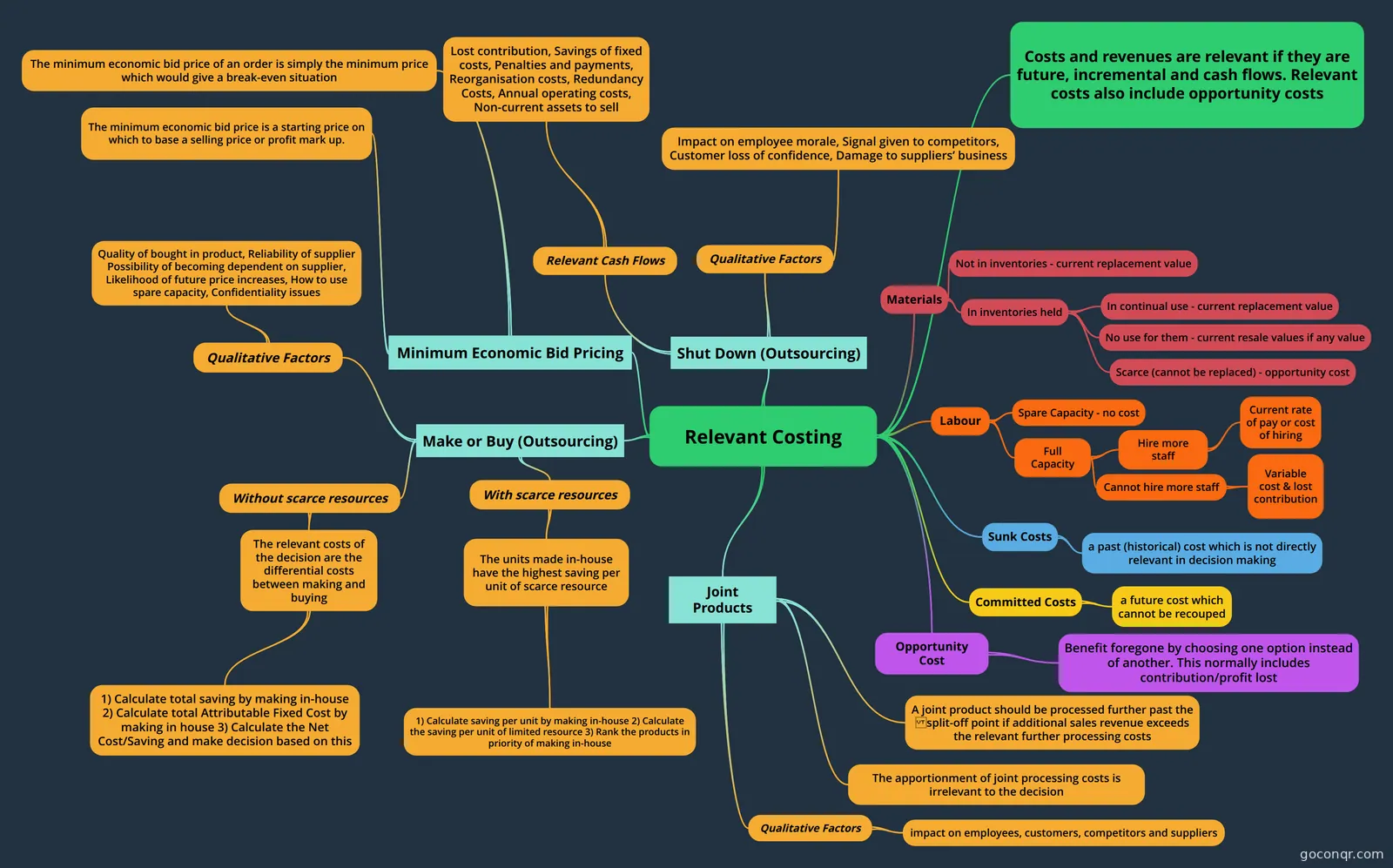
Mind map: Relevant costing
Map content
Relevant Costing
Joint Products
- A joint product should be processed further past the split-off point if additional sales revenue exceeds the relevant further processing costs
- The apportionment of joint processing costs is irrelevant to the decision
- Qualitative Factors
- impact on employees, customers, competitors and suppliers
Opportunity Cost
- Benefit foregone by choosing one option instead of another. This normally includes contribution/profit lost
Make or Buy (Outsourcing)
- Without scarce resources
- The relevant costs of the decision are the differential costs between making and buying
- 1) Calculate total saving by making in-house 2) Calculate total Attributable Fixed Cost by making in house 3) Calculate the Net Cost/Saving and make decision based on this
- The relevant costs of the decision are the differential costs between making and buying
- With scarce resources
- The units made in-house have the highest saving per unit of scarce resource
- 1) Calculate saving per unit by making in-house 2) Calculate the saving per unit of limited resource 3) Rank the products in priority of making in-house
- The units made in-house have the highest saving per unit of scarce resource
- Qualitative Factors
- Quality of bought in product, Reliability of supplier Possibility of becoming dependent on supplier, Likelihood of future price increases, How to use spare capacity, Confidentiality issues
- Without scarce resources
Shut Down (Outsourcing)
- Qualitative Factors
- Impact on employee morale, Signal given to competitors, Customer loss of confidence, Damage to suppliers’ business
- Relevant Cash Flows
- Lost contribution, Savings of fixed costs, Penalties and payments, Reorganisation costs, Redundancy Costs, Annual operating costs, Non-current assets to sell
- Qualitative Factors
Minimum Economic Bid Pricing
- The minimum economic bid price of an order is simply the minimum price which would give a break-even situation
- The minimum economic bid price is a starting price on which to base a selling price or profit mark up.
Materials
- Not in inventories - current replacement value
- In inventories held
- No use for them - current resale values if any value
- In continual use - current replacement value
- Scarce (cannot be replaced) - opportunity cost
Labour
- Spare Capacity - no cost
- Full Capacity
- Hire more staff
- Current rate of pay or cost of hiring
- Cannot hire more staff
- Variable cost & lost contribution
- Hire more staff
Sunk Costs
- a past (historical) cost which is not directly relevant in decision making
Committed Costs
- a future cost which cannot be recouped
Costs and revenues are relevant if they are future, incremental and cash flows. Relevant costs also include opportunity costs
Information
- Description
- Mind Map on Relevant Costing, created by Rebecca Jones on 19/05/2020.
- Created by
- Rebecca Jones
- Views
- 0
- History
-
- Created by Sue Evans · May 20, 2017
- Copied by Rebecca Jones · May 19, 2020
- Rating