
Mind map
Antimicrobial Drugs
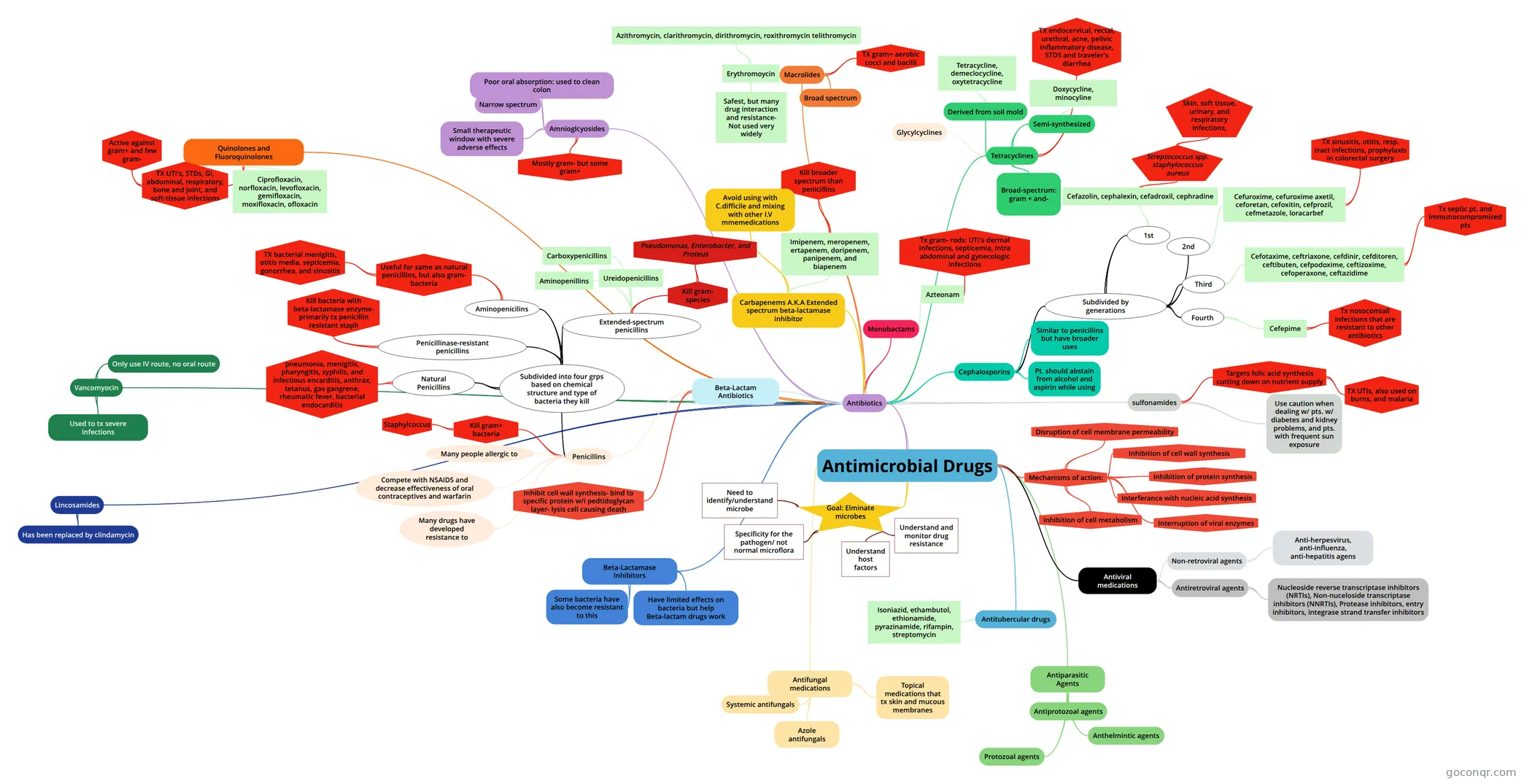
Mind map: Antimicrobial drugs
Map content
Antimicrobial Drugs
Goal: Elminate microbes
- Need to identify/understand microbe
- Specificity for the pathogen/ not normal microflora
- Understand and monitor drug resistance
- Understand host factors
Mechanisms of action:
- Inhibition of cell wall synthesis
- Inhibition of protein synthesis
- Interferance with nucleic acid synthesis
- Inhibition of cell metabolism
- Disruption of cell membrane permeability
- Interruption of viral enzymes
Antibiotics
- Beta-Lactam Antibiotics
- Inhibit cell wall synthesis- bind to specific protein w/i pedtidoglycan layer- lysis cell causing death
- Penicillins
- Many people allergic to
- Kill gram+ bacteria
- Staphylcoccus
- Subdivided into four grps based on chemical structure and type of bacteria they kill
- Natural Penicillins
- pneumonia, menigitis, pharyngitis, syphilis, and infectious encarditis, anthrax, tetanus, gas gangrene, rheumatic fever, bacterial endocarditis
- Penicillinase-resistant penicillins
- Kill bacteria with beta-lactamase enzyme- primarily tx penicillin resistant staph
- Aminopenicilins
- Useful for same as natural penicillins, but also gram- bacteria
- TX bacterial menigitis, otitis media, septicemia, gonorrhea, and sinusitis
- Useful for same as natural penicillins, but also gram- bacteria
- Extended-spectrum penicillins
- Kill gram- species
- Pseudomonas, Enterobacter, and Proteus
- Aminopenillins
- Carboxypenicillins
- Ureidopenicillins
- Kill gram- species
- Natural Penicillins
- Many drugs have developed resistance to
- Compete with NSAIDS and decrease effectiveness of oral contraceptives and warfarin
- Cephalosporins
- Similar to penicillins but have broader uses
- Subdivided by generations
- 1st
- Cefazolin, cephalexin, cefadroxil, cephradine
- Streptococcus spp. staphylococcus aureus
- Skin, soft tissue, urinary, and respiratory infections,
- Streptococcus spp. staphylococcus aureus
- Cefazolin, cephalexin, cefadroxil, cephradine
- 2nd
- Cefuroxime, cefuroxime axetil, ceforetan, cefoxitin, cefprozil, cefmetazole, loracarbef
- TX sinusitis, otitis, resp. tract infections, prophylaxis in colorectal surgery
- Cefuroxime, cefuroxime axetil, ceforetan, cefoxitin, cefprozil, cefmetazole, loracarbef
- Third
- Cefotaxime, ceftriaxone, cefdinir, cefditoren, ceftibuten, cefpodoxime, ceftizoxime, cefoperaxone, ceftazidime
- Tx septic pt. and immunocompromised pts
- Cefotaxime, ceftriaxone, cefdinir, cefditoren, ceftibuten, cefpodoxime, ceftizoxime, cefoperaxone, ceftazidime
- Fourth
- Cefepime
- Tx nosocomiall infections that are resistant to other antibiotics
- Cefepime
- 1st
- Pt. should abstain from alcohol and aspirin while using
- Carbapenems A.K.A Extended spectrum beta-lactamase inhibitor
- Imipenem, meropenem, ertapenem, doripenem, panipenem, and biapenem
- Kill broader spectrum than penicillins
- Avoid using with C.difficile and mixing with other I.V mmemedications
- Imipenem, meropenem, ertapenem, doripenem, panipenem, and biapenem
- Monobactams
- Azteonam
- Tx gram- rods: UTI's dermal infections, septicemia, intra abdominal and gynecologic infections
- Azteonam
- Beta-Lactamase Inhibitors
- Have limited effects on bacteria but help Beta-lactam drugs work
- Some bacteria have also become resistant to this
- sulfonamides
- Targets folic acid synthesis cutting down on nutrient supply
- TX UTIs, also used on burns, and malaria
- Use caution when dealing w/ pts. w/ diabetes and kidney problems, and pts. with frequent sun exposure
- Targets folic acid synthesis cutting down on nutrient supply
- Tetracyclines
- Derived from soil mold
- Tetracycline, demeclocycline, oxytetracycline
- Semi-synthesized
- Doxycycline, minocyline
- Broad-spectrum: gram + and-
- Glycylcyclines
- TX endocervical, rectal, urethral, acne, pelivic inflammatory disease, STDS and traveler's diarrhea
- Derived from soil mold
- Amnioglcyosides
- Mostly gram- but some gram+
- Small therapeutic window with severe adverse effects
- Narrow spectrum
- Poor oral absorption: used to clean colon
- Macrolides
- Erythromoycin
- Safest, but many drug interaction and resistance- Not used very widely
- Azithromycin, clarithromycin, dirithromycin, roxithromycin telithromycin
- Broad spectrum
- TX gram+ aerobic cocci and bacilli
- Erythromoycin
- Quinolones and Fluoroquinolones
- Ciprofloxacin, norfloxacin, levofloxacin, gemifloxacin, moxifloxacin, ofloxacin
- TX UTI's, STDs, GI, abdominal, respiratory, bone and joint, and soft-tissue infections
- Active against gram+ and few gram-
- Lincosamides
- Has been replaced by clindamycin
- Vancomyocin
- Used to tx severe infections
- Only use IV route, no oral route
- Beta-Lactam Antibiotics
Antitubercular drugs
- Isoniazid, ethambutol, ethionamide, pyrazinamide, rifampin, streptomycin
Antiviral medications
- Non-retroviral agents
- Anti-herpesvirus, anti-influenza, anti-hepatitis agens
- Antiretroviral agents
- Nucleoside reverse transcriptase inhibitors (NRTIs), Non-nuceloside transcriptase inhibitors (NNRTIs), Protease inhibitors, entry inhibitors, integrase strand transfer inhibitors
- Non-retroviral agents
Antifungal medications
- Systemic antifungals
- Azole antifungals
- Topical medications that tx skin and mucous membranes
Antiparasitic Agents
- Protozoal agents
- Antiprotozoal agents
- Anthelmintic agents
Information
- Description
- Mind Map on Antimicrobial Drugs, created by greder_12 on 03/24/2015.
- Created by
- greder_12
- Views
- 0
- Rating