
Mind map
MODAL VERBS AND RELATED PHRARES
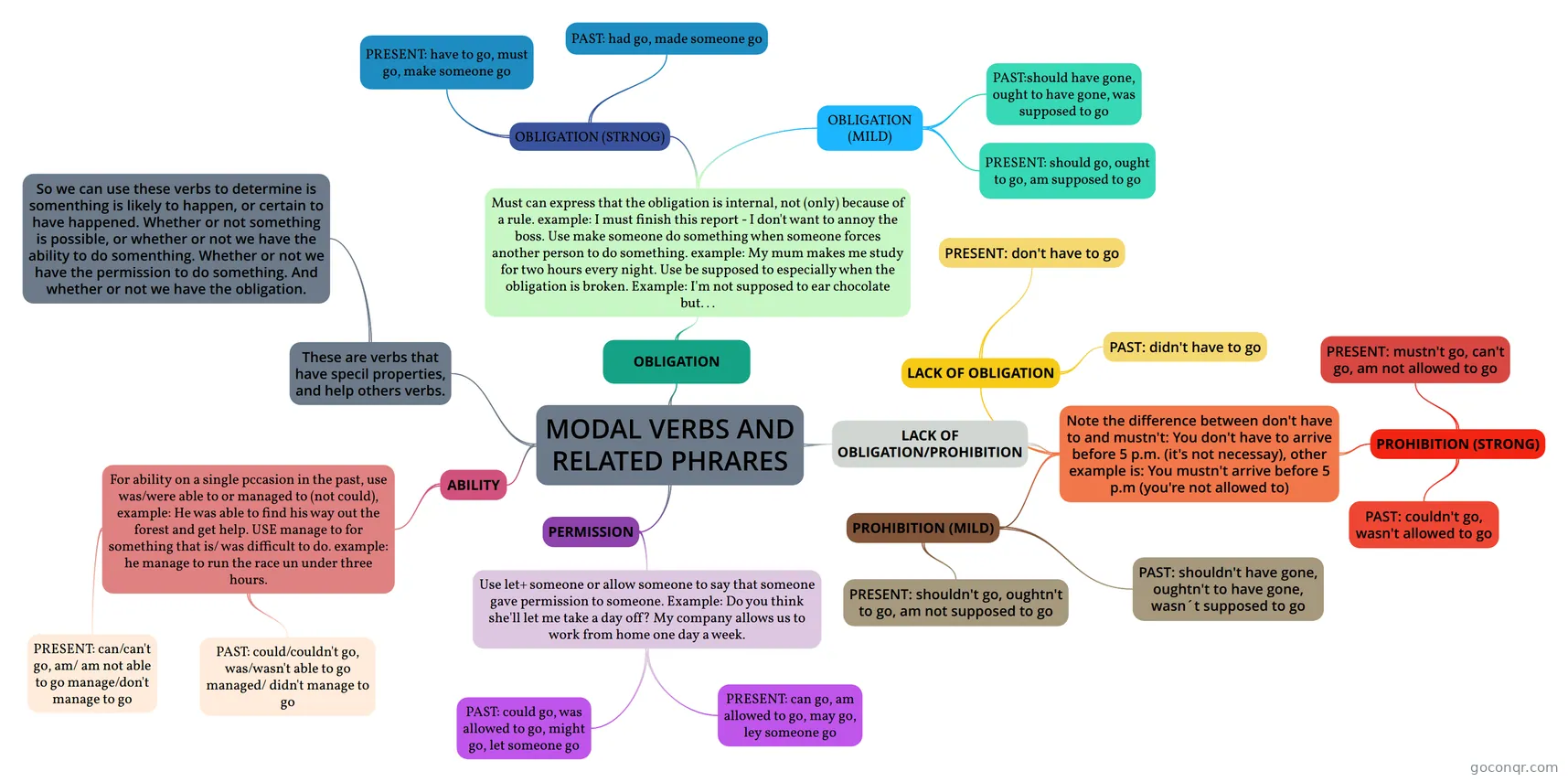
Mind map: Modal verbs and related phrases
Map content
MODAL VERBS AND RELATED PHRARES
OBLIGATION
- Must can express that the obligation is internal, not (only) because of a rule. example: I must finish this report - I don't want to annoy the boss. Use make someone do something when someone forces another person to do something. example: My mum makes me study for two hours every night. Use be supposed to especially when the obligation is broken. Example: I'm not supposed to ear chocolate but...
- OBLIGATION (MILD)
- PAST:should have gone, ought to have gone, was supposed to go
- PRESENT: should go, ought to go, am supposed to go
- OBLIGATION (STRNOG)
- PRESENT: have to go, must go, make someone go
- PAST: had go, made someone go
- OBLIGATION (MILD)
- Must can express that the obligation is internal, not (only) because of a rule. example: I must finish this report - I don't want to annoy the boss. Use make someone do something when someone forces another person to do something. example: My mum makes me study for two hours every night. Use be supposed to especially when the obligation is broken. Example: I'm not supposed to ear chocolate but...
ABILITY
- For ability on a single pccasion in the past, use was/were able to or managed to (not could), example: He was able to find his way out the forest and get help. USE manage to for something that is/ was difficult to do. example: he manage to run the race un under three hours.
- PRESENT: can/can't go, am/ am not able to go manage/don't manage to go
- PAST: could/couldn't go, was/wasn't able to go managed/ didn't manage to go
- For ability on a single pccasion in the past, use was/were able to or managed to (not could), example: He was able to find his way out the forest and get help. USE manage to for something that is/ was difficult to do. example: he manage to run the race un under three hours.
PERMISSION
- Use let+ someone or allow someone to say that someone gave permission to someone. Example: Do you think she'll let me take a day off? My company allows us to work from home one day a week.
- PRESENT: can go, am allowed to go, may go, ley someone go
- PAST: could go, was allowed to go, might go, let someone go
- Use let+ someone or allow someone to say that someone gave permission to someone. Example: Do you think she'll let me take a day off? My company allows us to work from home one day a week.
LACK OF OBLIGATION/PROHIBITION
- Note the difference between don't have to and mustn't: You don't have to arrive before 5 p.m. (it's not necessay), other example is: You mustn't arrive before 5 p.m (you're not allowed to)
- LACK OF OBLIGATION
- PRESENT: don't have to go
- PAST: didn't have to go
- PROHIBITION (STRONG)
- PRESENT: mustn't go, can't go, am not allowed to go
- PAST: couldn't go, wasn't allowed to go
- PROHIBITION (MILD)
- PRESENT: shouldn't go, oughtn't to go, am not supposed to go
- PAST: shouldn't have gone, oughtn't to have gone, wasn´t supposed to go
- LACK OF OBLIGATION
- Note the difference between don't have to and mustn't: You don't have to arrive before 5 p.m. (it's not necessay), other example is: You mustn't arrive before 5 p.m (you're not allowed to)
These are verbs that have specil properties, and help others verbs.
- So we can use these verbs to determine is somenthing is likely to happen, or certain to have happened. Whether or not something is possible, or whether or not we have the ability to do somenthing. Whether or not we have the permission to do something. And whether or not we have the obligation.
Information
- Description
- Mind Map on MODAL VERBS AND RELATED PHRARES, created by Alondra R on 16/06/2020.
- Created by
- Alondra R
- Views
- 0
- Rating