
Mind map
Disruptions to attachment
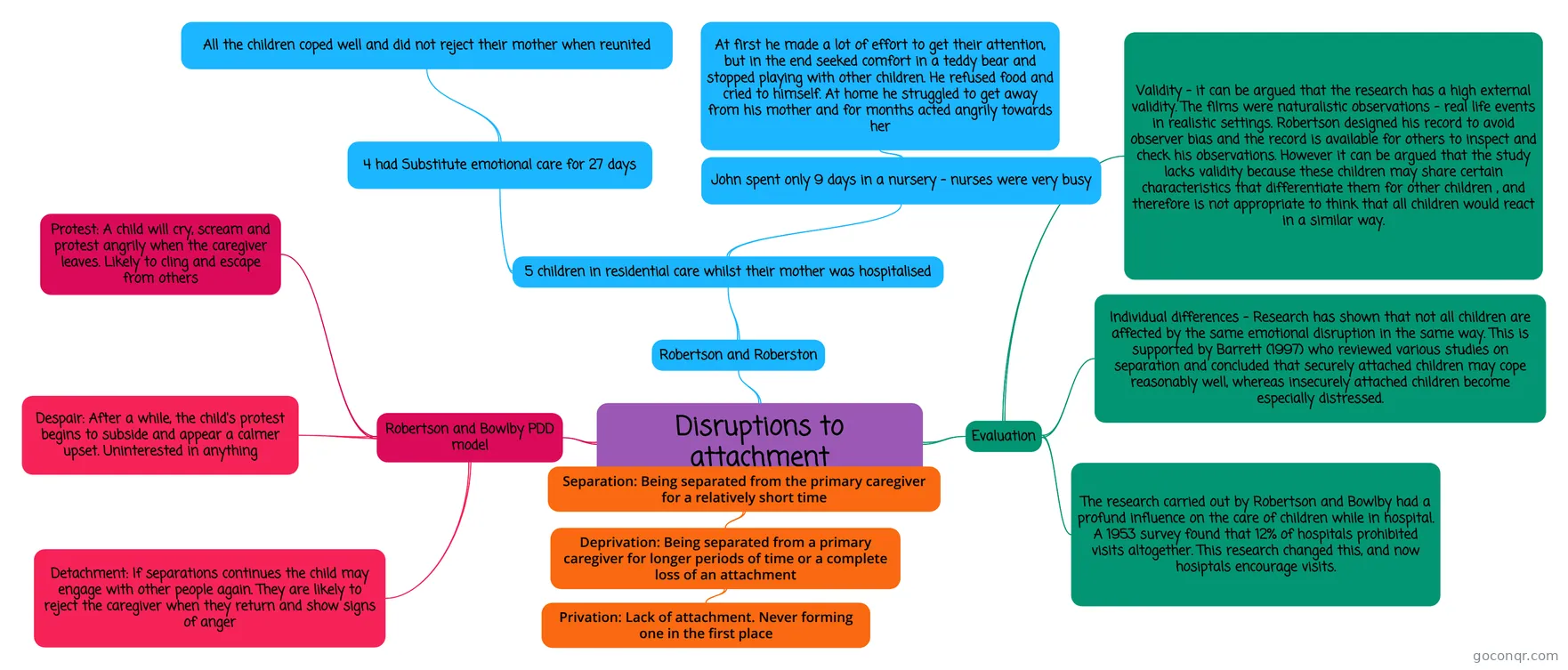
Mind map: Disruptions to attachment
Map content
Disruptions to attachment
Separation: Being separated from the primary caregiver for a relatively short time
- Deprivation: Being separated from a primary caregiver for longer periods of time or a complete loss of an attachment
- Privation: Lack of attachment. Never forming one in the first place
- Deprivation: Being separated from a primary caregiver for longer periods of time or a complete loss of an attachment
Robertson and Bowlby PDD model
- Protest: A child will cry, scream and protest angrily when the caregiver leaves. Likely to cling and escape from others
- Detachment: If separations continues the child may engage with other people again. They are likely to reject the caregiver when they return and show signs of anger
- Despair: After a while, the child's protest begins to subside and appear a calmer upset. Uninterested in anything
Robertson and Roberston
- 5 children in residential care whilst their mother was hospitalised
- 4 had Substitute emotional care for 27 days
- All the children coped well and did not reject their mother when reunited
- John spent only 9 days in a nursery - nurses were very busy
- At first he made a lot of effort to get their attention, but in the end seeked comfort in a teddy bear and stopped playing with other children. He refused food and cried to himself. At home he struggled to get away from his mother and for months acted angrily towards her
- 4 had Substitute emotional care for 27 days
- 5 children in residential care whilst their mother was hospitalised
Evaluation
- Validity - it can be argued that the research has a high external validity. The films were naturalistic observations - real life events in realistic settings. Robertson designed his record to avoid observer bias and the record is available for others to inspect and check his observations. However it can be argued that the study lacks validity because these children may share certain characteristics that differentiate them for other children , and therefore is not appropriate to think that all children would react in a similar way.
- Individual differences - Research has shown that not all children are affected by the same emotional disruption in the same way. This is supported by Barrett (1997) who reviewed various studies on separation and concluded that securely attached children may cope reasonably well, whereas insecurely attached children become especially distressed.
- The research carried out by Robertson and Bowlby had a profund influence on the care of children while in hospital. A 1953 survey found that 12% of hospitals prohibited visits altogether. This research changed this, and now hosiptals encourage visits.
Information
- Description
- Mind Map on Disruptions to attachment, created by courtneymariegre8723 on 26/03/2015.
- Created by
- courtneymariegre8723
- Views
- 1
- Rating