
Mind map
Evolution and Biodiversity, Classification of biodiversity
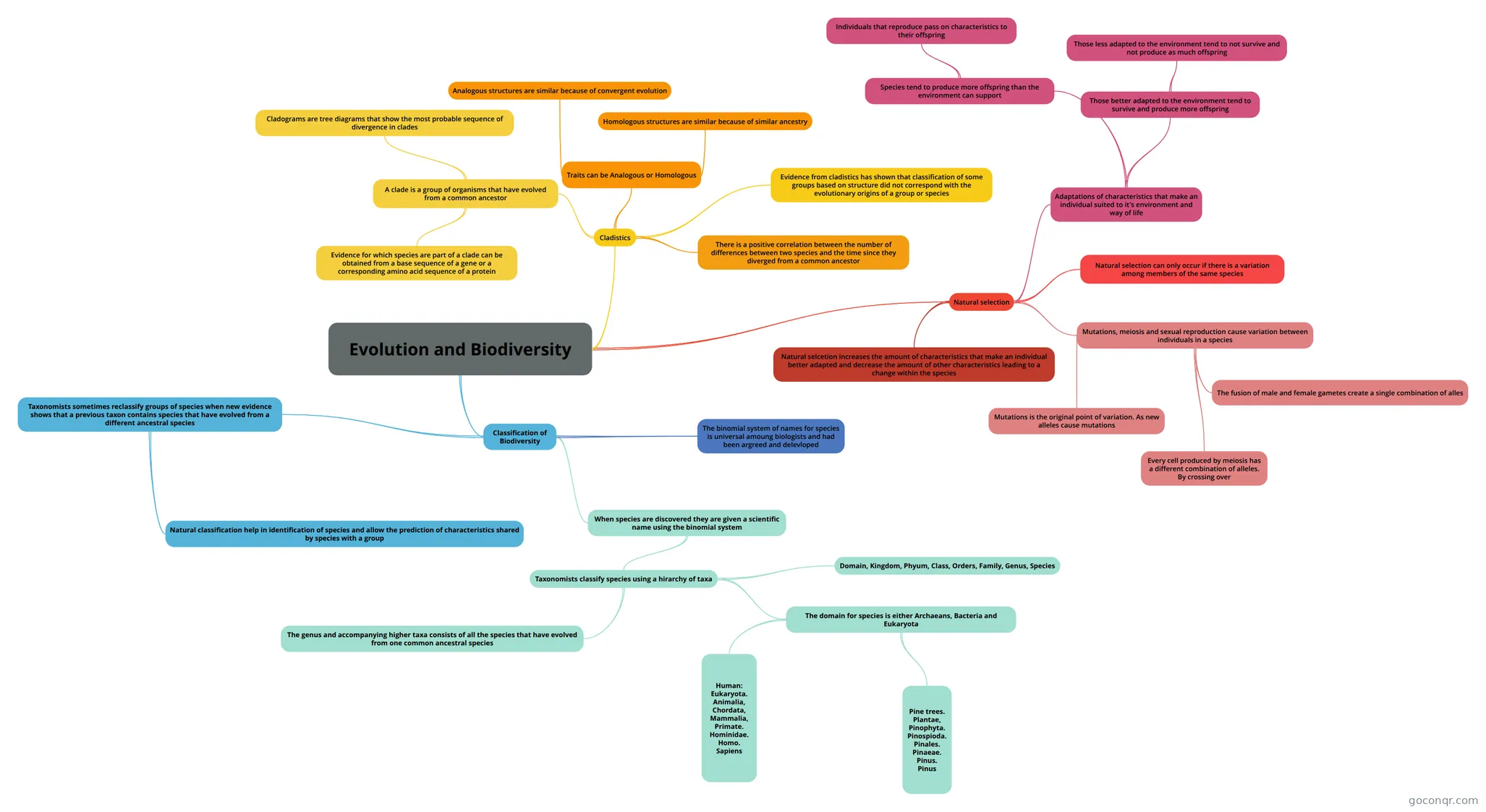
Mind map: Evolution and Biodiversity, Classification of Biodiversity, Cladistics, Natural Selection
Map content
Evolution and Biodiversity
Classification of Biodiversity
- The binomial system of names for species is universal amoung biologists and had been argreed and delevloped
- When species are discovered they are given a scientific name using the binomial system
- Taxonomists classify species using a hirarchy of taxa
- Domain, Kingdom, Phyum, Class, Orders, Family, Genus, Species
- The domain for species is either Archaeans, Bacteria and Eukaryota
- Human: Eukaryota. Animalia, Chordata, Mammalia, Primate. Hominidae. Homo. Sapiens
- Pine trees. Plantae, Pinophyta. Pinospioda. Pinales. Pinaeae. Pinus. Pinus
- The genus and accompanying higher taxa consists of all the species that have evolved from one common ancestral species
- Taxonomists classify species using a hirarchy of taxa
- Taxonomists sometimes reclassify groups of species when new evidence shows that a previous taxon contains species that have evolved from a different ancestral species
- Natural classification help in identification of species and allow the prediction of characteristics shared by species with a group
Cladistics
- A clade is a group of organisms that have evolved from a common ancestor
- Evidence for which species are part of a clade can be obtained from a base sequence of a gene or a corresponding amino acid sequence of a protein
- Cladograms are tree diagrams that show the most probable sequence of divergence in clades
- There is a positive correlation between the number of differences between two species and the time since they diverged from a common ancestor
- Traits can be Analogous or Homologous
- Analogous structures are similar because of convergent evolution
- Homologous structures are similar because of similar ancestry
- Evidence from cladistics has shown that classification of some groups based on structure did not correspond with the evolutionary origins of a group or species
- A clade is a group of organisms that have evolved from a common ancestor
Natural selection
- Natural selection can only occur if there is a variation among members of the same species
- Mutations, meiosis and sexual reproduction cause variation between individuals in a species
- Mutations is the original point of variation. As new alleles cause mutations
- Every cell produced by meiosis has a different combination of alleles. By crossing over
- The fusion of male and female gametes create a single combination of alles
- Adaptations of characteristics that make an individual suited to it's environment and way of life
- Species tend to produce more offspring than the environment can support
- Individuals that reproduce pass on characteristics to their offspring
- Those better adapted to the environment tend to survive and produce more offspring
- Those less adapted to the environment tend to not survive and not produce as much offspring
- Species tend to produce more offspring than the environment can support
- Natural selcetion increases the amount of characteristics that make an individual better adapted and decrease the amount of other characteristics leading to a change within the species
Information
- Description
- Mind Map on Evolution and Biodiversity, Classification of biodiversity, created by Gabby Sluce on 28/03/2015.
- Created by
- Gabby Sluce
- Views
- 22
- Rating