
Mind map
Psychology Exam II
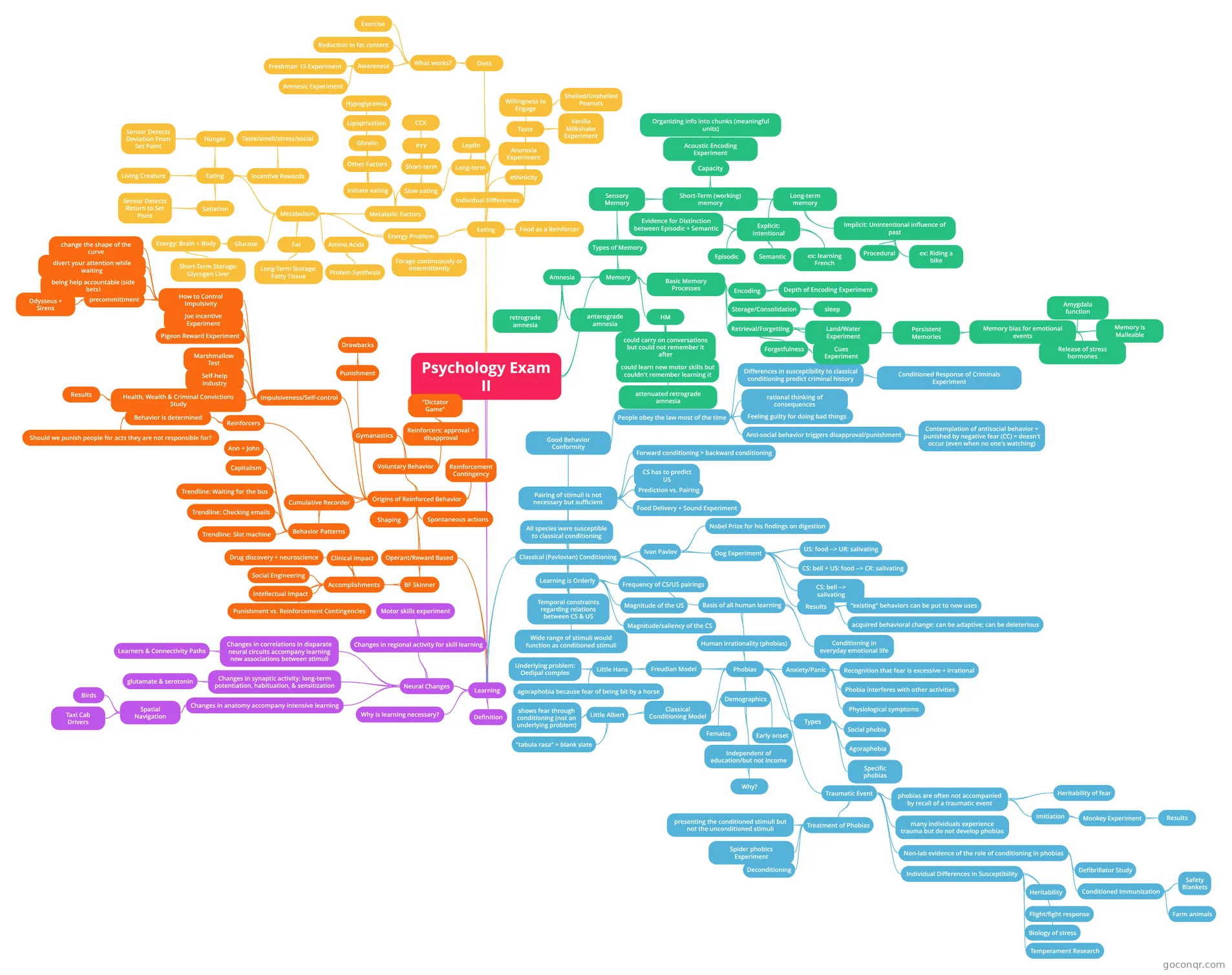
Mind map: Psychology exam II
Map content
Psychology Exam II
Learning
- Neural Changes
- Changes in regional activity for skill learning
- Motor skills experiment
- Initially cerebellum was active, then with practice striatum takes over
- Motor skills experiment
- Changes in correlations in disparate neural circuits accompany learning new associations between stimuli
- Learners & Connectivity Paths
- Successful learners have several strong connections in different regions of the brain while less successful and non-learners have few connections that are all weak
- Learners & Connectivity Paths
- Changes in synaptic activity; long-term potentiation, habituation, & sensitization
- glutamate & serotonin
- Changes in anatomy accompany intensive learning
- Spatial Navigation
- Birds
- hippocampus increases in size when the birds remember where they put their seeds months later
- Taxi Cab Drivers
- Taxi cab drivers have large hippocampi to memorize maps
- Birds
- Spatial Navigation
- Changes in regional activity for skill learning
- Definition
- Acquisition of new knowledge & behavior Enduring change in behavior as the result of experience Often hard to measure
- Classical (Pavlovian) Conditioning
- learning associations between events (stimuli), between emotions and events (stimuli), between behavior and its consequences
- Ivan Pavlov
- Nobel Prize for his findings on digestion
- Dog Experiment
- US: food --> UR: salivating
- CS: bell + US: food --> CR: salivating
- CS: bell --> salivating
- Results
- "existing" behaviors can be put to new uses
- acquired behavioral change: can be adaptive; can be deleterious
- Basis of all human learning
- Conditioning in everyday emotional life
- Human irrationality (phobias)
- Phobias
- unrelenting, disproportionate fear of a situation, activity, or thing, resulting in avoidance and/or panic
- Freudian Model
- Assumes an internal psychological structure that is out of sync
- Little Hans
- agoraphobia because fear of being bit by a horse
- Underlying problem: Oedipal complex
- Anxiety/Panic
- Recognition that fear is excessive + irrational
- Phobia interferes with other activities
- Physiological symptoms
- increase in heart rate increase in blood pressure sweating nausea dry mouth aches confusion inability to speak
- Types
- Social phobia
- Agoraphobia
- Specific phobias
- Demographics
- Early onset
- Females
- Independent of education/but not income
- earning a living is more anxiety provoking and schools are a relatively protected environment
- Why?
- Classical Conditioning Model
- phobias are caused by the experiences that affect you and by your capacity to learn
- Little Albert
- John Watson conditioned Little Albert to have a fear of all furry things by accompanying the presence of a furry thing with a loud noise --> phobia of the furry things
- shows fear through conditioning (not an underlying problem)
- "tabula rasa" = blank slate
- Traumatic Event
- phobias are often not accompanied by recall of a traumatic event
- Imitiation
- Monkey Experiment
- lab-reared monkeys are not afraid of snake while wild-reared monkeys are always afraid
- Results
- when the lab monkeys observed the wild monkeys, they acted the same way as the wild monkeys to the snakes
- Monkey Experiment
- Heritability of fear
- Imitiation
- many individuals experience trauma but do not develop phobias
- Non-lab evidence of the role of conditioning in phobias
- Defibrillator Study
- 72 patients with implantable cardio defibrillators many can anticipate arrhythmias --> anticipate shock 16% develop anxiety disorders (phobias)
- Conditioned Immunization
- Farm animals
- farmers don't develop phobias to animals because of conditioning
- Safety Blankets
- produces a parasympathetic response (calming effect)
- Farm animals
- Defibrillator Study
- Individual Differences in Susceptibility
- Biology of stress
- external threat --> amygdala --> hypothalamus --> sympathetic nervous system + adrenal glands --> release of adrenalin, noradrenalin & stress hormones --> flight/flight response
- Flight/fight response
- heart beats fast greater blood flow + redistribution spleen releases more red blood cells air passages in lungs widen increase in BP liver releases sugar sweating increases pupils widen sweaty palms
- Temperament Research
- children who are frightened at novelty at a young ante are more likely to develop phobias
- Heritability
- if a sibling has an anxiety disorder, likelihood of at least one other sibling having a disorder is: 11% if no disorder in parents 25% if one parent has anxiety 40% if both parents have anxiety
- Biology of stress
- Treatment of Phobias
- Spider phobics Experiment
- pictures of spiders to handling a real spider in gradual steps + relaxation
- presenting the conditioned stimuli but not the unconditioned stimuli
- Go outside but do not present a biting dog
- Deconditioning
- Because you can be susceptible and imagination can form a phobia face your fears and hang out with brave monkeys
- Spider phobics Experiment
- phobias are often not accompanied by recall of a traumatic event
- Phobias
- Learning is Orderly
- Magnitude of the US
- Magnitude/saliency of the CS
- Frequency of CS/US pairings
- Temporal constraints regarding relations between CS & US
- Wide range of stimuli would function as conditioned stimuli
- All species were susceptible to classical conditioning
- Pairing of stimuli is not necessary but sufficient
- Forward conditioning > backward conditioning
- CS has to predict US
- Prediction vs. Pairing
- Pairing: necessary but not sufficient because it's not necessarily learning Prediction: requires some degree of pairing and is sufficient
- Food Delivery + Sound Experiment
- Random food deliveries (US) + Random tones (CS) Combining random streams together 1. Playing tune but food at random intervals = no learning 2. Playing tune and food at same times = learning to predict when food is there
- Good Behavior Conformity
- People obey the law most of the time
- Feeling guilty for doing bad things
- rational thinking of consequences
- Anti-social behavior triggers disapproval/punishment
- Contemplation of antisocial behavior = punished by negative fear (CC) = doesn't occur (even when no one's watching)
- Differences in susceptibility to classical conditioning predict criminal history
- Conditioned Response of Criminals Experiment
- 3 groups: No criminal history but anti-social, control group, serious criminal history Tested for strength of response to unpredictably loud noises --> lowest responses = highest number of arrests
- Conditioned Response of Criminals Experiment
- People obey the law most of the time
- Operant/Reward Based
- changes in the topography and frequency of behavior as a function of its consequences rewards/punishments "shape" behavior
- BF Skinner
- 1904-1990 Read Pavlov's work and was interested in studying behavior
- Accomplishments
- Drug discovery + neuroscience
- Clinical Impact
- Behavioral treatment based on reinforcement
- Intellectual Impact
- Behavior as a natural science = behavioral economic
- Social Engineering
- people naturally have unplanned, ineffectual reinforcement contingencies --> want to replace them with planned, effective reinforcement contingencies to have an ideal behavior
- Punishment vs. Reinforcement Contingencies
- Can predict + control behavior = manufacture a new breed of human being Change the environment = change the individual
- Origins of Reinforced Behavior
- Spontaneous actions
- Shaping
- feedback process whereby consequences of behavior (rewards + punishment) shape behavior = new behavior
- Reinforcement Contingency
- Discriminative stimulus operant behavior reinforcer
- Cumulative Recorder
- device that measures behavior visualizes activity in the brain to a 2D representation on a roll of paper that moves at a constant speed the pen is electronically connected to the reinforcer --> every time subject responds it deflects vertically measured rate at which the individual response = slope of line
- Behavior Patterns
- Trendline: Waiting for the bus
- scallopped trend because while waiting for the bus, it flattens out (loses interest) but picks up when the bus arrives
- Trendline: Checking emails
- straight trend line because the emails are random = constantly checking to see if there are emails
- Trendline: Slot machine
- steeper straight line because random reinforcers but the random reinforcers are stronger
- Capitalism
- Worker: you want 1st trend for guaranteed pay (pay by hour) Factory Owner: you want 3rd trend because random reinforcers (less than 2nd) and higher work load
- Ann + John
- Ann wanted music --> touched the cylinder and got music --> trend line is scalloped then steep (because she caught on) John wanted food --> touched cylinder and got food --> almost flat line because he didn't catch on...
- Trendline: Waiting for the bus
- Voluntary Behavior
- Gymanastics
- coaches are very stern very few rewards but working very hard --> isn't just the environment; also is PERSONAL MOTIVATION
- Reinforcers: approval + disapproval
- "Dictator Game"
- Will approval/disapproval influence sharing money even when approval/disapproval have no consequences? Results: what someone else thinks (someone they don't even know), it affects their behavior
- "Dictator Game"
- Gymanastics
- Impulsiveness/Self-control
- having a large access to reinforcers leads to problems in addiction, procrastination
- Health, Wealth & Criminal Convictions Study
- studying children in self-control ages 3-11 followed children after 20 year period --> observed health, wealth & crimes psychological variables: IQ, self control, socioeconomic status
- Results
- results: low self control --> more health problems, single parent, more crimes, etc.
- Self-help industry
- Why is self-help a problem? -lack of understanding -compulsion -self-control = important individual difference
- Marshmallow Test
- children had the option of eating the marshmallow right away or not eating it now and receiving another later
- Pigeon Reward Experiment
- pecks produced reward pecks --> delay --> reward delay time decrease = increase in response rate
- Joe incentive Experiment
- -1st reward is smaller but comes sooner -2nd reward is larger but has a delay of 5 minutes -when both rewards are distant, the long-term reward's value is larger
- How to Control Impulsivity
- change the shape of the curve
- give other rewards (or smaller ones) so that the value of the long-term reward is still higher
- divert your attention while waiting
- being help accountable (side bets)
- if not fulfilling your bet = embarrassment make the side bets before crossing point (where the longterm > short term)
- precommittment
- -knowing that switching preferences will happen but don't want it to happen --> take precautions before the shift to prevent yourself from switching
- Odysseus + Sirens
- change the shape of the curve
- Punishment
- a contingent event that reduces the likelihood of the behavior that produced it
- Drawbacks
- -teaches avoidance of punisher -is hard to make severe enough -severe corporal punishment correlated with negative outcomes -adds negative value to reinforcer (fear of punishment makes reinforcer less desirable)
- Reinforcers
- virtually anything can be a reinforcer
- Behavior is determined
- Should we punish people for acts they are not responsible for?
- Why is learning necessary?
- creatures needs the ability to adjust to changing circumstances world changes at a rapid rate and heredity/evolution cannot keep pace
- Neural Changes
Eating
- Energy Problem
- Cells are independent organisms and need energy continuously
- Metabolism
- transform outside energy sources into glucose
- Glucose
- Energy: Brain + Body
- Short-Term Storage: Glycogen Liver
- storage frees the need of eating continuously
- Short-Term Storage: Glycogen Liver
- Energy: Brain + Body
- Fat
- Long-Term Storage: Fatty Tissue
- Amino Acids
- Protein Synthesis
- Eating
- Hunger
- Sensor Detects Deviation From Set Point
- Satiation
- Sensor Detects Return to Set Point
- Living Creature
- Incentive Rewards
- Taste/smell/stress/social
- Hunger
- Metabolic Factors
- Initiate eating
- Hypoglycemia
- low blood glucose
- Lipoprivation
- depriving cells of lipids
- Ghrelin
- hormone that is released when the stomach is empty to promote eating
- Other Factors
- decrease in body temperature release of insulin
- Hypoglycemia
- Slow eating
- Short-term
- CCK
- depends on fat content of intestine stimulates metabolism of fat injections of CCK slow eating rats without CCK receptors become obese
- PYY
- -levels are proportional to caloric content of food in intestine -slows gastric emptying so that there is enough time to metabolize nutrient -water does not stimulate PYY release -individual differences in PYY correlated with body weight
- CCK
- Long-term
- Leptin
- -hormone that is reflective of number of fat cells in the body -fuller fat cells --> release leptin --> fuller -low leptin levels = hungry + low body temp (lethargy) -high leptin levels = fuller + warmer (active)
- Leptin
- Short-term
- Initiate eating
- Forage continuously or intermittently
- Individual Differences
- ethinicity
- -environments in which food is often scarce; invidiuals better at storing food = efficient metabolisms ex: Native Americans in SW are subject to drought those who are shielded from immediate environmental (US) have inefficient metabolisms
- Anorexia Experiment
- Normal vs. Anorexic vs. Anorexic with treatment insulin allows cells to incorporate glucose for energy --> no insulin = high blood sugar + starving cells -Injections of Insulin -normal: blood glucose decrease = increase in hunger -anorexic: blood glucose decrease = decrease in hunger (psychological response) -recovered anorexic: blood glucose decrease = no change in hunger
- Taste
- Vanilla Milkshake Experiment
- correlation btwn eating a lot + pickiness -Normal Group + Obese Group -vanille milk shake + vanilla milkshake with quinine (bitter) -normal people drank vanilla and a little bit less quinine -obese people drank more vanilla and much less quinine
- Vanilla Milkshake Experiment
- Willingness to Engage
- Shelled/Unshelled Peanuts
- normal people ate almost equal number of shelled + unshelled obese ate ALOT of unshelled and almost no shelled
- Shelled/Unshelled Peanuts
- ethinicity
- Food as a Reinforcer
- -complements any event -form of self-medication -focus of cultural/social/individual elaboration
- Diets
- What works?
- Exercise
- Reduction in fat content
- Awareness
- Freshman 15 Experiment
- 1 control group + 1 group that had to email their body weight every morning -group that had to email weight = weight brought into consciousness --> lost pounds -control group gained weight
- Amnesic Experiment
- people who forgot they ate dinner = kept eating dinner because it was placed in front of them
- Freshman 15 Experiment
- What works?
- Energy Problem
Memory
- HM
- had his temporal lobes removed (including hippocampus) in a surgery designed to stop epileptic seizures result: epilepsy cured but changes in memory
- could carry on conversations but could not remember it after
- could learn new motor skills but couldn't remember learning it
- attenuated retrograde amnesia
- Types of Memory
- Sensory Memory
- Short-Term (working) memory
- Long-term memory
- distinguishable from STM: -everyday observations -serial position effect -selective amnesias that spare working memory (HM)
- Explicit: Intentional
- formation often involves effort can be stated (declared)
- Episodic
- biographic where you were when something happened
- Semantic
- knowledge
- ex: learning French
- Evidence for Distinction between Episodic + Semantic
- Aging Effects Showed pictures of people who died dramatic deaths --> asked where they were when it happened -recognition: equally good -basis of fame: equally good -biography/fact: decreased as a function of age Episodic memory affected by age
- Implicit: Unintentional influence of past
- established without conscious effort hard to put into words
- Procedural
- ex: Riding a bike
- Capacity
- 5-7 chunks typically under 30 sec (7 +/- 2)
- Acoustic Encoding Experiment
- -Subject exposed to 3 letter string followed by an interference task that prevents rehearsal -errors were in terms of sound and not what they look like (V + B for P but rarely E for F)
- Organizing info into chunks (meaningful units)
- Long-term memory
- Short-Term (working) memory
- Sensory Memory
- Amnesia
- retrograde amnesia
- remembering events before surgery
- anterograde amnesia
- amnesia after surgery
- retrograde amnesia
- Basic Memory Processes
- Encoding
- processes that transform experience into an enduring change in brain/consciousness behavior
- Depth of Encoding Experiment
- Print vs. Sound vs. Meaning people had to say the meaning of the word, they recognized more of the words people memorize more things when they're more meaningful to you
- Storage/Consolidation
- processes that maintain experience induced changes over time
- sleep
- Retrieval/Forgetting
- process of bringing to mind previously encoded/consolidated material
- Land/Water Experiment
- people learn words under water and recite on land/water people learn words on land and recite on land/water best memory in a setting that is the most similar to their setting in which they learned
- Forgetfulness
- Cues Experiment
- subjects learned a list and tested on it 10 min later but have to learn intervening lists between time WITHOUT CUE: more intervening lists = decreasing performance WITH CUE: performance jumps up and it doesn't matter how many lists they had
- Cues Experiment
- Persistent Memories
- Memory bias for emotional events
- Amygdala function
- Release of stress hormones
- Memory is Malleable
- hippocampus sorts/assembles emotions/sights aspects of memory but can assmelbe them wrong (memory with imagination)
- Memory bias for emotional events
- Encoding
- HM
Information
- Description
- Mind Map on Psychology Exam II, created by Tisshu on 28/03/2015.
- Created by
- Tisshu
- Views
- 1
- Rating
More on Classical and operant conditioning