
Mind map
C7. Sound
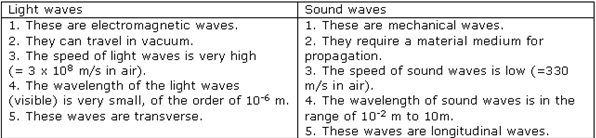
Map content
C7. Sound
Sound Waves
- Produced when a body vibrates and the waves reaches us through the vibrations of the particles of the surrounding medium
- Needs a medium for its propagation
- Infrasonic - Audible Range - Ultrasonic <20 Hz - 20 To 20,000 Hz - >20,000 Hz
- Frequency (f)
- No. of vibrations made by the particle in one sec
- Depends on the vibrating source producing the sound
- Amplitude (a)
- Max displacement of the particle on either side of its mean position
- Wavelength (λ)
- Distance traveled by a wave in one Time period of the particle
- Time Period (T)
- f = 1/T
- Time taken by the particle to complete one vibration
- Velocity (V)
- Distance traveled by the wave in 1 sec
- Depends on the properties of the medium in which the wave travels
- V = f λ
- Transfer of energy - through vibration of the particles in the medium about its mean position (Kinetic to Potential energy & vice versa)
- a.k.a Elastic or Mechanical waves
- Longitudinal waves
- Particles vibrate along the direction of propagation of the wave forming compressions & rarefactions in the medium
- E.g. Sound Waves solid, liquid, gas (air)
- Transverse waves
- Particles in medium vibrate normal to direction of wave propagation, forming crests & troughs
- E.g. Sound waves in a solid & liquid surface. In surfaces that possess rigidity
- Longitudinal waves
- Reflection
- Obeys laws of reflection i.e. a) Angle of Reflection = Angle of Incidence b) Incident ray, Reflecting ray & normal to point of incidence lie in the same plane
- Return of a sound wave on striking a surface such as a wall, metal sheet etc back in the same medium
- Does not require a smooth/shining surface
- Principle used in megaphone, sound board, ear trumpet
- Echo
- Requires the size of reflecting surface to be greater than the wavelength of the sound wave
- Sound heard after reflection from a distant object (e.g. Cliff, Hillside, Wall etc) after the original sound has ceased
- Heard only if distance (d) of sound source from reflecting surface is far enough to allow the reflected sound to reach the source at least 0.1s after the original sound is heard
- d = Vt/2 = 17m (V = 340m/s; t=0.1s)
- 1. If d<17m, reflected sound overlaps with original sound 2. Repeated reflections of sound will cause the reflected sound to be prolonged - Reverberation
- Intensity of sound should be such that reflected sound is sufficiently loud to be audible
- Applied in Sound ranging and echo depth sounding using Ultrasonic waves
- Ultrasonic waves can 1. travel undeviated through long distances 2. Can be confined to a narrow beam 3. Not easily absorbed in a medium
- By Bats, Dolphins & Fishermen
- SONAR - Finding obstacles, depth of ocean (echo depth sounding)
- RADAR - Similar principle using electromagnetic waves (Radio waves)
- Medical Field (Imaging human organs - Ultrasonography & heart - Echo Cardiography)
- Natural/Free Vibrations
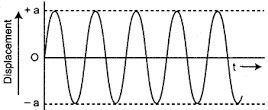
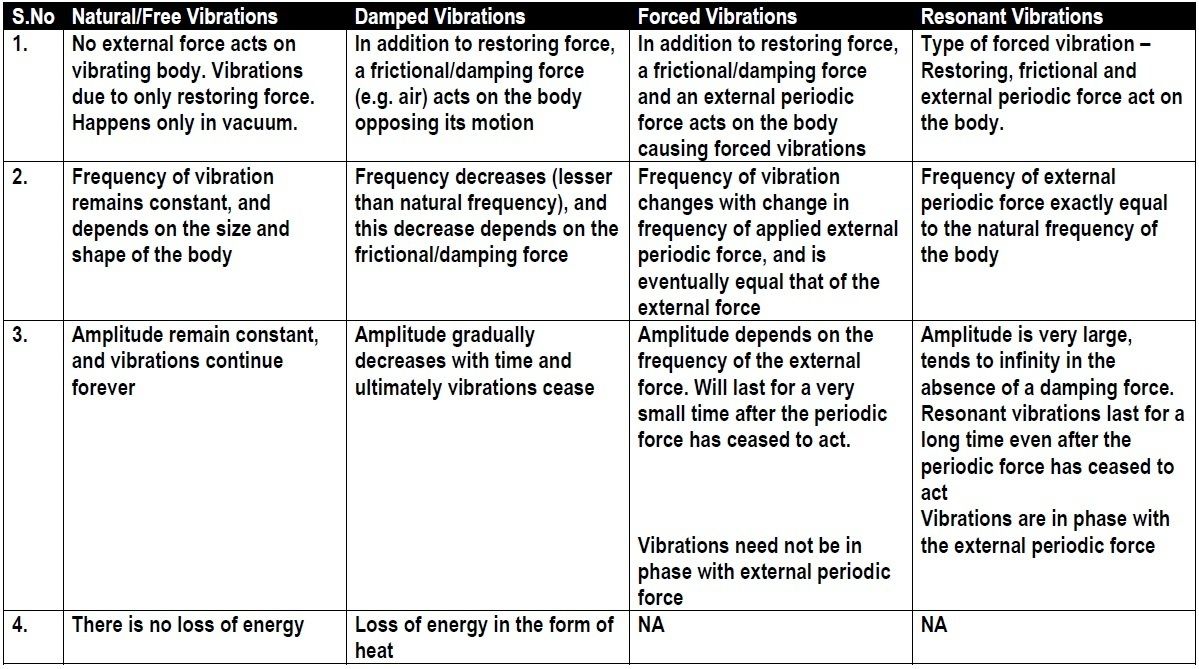
- Periodic vibrations of a body of constant amplitude in the absence of an external force
- Period (Natural Period)/Frequency (Natural Frequency) depends on the shape and size/structure of the body
- Happens only in vacuum as medium offers resistance due to which amplitude of vibration continuously decreases
- Constant natural frequency and amplitude remains constant
- Simple Pendulum displaced slightly from mean position
- f = (1/2π) .√(g/l) where g=acc. due to gravity, l = length of pendulum
- Load suspended from spring when stretched/compressed and released
- f = (1/2π) .√(K/m) where K=force of spring, m = mass of load
- Tuning fork struck against a hard rubber pad. Vibrated with a single frequency = pure note
- Air column in a flute/organ pipe
- f ∝ 1/l where l = length of air column. Different notes created by varying length of air column , or blowing air differently
- Striking keys of a piano. Each key has a different thickness and under different tension, hence different natural frequencies
- Plucking a string of given length stretched at its ends
- Plucking a stretched string in a Sitar, Violin.
- f = (1/2l).√ (T/(πr^2)d) where l = length of string, T = tension in string, d = density of string material, (πr^2)d = mass of unit length of string
- I.e. frequency of note can be increased by decreasing length, increasing Tension or reducing density/mass/radius
- f = (1/2l).√ (T/(πr^2)d) where l = length of string, T = tension in string, d = density of string material, (πr^2)d = mass of unit length of string
- Damped Vibrations
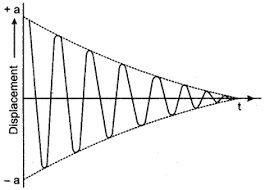
- Periodic vibrations of a body of decreasing amplitude in the presence of a resistive force
- Frictional/Resistive force
- F = ma = m(v-u)/t = mv/t i.e. F ∝ v
- Comes from surrounding medium, resists motion and reduces the amplitude of the wave. Energy of the vibrating body dissipates into heat lost to the surrounding medium.
- Rate of energy loss (rate of decrease in amplitude) depends on nature of medium, and shape and size of vibrating body
- Slim branch of a tree pulled and released
- Tuning fork stroked on a rubber pad
- Simple pendulum oscillating in air
- Vibrations of a spring having a mass at its end, in air
- Restoring force
- Forced Vibrations
- Vibrations of a body that take place under the influence of an external periodic force acting on it
- External Periodic force aka Driving force
- Body no longer vibrates with natural frequency, it gradually acquires frequency of applied external periodic force. Amplitude of forced vibrations depends on the frequency of external force
- If frequency of external force != natural frequency, amplitude dies down eventually. If exactly equal to natural frequency of vibrating body, amplitude of forced vibrations becomes very large (Resonance), tends to infinity in the absence of damping force
- Amplitude of forced can be kept constant by applying a driving force such that it compensates for loss of energy from damping forces. The vibrations of the body now are called sympathetic vibrations
- If frequency of external force != natural frequency, amplitude dies down eventually. If exactly equal to natural frequency of vibrating body, amplitude of forced vibrations becomes very large (Resonance), tends to infinity in the absence of damping force
- Stem of vibrating tuning fork pressed against a table top. Resulting forced vibrations have greater energy/louder
- Vibrations in diaphragm of mic. sound box, with frequencies of speaker
- Stringed Instruments - Vibrations in plucked strings cause forced vibrations in the air in the acoustic/hollow sound box. Surface area of air in sound box is large, so forced vibrations have greater energy and are louder. E.g. Guitar, Violin etc
- Resonance
- Special case of forced vibrations when the frequency of the external periodic force applied is exactly equal to the natural frequency of the body, and the body vibrates with an increased amplitude
- Resonance experiments - Using identical tuning forks (2), pendulums (4) on a rubber string, air column
- Resonant vibrations of pendulums
- Resonance in machine parts
- String Instruments - column of air in hollow chamber (sound box) exactly equal to natural frequency of string
- Tuning fork and air column
- Bridges - Wind, Troops marching
- Radio & TV receivers - Frequency of electromagnetic vibrations changed till it equals that of radio waves
Characteristics of Sound
- Loudness (Subjective)
- Characteristic by virtue of which a loud sound can be distinguished from a faint one, both having the same pitch & quality
- Depends on amplitude of the wave
- Intensity (Objective)
- Intensity of sound at a point of the medium is the amt of sound energy passing per sec normally through a unit area at that point
- Proportional to a) Sq of amplitude b) Sq of frequency c) density of medium d) velocity of sound
- Depends on a) Intensity of sound b) Sensitivity of receiver
- Sensitivity of normal human hearing is max at a frequency of 1KHz
- Directly proportional to a) Sq of amplitude b) Surface area of vibrating body c) Density of medium d) Presence of resonant bodies & Inv. proportional to Sq of distance from source
- Unit = phon. Indicates an individual's perception of loudness
- Level of sound expressed in decibel (dB)
- Pitch (Shrillness)
- Characteristic of sound by which an acute (shrill) note can be distinguished from a grave (flat) note of the same loudness
- Depends on Frequency
- Quality (Timbre)
- Characteristic of sound which distinguishes two sounds of the same loudness and pitch,, but emitted by two different instruments because of a change in their wave forms
- Depends on the wave form
- Loudness (Subjective)
Images and files in the map
Information
- Description
- X Physics (Xth ICSE) Mind Map on C7. Sound, created by Agy George on 30/06/2020.
- Created by
- Agy George
- Views
- 1
- Tags
- Rating