
Mind map
P6 Radioactive Materials
Map content
P6 Radioactive Materials
Radioactivity
- Atoms Consist of a Nucleus and Orbiting Electrons
- The nucleus of an atom has protons and neutrons which makes up most of it's mass but doesn't take up much space. They orbit around the outside of the atom which gives the atom most of it's space.
- Every atom of a element has the same number of protons in it's nucleus, every carbon atom has 6 protons and every nitrogen atom has 7 protons. But they don't have different neutrons.
- Isotopes are atoms with the same number of protons but different numbers of neutons. There are two common isotopes of carbon - carbon-14 has 2 more neutrons than the normal carbon (carbon-12
- Some isotopes are unstable so they decay (break up), so they can become more stable. This makes them emit radiation and therefore are radioactive (like carbon-14). Some elements emit ionising radiation all the time. When an atom does decay, it spits out either three types of ionising radiation: ALPHA or BETA or GAMMA. During the process,, the atom changes into a new element. Ionising radiation can transfer enough energy to break an atom or molecule into ions (ionisation). These ions can go on to take part in other chemical reactions.
- Isotopes are atoms with the same number of protons but different numbers of neutons. There are two common isotopes of carbon - carbon-14 has 2 more neutrons than the normal carbon (carbon-12
- Every atom of a element has the same number of protons in it's nucleus, every carbon atom has 6 protons and every nitrogen atom has 7 protons. But they don't have different neutrons.
- The nucleus of an atom has protons and neutrons which makes up most of it's mass but doesn't take up much space. They orbit around the outside of the atom which gives the atom most of it's space.
- Alpha (α)
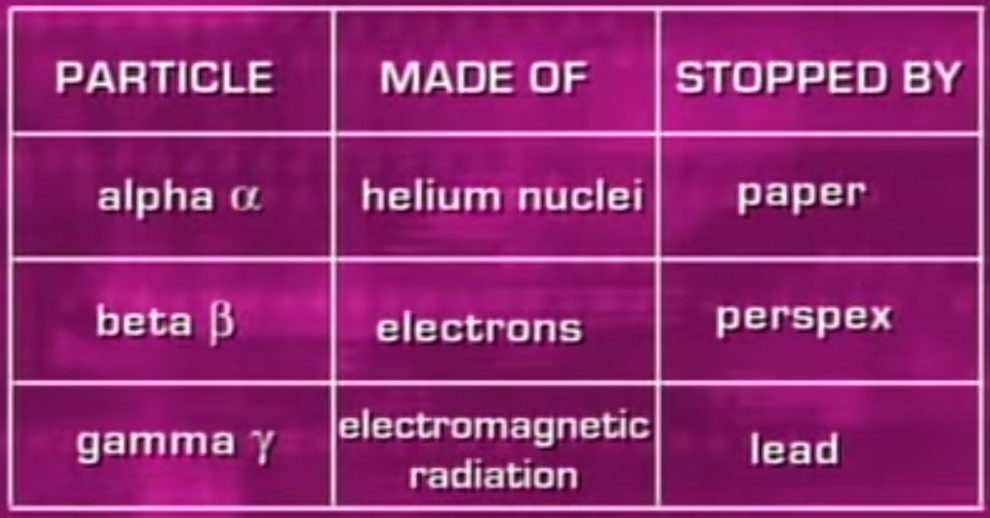
- The least penetrating. It can be stopped (or absorbed) by a sheet of paper.
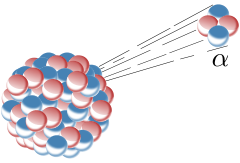
- Big and slow moving, they are released by very heavy nuclei like uranium
- Alpha particles have a mass of 4 and a charge of +2. Decay changes the element of the atom since it looses protons
- Big and slow moving, they are released by very heavy nuclei like uranium
- The least penetrating. It can be stopped (or absorbed) by a sheet of paper.
- Beta (β)
- Can penetrate air and paper. It can be stopped by a thin sheet of aluminium.
- Quite small and quite fast moving, they are released by nuclei that have too many neutrons
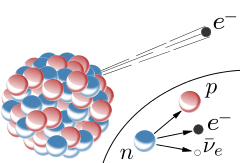
- Beta particles have basically no mass and a charge of -1. Decay turns a neutron in the nucleus to a proton and a beta particle is emitted,
- Quite small and quite fast moving, they are released by nuclei that have too many neutrons
- Can penetrate air and paper. It can be stopped by a thin sheet of aluminium.
- Gamma (γ)
- The most penetrating. Small levels can penetrate air, paper or thin metal. Higher levels can only be stopped by many centimetres of lead or many metres of concrete.
- Used after a alpha or beta particle is spat out so the nucleus can get rid of extra energy. Gamma rays are electromagnetic waves.
- No mass. It's just energy so it doesn't change the element of the nucleus that emits it.
- Used after a alpha or beta particle is spat out so the nucleus can get rid of extra energy. Gamma rays are electromagnetic waves.
- The most penetrating. Small levels can penetrate air, paper or thin metal. Higher levels can only be stopped by many centimetres of lead or many metres of concrete.
- Atoms Consist of a Nucleus and Orbiting Electrons
Half life, Fusion, Fission
- Half life is the time taken for half of the radioactive nuclei now present to DECAY
- Each time an unstable nucleus decays and emits radiation, one more radioactive nucleus isn't there to decay later. The older a radioactive source is, the less radiation it emits. A short half-life means activity falls quickly; a long half-life means the activity falls more slowly.
- EXAMPLE: The activity of a radioactive material is 640 Bq. Two hours later it is 40 Bq. Find its half life.
- Four half lives (640, 320, 160, 80) So the half life is 2 hours/4 = 30 minutes
- Fusion: Atoms have a positive nucleus
- Rutherford found that most alpha particles went straight through a thin gold foil but the odd one did not. This meant that most of the mass of a gold atom was concentrated at the centre in a tiny nucleus. The rest of the atom must be mainly empty space because most of the alpha particles went straight through The nucleus had to have a positive charge - otherwise the positively charged alpha particle wouldn't be repelled by the nucleus and wouldn't scatter.
- The nucleus contains protons (positive) which repel each other. However, they are held together by an attractive force called the strong force which has a very short range. At larger seperations, the strong force is so weak that it effectively dissappers
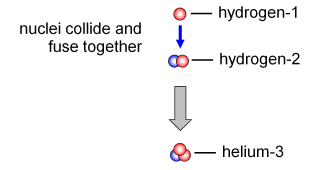
- Two nuclei can fuse to create a larger nucleus which would affectively release energy - fusion. Hydrogen nuclei fuse together to make helium nuclei. For them to overcome the repulsive electrostatic force and get strong enough for the strong force, they need high temperatures. Fusion happens in the sun all the time.
- energy = mass x (speed)²
- When nuclei undergo nuclear fusion or fission, they loose mass and energy is released.
- energy = mass x (speed)²
- Fission and Nuclear Power
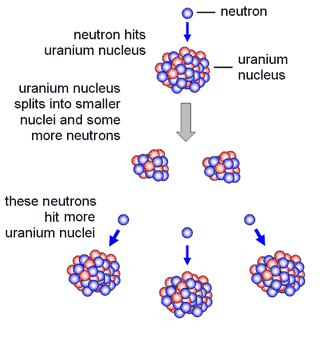
- Nuclear fuels such as uranium or plutonium release large amounts of energy when its nuclei split apart.. Neutrons are fired at a fuel causing some of its large, unstable nuclei to split into two smaller nuclei and 2/3 more neutrons and lots of energy - fission.
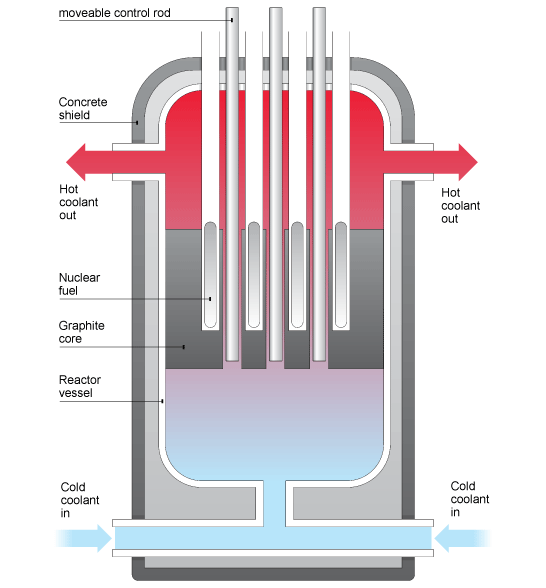
- Because so much energy is released, it needs to be carefully controlled. A neutron splits a nucleus, releasing more neutrons. These go and split other nuclei - chain reaction. The uranium/plutonium fuel used in nuclear reactors is contained in fuel rods which capture the neutrons when the nuclei in the rod split.
- The chain reaction in the reactor has to be controlled otherwise it would overheat. Control rods absorb some of the neutrons to slow down the reaction. Coolants like water are used to take away the heat produced by fission. This is used to produce steam to drive turbine and a generator.
- Because so much energy is released, it needs to be carefully controlled. A neutron splits a nucleus, releasing more neutrons. These go and split other nuclei - chain reaction. The uranium/plutonium fuel used in nuclear reactors is contained in fuel rods which capture the neutrons when the nuclei in the rod split.
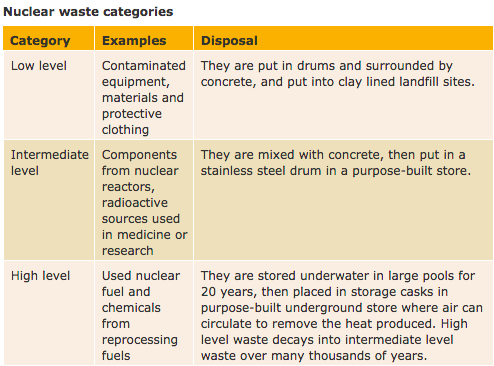
- The main process with nuclear power is that it produces radioactive waste. All nuclear reactors produce radioactive waste. At present the most dangerous waste is sealed in glass-like blocks which are buried deep within rocks. Careless disposal of waste in the past has led to pollution of land, rivers and the ocean.
- Nuclear fuels such as uranium or plutonium release large amounts of energy when its nuclei split apart.. Neutrons are fired at a fuel causing some of its large, unstable nuclei to split into two smaller nuclei and 2/3 more neutrons and lots of energy - fission.
- Half life is the time taken for half of the radioactive nuclei now present to DECAY
Danger and Uses
- Danger from Radiation
- IRRADIATION - being exposed to radiation without coming into contact with the source. The damage to your body stops as soon as you leave the radioactive area.
- CONTAMINATION - picking up some radioactive material by breathing it in, drinking contaminated water or getting it on your skin. You'll still be exposed to the radiation once you've left the radiative area.
- Radiation dose is measured in sieverts (Sv) or more usually millisieverts (mSv) - it takes into account the type and amount of radiation you've been exposed to. People who are exposed to higher radiations are: uranium miners and processors, workers in nuclear power stations, airline staff, miners and nuclear researches.
- CONTAMINATION - picking up some radioactive material by breathing it in, drinking contaminated water or getting it on your skin. You'll still be exposed to the radiation once you've left the radiative area.
- IRRADIATION - being exposed to radiation without coming into contact with the source. The damage to your body stops as soon as you leave the radioactive area.
- Using Ionising Radiation
- NATURAL RADIOACTIVE ELEMENTS - the air, soil, in living things, in rocks
- SPACE - cosmic rays from the sun
- HUMAN ACTIVITY - nuclear explosions or waste from nuclear power plants
- Radioactive sources are considered to be 'safe' when the radiation it emits is around the same level as the background radiation (2mSv/year)
- Treating cancer - high gamma rays kill living cells. Directly shot at bad cells
- Sterilising Medical equipment - gamma rays kill microbes.
- Sterilising food - Kills microbes keeping food fresh for longer, food doesn't become radioactive either
- Detecting diseases using tracers (radioactive materials) - Injected into people to detect cancer or see whether an organ is working properly, followed by an external detector. Isotopes have to be gamma/beta so the radiation passes out of the body and it should have a short half-life
- Sterilising food - Kills microbes keeping food fresh for longer, food doesn't become radioactive either
- Sterilising Medical equipment - gamma rays kill microbes.
- Treating cancer - high gamma rays kill living cells. Directly shot at bad cells
- Radioactive sources are considered to be 'safe' when the radiation it emits is around the same level as the background radiation (2mSv/year)
- HUMAN ACTIVITY - nuclear explosions or waste from nuclear power plants
- SPACE - cosmic rays from the sun
- NATURAL RADIOACTIVE ELEMENTS - the air, soil, in living things, in rocks
- Danger from Radiation
Images and files in the map

Information
- Description
- Mind Map on P6 Radioactive Materials, created by Ghazhal on 01/04/2015.
- Created by
- Ghazhal · Apr 2015
- Updated
- Feb 19, 2016
- Views
- 1
- Rating